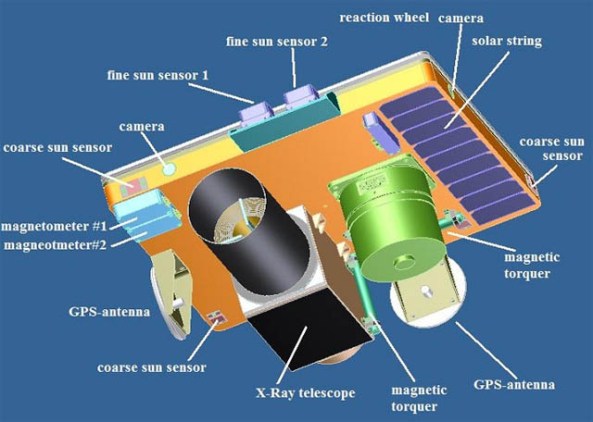
Duchifat-1 is an experimental and educational spacecraft developed and built by young Israeli students at the Space Laboratory of the Herzliya Science Centre (HSC).
As well as APRS on 145.825 MHz it also carries a UHF/VHF 1200 bps BPSK transceiver that can provide a FM to DSB transponder.
Ecuador’s first satellite NEE-01 Pegasus, built by the Ecuadorian Space Agency EXA, is currently planned to launch in the 1st quarter of 2013 on a DNEPR rocket from Yasny.
The JURBAN team not only hope to win the Google Lunar X-Prize by landing a robot on the Moon they also aim to inspire future generations to pursue Science, Technology Engineering and Math (STEM).
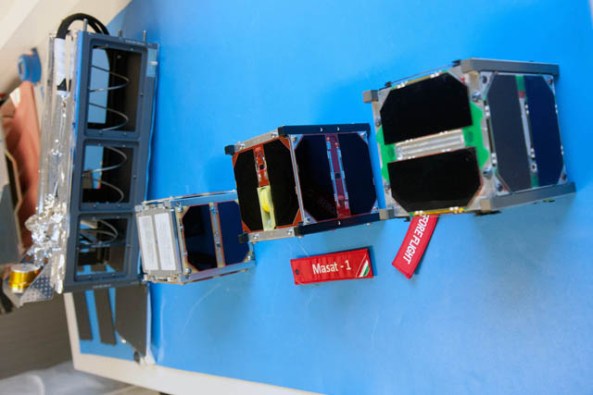
Vega Amateur Radio CubeSats PW-Sat, Masat-1 and Robusta
ESA’s Education Office is inviting the CubeSat community to send their notifications of interest for a new initiative involving the development of educational picosatellites and the provision of deployers and launch services. The call closes on 7 September 2012.
An English language NHK TV news story covers the amateur radio CubeSat FITSAT-1 also known as NIWAKA which launched to the International Space Station (ISS) on July 21.
Takushi Tanaka JA6AVG and FITSAT
FITSAT-1 has multiple downlinks, CW on 437.250 MHz, AX.25 on 437.445 MHz and a 4 watt high speed data transmitter on 5840 MHz capable of sending a 640 by 480 pixel VGA JPEG image in 6 seconds.
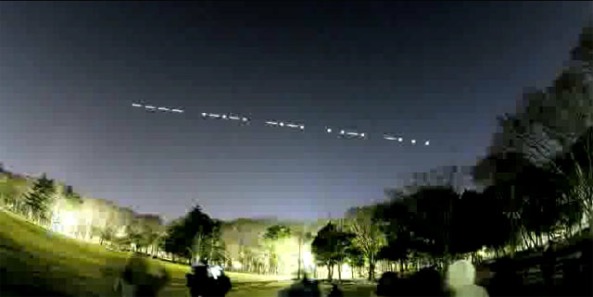
In addition it carries high power LEDs that will be driven with 100W pulses to produce extremely bright flashes. These, it is hoped, will be observable by the unaided eye or with small binoculars. Both the 5840 MHz and optical downlinks have a high power consumption so they may only be activated when in range of the ground station in Japan. It use a neodymium magnet for attitude control.
The CubeSat will remain on the ISS until September when it will be deployed by Japanese astronaut and radio amateur Akihiko Hoshide KE5DNI using the ISS Kibo robot arm.
FITSAT-1 (NIWAKA) is mounted in a JEM-Small Satellite Orbital Deployer (J-SSOD) with the amateur radio TechEdSat and F-1 CubeSats. In a second deployment pod are WeWish and a scientific 2U CubeSat Raiko. The CubeSats will be deployed into a 400 km orbit and should have a lifetime of 3 or 4 months before re-entering the Earth’s atmosphere and burning up.
In this video NHK interviews Takushi Tanaka JA6AVG and students from the Fukuoka Institute of Technology (FIT) about the project.
 Duchifat-1 is an experimental and educational spacecraft developed and built by young Israeli students at the Space Laboratory of the Herzliya Science Centre (HSC).



 AMSAT-UK
You must be logged in to post a comment.