Terry Baume VK5VZI and the amateur radio Project Horus Balloon 22 was filmed and featured on the Channel 10 Kids Science Program, Scope TV. This program aired on May 24, 2012. For more information on project Horus check out their website, http://projecthorus.org/.
Watch Amateur Radio Project Horus on Kids TV Show “Scope”
Terry Baume VK5VZI and the amateur radio Project Horus Balloon 22 was filmed and featured on the Channel 10 Kids Science Program, Scope TV. This program aired on May 24, 2012. For more information on project Horus check out their website, http://projecthorus.org/.
Watch Amateur Radio Project Horus on Kids TV Show “Scope”
First-MOVE is an amateur radio CubeSat being built by students at the Technical University of München.
Integrated First-MOVE
MOVE stands for München Orbital Verification Experiment. The 1U CubeSat carries a CCD camera and has two deployable solar panels carrying a new generation of solar cell – triple junction GaAs / Ge.
This video shows the test preparations for the thermal vacuum test of the cubesat First-Move. The satellite was left in vacuum conditions for 24 hours in the LRT vacuum chamber to offgas any residual materials that could harm the vacuum chambers at IABG.
Afterwards the satellite was transported to the IABG premises and installed in to the thermal vacuum chamber. To reduce thermal influence from the environment the satellite is suspended from the chamber ceiling. After some final functional checks First-Move is ready to start the thermal vacuum testing mid-next week.
Watch First-MOVE TVac Preparations
The First-MOVE transceiver, was supplied by ISIS and uses a UHF uplink and VHF downlink. The antennas are mounted on the ends of the deployable solar panels.
The frequencies for First-MOVE were coordinated by the IARU as:
Downlink: 145.970 MHz
Uplink: 435.520 MHz
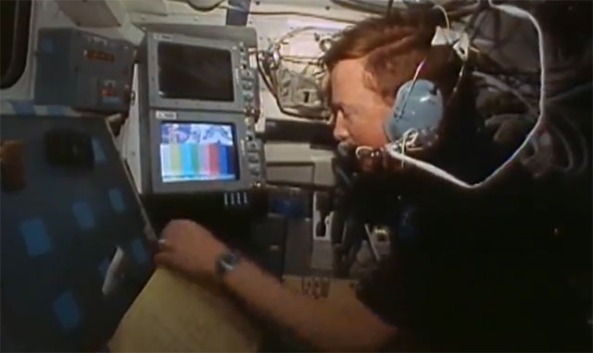
Richard Richards KB5SIW Receiving SSTV on Space Shuttle mission STS-50
The 1992 space shuttle STS-50 mission was the first time that astronauts received an amateur radio fast-scan television video. It was sent by the ham radio club station W5RRR at the Johnson Space Center (JSC).
Narrated by the Commander and crew, this video contains footage selected by the astronauts, as well as their comments on the mission. Footage includes launch, onboard crew activities, and landing.
The amateur radio aspect of the mission gets a mention at 11:32 into this video.
Watch Space Shuttle STS-50 Columbia Spacelab USML pt1-2 Post Flight Press 1992 NASA
Watch Space Shuttle STS-50 Columbia Spacelab USML pt2-2 Post Flight Press 1992 NASA
The NanoSatisfi team is building an Arduino CubeSat ArduSat. On this satellite they plan to put up to 5 Arduino’s and plug in 50+ sensors into them as well as 2 optical and 1 IR camera.
Once the satellite is on orbit they aim to give access to the general public/citizen scientists to the payload (Arduinos, sensors and camera) to upload their own scientific experiments.
The team want to capture the attention of the DIY community, hackers and makers, amateur astronomers and in general those interested in space exploration and the next frontier.
Sensor wise they have so far magnetometers, O3 sensors, GPS , gyros, plasma sensors, photometer, thermometer, pressure sensor, space radiation (bitflip) sensor, Geiger counter and 2 optical and 1 IR camera etc. The idea is that people can rent scientific packages for a week, during the week they run their experiment the team will send data constantly back to them to analyze.
Imagine general public, including teachers having access to experiment platform in space for a couple of hundreds of dollar and they analyze data and engage students, friends etc., it could revolutionize the way people see space and perceive space exploration.
The team are also looking for feedback from people interested in the project and want to hear ideas on sensors and experiments!
Watch ArduSat Kickstarter Video
Watch Sensor prototype demo
Watch The DISCOVER Space Challenge & ArduSat: Invent an experiment and run it in space!
Watch SciStarter & Science Cheerleader Join ArduSat as Community Partner
NanoSatisfi was founded by Austrian-born Peter Platzer a former high-energy physicist (CERN), former Hedge Fund Quantitative Trader, avid HP-41 hacker and Arduino enthusiast, along with Belgian aerospace engineer Jeroen Cappaert intern at NASA Ames Research Center, Canadian aerospace engineer Joel Spark intern at EADS Astrium and Hungarian Reka Kovacs intern at NASA Ames Research Center working on alternative methods of public outreach for space science. The four founders met at the International Space University in Strasbourg and thought that they could do something to provide affordable, open-source space exploration for everyone.
Here is your chance to send a message into Space on board the F-1 Cubesat. Just follow this link http://fspace.edu.vn/?page_id=31 to add a message. Good Luck
You must be logged in to post a comment.