It’s tipped to be India’s heaviest rocket till date weighing 640 tons, it’s also taken 10 years to develop and will hopefully launch Indian astronauts into space. That’s the Indian Space Research Organisation (ISRO) designed and developed GSLV MK3 that has cost Rs 2500 crores and will put India on the multimillion dollar commercial launch market.
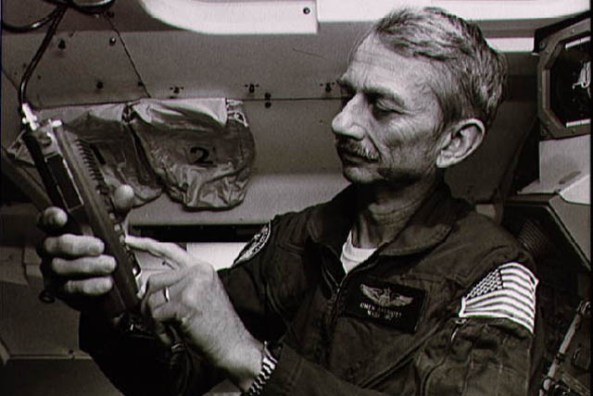
Owen Garriott W5LFL with Motorola two meter FM ham radio on STS-9 Columbia
The first ham radio transmissions by an amateur radio operator in space were made by Owen K. Garriott W5LFL during the STS-9 Columbia mission in 1983. This led to many further space flights incorporating amateur radio as an educational and back-up communications tool.
Watch ARRL – Amateur Radio’s Newest Frontier (STS-9 Columbia) narrated by Roy Neal K6DUE
Narrated by the Commander and crew, the following video contains footage selected by the astronauts, as well as their comments on the mission. Footage includes launch, onboard crew activities, and landing.
Watch Space Shuttle STS-9 Columbia-Spacelab 1 pt1-2 Post Flight Press Conference Film 1983 NASA
Watch Space Shuttle STS-9 Columbia-Spacelab 1 pt2-2 Post Flight Press Conference Film 1983 NASA
STS-9 (also known as STS-41A and Spacelab 1) was a NASA Space Shuttle mission which carried the first Spacelab module into orbit to conduct space-based scientific experiments. It was the sixth mission of the Space Shuttle Columbia, and was Columbia’s last flight until STS-61-C in January 1986. It was also the last time the old STS numbering was used until STS-26 (in the aftermath of the Challenger disaster of STS-51-L). Under the new system, STS-9 would have been designated as STS-41-A.
STS-9 launched successfully from Kennedy Space Center at 11 am EST on 28 November 1983.
The shuttle’s crew was divided into two teams, each working 12-hour shifts for the duration of the mission. Young, Parker and Merbold formed the Red Team, while Shaw, Garriott and Lichtenberg made up the Blue Team. Usually, the commander and the pilot team members were assigned to the flight deck, while the mission and payload specialists worked inside the Spacelab.
Over the course of the mission, seventy-two scientific experiments were carried out, spanning the fields of atmospheric and plasma physics, astronomy, solar physics, material sciences, technology, life sciences and Earth observations. The Spacelab effort went so well that the mission was extended an additional day to 10 days, making it the longest-duration shuttle flight at that time.
The Spacelab 1 mission was highly successful, proving the feasibility of the concept of carrying out complex experiments in space using non-NASA persons trained as payload specialists in collaboration with a POCC. Moreover, the Tracking and Data Relay Satellite, now fully operational, was able to relay vasts amounts of data through its ground terminal to the POCC.
During orbiter orientation, four hours before re-entry, one of the flight control computers crashed when the RCS thrusters were fired. A few minutes later, a second crashed in a similar fashion, but was successfully rebooted. Young delayed the landing, letting the orbiter drift. He later testified: “Had we then activated the Backup Flight Software, loss of vehicle and crew would have resulted.” Post-flight analysis revealed the GPCs failed when the RCS thruster motion knocked a piece of solder loose and shorted out the CPU board.
Columbia landed on Runway 17 at Edwards Air Force Base on 8 December 1983, at 3:47 pm PST, having completed 166 orbits and travelled 4.3 million miles (6.9×10⁶ km) over the course of its mission. Right before landing, two of the orbiter’s three auxiliary power units caught fire due to a hydrazine leak, but the orbiter nonetheless landed successfully. Columbia was ferried back to KSC on 15 December. The leak was later discovered after it had burned itself out and caused major damage to the compartment…
Commander: John W. Young
Pilot: Brewster H. Shaw, Jr.
Mission Specialists: Owen K. Garriott, Robert A. R. Parker
Payload Specialists: Byron K. Lichtenberg (MIT), Ulf Merbold (Germany)
Dates: November 28 to December 8, 1983
Vehicle: Columbia OV-102
Payloads: Spacelab-1
Landing site: Runway 17 dry lakebed at Edwards AFB, CASpace Shuttle
A United Launch Alliance Atlas V carries a U.S. Air Force/ Lockheed Martin AEHF spacecraft to orbit. The AEHF-2 satellite will carry the most highly-classified U. S. satcom traffic. This flight marks the 30th successful Atlas V mission; the launch vehicle has a 100 percent success record. Photo Credit: Alan Walters/awaltersphoto.com
The second U.S. Air Force Advanced Extreme High Frequency (AEHF) communications spacecraft was successfully launched into a super synchronous transfer orbit May 4 atop a United Launch Alliance (ULA) Atlas V 531 rocket.
Liftoff of the 197 ft. tall 2.7 million lb. thrust vehicle from Launch Complex 41 at Cape Canaveral Air Force Station occurred at 2:42 p.m. EDT.
“The 13,600 lb. satellite cost $1.7 billion”, said USAF Capt. John Francis, the AEHF project lead in charge of Operations and Sustainment. This makes it one of the most expensive military spacecraft ever launched from Cape Canaveral. The first AEHF spacecraft launched in August 2010 also cost $1.7 billion.
“The AEHF satellite series is the most sophisticated military communications system ever built and it will be a integral part of our national space security architecture,” said Steve Tatum, Lockheed-Martin’s Communications Director.
Three Aerojet solid rocket boosters along with the Russian-built RD-180 engine send out a massive plume of fury as the Atlas V 531 roars into Florida’s blue sky. Photo Credit: Jeffrey J. Soulliere
“We’re extremely pleased and excited with today’s launch,” said USAF Capt. Francis. “We have a big AEHF-2 team and it all culminated today,” he said. It’s kind of like the Super Bowl – and we just scored the winning touchdown.”
Space Hackers fom Lausanne, Switzerland and San Francisco, USA have been working on the TechEdSat CubeSat challenge.
TechEdSat is a 1U CubeSat that will be launched on July 21, 2012 from Tanegashima, Japan aboard the HTV-3 ISS resupply mission. TechEdSat will be among the first CubeSats to be deployed from the ISS, and is investigating the use of Plug and Play software/hardware and intersatellite communication via Iridium and Orbcomm networks.
For this challenge, space hackers must implement a command and control system, utilizing both the OrbComm and Iridium modems as uplink and downlink. The software should be modular to facilitate the easy implementation of future commands, and should be fault tolerant.
A ground segment of the software should include the ability for a laptop (or bonus points for an Apple or Android phone) to issue commands to the spacecraft over Iridium/Orbcomm. The spacecraft segment should be written for a Linux environment able to listen for commands, and have the ability to send arbitrary data packages back to the ground.
Bonus points for relaying data received from the spacecraft automatically to Twitter. Space hackers will be issued interface documentation for Iridium and OrbComm modems, and engineering development hardware for testing. This software has the potential to fly on the TechEdSat mission if completed.
For 2012 the NASA CubeSat Launch Initiative includes 6U CubeSat satellites. An 8 kg 6U CubeSat can be designed to perform some of the Earth observation missions of 100 kg microsatellites. A 6U CubeSat (~33 x 10 x 22 cm, ≤ 8kg) has 4 times the payload capacity of a 3U CubeSat (33 x 10 x 10 cm, ≤ 4 kg) which uses two thirds of its volume for system components.
This workshop, the first in the world dedicated to the 6U CubeSat, will explore the range of missions possible with a 6U CubeSat in the areas of:
Astronomy
Atmospheric Science and other Planetary Science
Space Physics
Earth Observation
Biology
Other
Keynotes
Technology Keynote – John W. Hines, Chief Technologist, NASA-Ames Research Center (To be confirmed) Science Keynote – Professor Harvey Butcher , Director Research School of Astronomy and Astrophysics
Chair
Dr Steven Tsitas, Senior Research Associate, Australian Centre for Space Engineering Research, University of New South Wales
Presentations are invited describing payloads and mission concepts for the 6U CubeSat. Presentations are also invited regarding 6U launch opportunities and 6U CubeSat standards.
SESSION 1: Earth Observation Missions
SESSION 2: Astronomy Missions
SESSION 3: Planetary Science and Space Physics Missions
For 2012 the NASA CubeSat Launch Initiative includes 6U CubeSat satellites. An 8 kg 6U CubeSat can be designed to perform some of the Earth observation missions of 100 kg microsatellites. A 6U CubeSat (~33 x 10 x 22 cm, ≤ 8kg) has 4 times the payload capacity of a 3U CubeSat (33 x 10 x 10 cm, ≤ 4 kg) which uses two thirds of its volume for system components.
This workshop, the first in the world dedicated to the 6U CubeSat, will explore the range of missions possible with a 6U CubeSat in the areas of:
Astronomy
Atmospheric Science and other Planetary Science
Space Physics
Earth Observation
Biology
Other
Keynotes
Technology Keynote – John W. Hines, Chief Technologist, NASA-Ames Research Center (To be confirmed) Science Keynote – Professor Harvey Butcher , Director Research School of Astronomy and Astrophysics
Chair
Dr Steven Tsitas, Senior Research Associate, Australian Centre for Space Engineering Research, University of New South Wales
Presentations are invited describing payloads and mission concepts for the 6U CubeSat. Presentations are also invited regarding 6U launch opportunities and 6U CubeSat standards.
SESSION 1: Earth Observation Missions
SESSION 2: Astronomy Missions
SESSION 3: Planetary Science and Space Physics Missions




You must be logged in to post a comment.