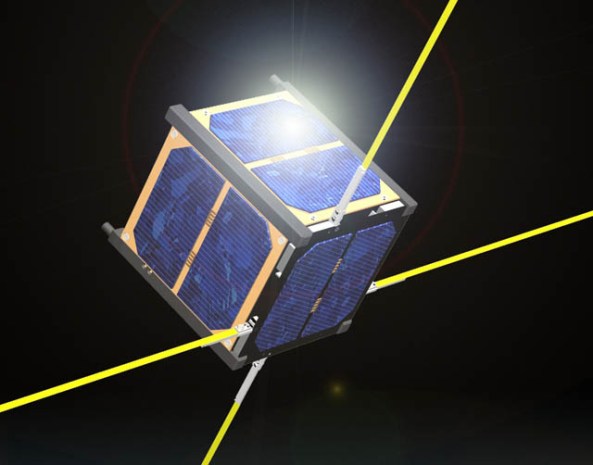
OSSI Art CubeSat to Launch in August

Hojun Song DS1SBO and the NovaNano FlyMate™ deployer

Hojun Song DS1SBO and the NovaNano FlyMate™ deployer

Hojun Song DS1SBO is a cutting-edge, tech-obsessed Korean artist breaking boundaries with his passion for telling stories through technology. He hopes to instill a sense of empowerment in the world, through the DIY nature and uplifting undertones in each of his works.

OSSI CubeSat

OSSI CubeSat

At univeristy he studied Electrical Engineering and Computer Science after which he started working on his art.

After years of research he has found that it is indeed possible to launch and operate a personal satellite at a fairly reasonable price. For the past six years he has been exploring ways to integrate the concept of a personal satellite project into cultural contexts and into his artistic practice.

Hojun Song’s first satellite OSSI will take off on a Soyuz rocket from Baikonour in Kazakhstan this August. He obtained his rocket launch through a new French launch brokerage company NovaNano http://www.novanano.com/. In this video he shares his story, his struggles and his plans.

Watch The Open Source Satellite Initiative by Hojun Song

The OSSI CubeSat should be delivered on May 31 in preperation for its launch on August 31. The team are working hard to finish building the satellite.

Watch Building OSSI EPS / 20120429

Open Source Satellite Initiative (OSSI) http://opensat.cc/

The Creators Project http://thecreatorsproject.com/en-uk/creators/hojun-song

DIY Satellite http://opensat.cc/download/DIYSatellite_en.pdf

Studio hhjjj http://www.hhjjj.com/

Blue Origin

Blue Origin is developing a reusable first-stage booster. It will take off vertically like a conventional booster rocket and lift the upper stages to a conventional suborbital staging point, where the upper stage will separate and continue to propel the astronauts to orbit.

Blue Origin Picture

Once separated, the first stage booster will descend to perform a powered vertical landing similar to the New Shepard Propulsion Module. Then the orbital booster can be refueled and launched again, allowing improved reliability and lowering the cost of human access to space.

Orbital Reusable Booster System
The booster rocket will loft a biconic Space Vehicle to orbit, carrying astronauts and supplies for adventure, science research, and exploration. After orbiting the Earth, the Space Vehicle will reenter Earth’s atmosphere to land on land under parachutes, and then be reused on future missions to Earth orbit.

What is Blue Origin

Blue Origin, LLC is developing technologies to enable private human access to space at dramatically lower cost and increased reliability. We’ve adopted an incremental approach, with each development step building on the prior development. We are currently focused on developing rocket-powered Vertical Takeoff and Vertical Landing (VTVL) vehicles for access to suborbital and orbital space

http://www.blueorigin.com/

TEDxKiruna Presentation – Human Exploration of Space

Lopez-Alegria is a former NASA astronaut, International Space Station commander and test pilot. A four-time astronaut he holds three NASA records incl longest spaceflight; 215 days! Michael will share his extraordinary story and gaze into the future of spaceflight as the new President of the Commercial Spaceflight Federation.

Watch TEDxKiruna – Michael E. Lopez-Alegria – Human Exploration of Space

‘Kinect’ STRaND-2 at UK Space Agency Conference

Tim Peake at UKSA Conference 20120426

Prospective UK Astronaut Tim Peake addressed the conference via Skype

On the anniversary of the launch of Ariel-1, April 26, the UK Space Agency and the Science Museum co-hosted a two-day conference celebrating 50 years of the UK in space. It brought together those who started the UK on the road to being a world-renowned centre for space technology and research with the scientists and engineers of the next fifty years.

Vince Cable at UKSA Conference 20120426

Vince Cable Secretary of State for Business, Innovation and Skills

Ariel-1 was the world’s first international satellite. The United Kingdom stepped up to an offer from NASA to launch scientific satellites at an international meeting on space research in 1959. From this point, the UK took the lead in satellite technology as well as beginning the UK’s long history of international collaboration.

As part of the programme on the 26th, there were personal insights from scientists and engineers involved in the original design and build of the Ariel series of satellites, as well as those teams developing the flagship programmes of today and tomorrow. The Science Museum will be highlighting historic milestones in the UK space sector over the course of the week.

Shaun Kenyon at UKSA Conference 20120426

Shaun Kenyon of the STRaND project

The future is set to be as innovative and inspirational as the last 50 years. There is a vast potential for space technology. From the growing need for Earth observation satellites to monitor urgent social and environmental issues; to the emerging reality of space tourism; to our ever-improving capability to see deep into the Universe, the UK space sector is at the forefront of facing up to these challenges.

During the conference prospective UK astronaut Tim Peake, currently in the USA, addressed the conference via a Skype video link.

Shaun Kenyon, who has worked on the innovative STRaND-1 SmartPhone satellite project, gave a well received presentation about the future opportunities for the UK Space Industry. He also described another UK first – STRaND-2 – twin 3U CubeSats with docking capabilities using a gridded Lidar system based on that used in the Kinect games controller.

Surrey Space Centre http://www.surrey.ac.uk/ssc/
STRaND on Facebook http://www.facebook.com/nanosats

'Kinect' STRaND-2 at UK Space Agency Conference

Tim Peake at UKSA Conference 20120426

Prospective UK Astronaut Tim Peake addressed the conference via Skype

On the anniversary of the launch of Ariel-1, April 26, the UK Space Agency and the Science Museum co-hosted a two-day conference celebrating 50 years of the UK in space. It brought together those who started the UK on the road to being a world-renowned centre for space technology and research with the scientists and engineers of the next fifty years.

Vince Cable at UKSA Conference 20120426

Vince Cable Secretary of State for Business, Innovation and Skills

Ariel-1 was the world’s first international satellite. The United Kingdom stepped up to an offer from NASA to launch scientific satellites at an international meeting on space research in 1959. From this point, the UK took the lead in satellite technology as well as beginning the UK’s long history of international collaboration.

As part of the programme on the 26th, there were personal insights from scientists and engineers involved in the original design and build of the Ariel series of satellites, as well as those teams developing the flagship programmes of today and tomorrow. The Science Museum will be highlighting historic milestones in the UK space sector over the course of the week.

Shaun Kenyon at UKSA Conference 20120426

Shaun Kenyon of the STRaND project

The future is set to be as innovative and inspirational as the last 50 years. There is a vast potential for space technology. From the growing need for Earth observation satellites to monitor urgent social and environmental issues; to the emerging reality of space tourism; to our ever-improving capability to see deep into the Universe, the UK space sector is at the forefront of facing up to these challenges.

During the conference prospective UK astronaut Tim Peake, currently in the USA, addressed the conference via a Skype video link.

Shaun Kenyon, who has worked on the innovative STRaND-1 SmartPhone satellite project, gave a well received presentation about the future opportunities for the UK Space Industry. He also described another UK first – STRaND-2 – twin 3U CubeSats with docking capabilities using a gridded Lidar system based on that used in the Kinect games controller.

Surrey Space Centre http://www.surrey.ac.uk/ssc/
STRaND on Facebook http://www.facebook.com/nanosats

ISS: successful contact with Balaklava school

We are pleased to announce very successful contact of Balaklava school
(Sevastopol, Crimea, Ukraine) with International Space Station.
More than 100 children came to take part of the evening event on April
11, 2012 in Balaklava – very unique place with interesting history as well
as known as a place where Russian cosmonaut Anton Shkaplerov was born.
17 questions were asked and after the radio contact was finished we continued
communication via phone in combination with video stream available on http://spacestationlive.jsc.nasa.gov/timeline/index.html
Anton came to the place where web camera is located so we were able
not only to speak but also to see what he was doing on board of the station.
During the conversation Daniel Burbank joined giving greetings to all participants
on the ground.
Anton has answered 5 more questions and shown how Orlan space suit glovers
works, how to drink water in the space. Under storm of applause Anton presented
Balaklava’s school pennon which he has on board.
Space station

Space station

Event was organized by Ukrainian radio-amateurs Andrey Begunov – UT9UF and
Oleg Dmitrenko UR4UKV with support of Sevastopol’s radio-amateurs, space enthusiast
Vladimir Kovgan and Anton’s first teacher Irina Bogdanova.
Andrey
UT9UF