Amateur Radio CubeSat burns-up in atmosphere

Altitude of the five CubeSats - Image credit Masahiro Arai JN1GKZ

Altitude of the five CubeSats compared with ARISSat-1/Kedr – Image credit Masahiro Arai JN1GKZ

WE-WISH, one five CubeSats deployed from the International Space Station (ISS) on October 4, 2012. burnt up in the Earth’s atmosphere on Monday, March 11. On the AMSAT Bulletin Board Nico Janssen PA0DLO suggested it burnt up at 02:59 UT near 48 degrees North, 119 degrees East. He says TechEdSat is likely to be the next of the five to re-enter sometime in April.
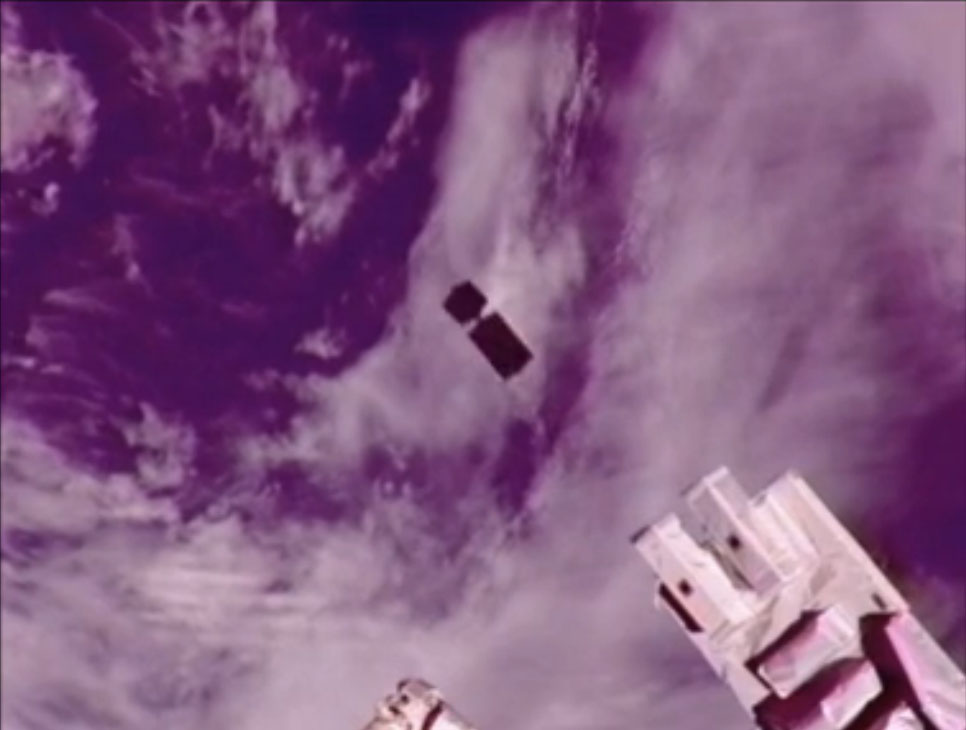
Deployment of CubeSats WE-WISH and RAIKO from the ISS

Deployment of CubeSats WE-WISH and RAIKO from the ISS – Image NASA

Built by members of the Meisei Amateur Radio Club WE-WISH carried an infrared camera for environmental studies. The 320 by 256 pixels images  of the Earth’s surface were transmitted in approx 110 secs using SSTV. The callsign was JQ1ZIJ and the 100mW downlink on 437.515 MHz operated on CW (A1A), AX.25 1200 bps packet radio (F2D) or SSTV (F3F).

Masahiro Arai JN1GKZ has produced a chart that shows the declining altitude of the five CubeSats since their deployment. RAIKO was the largest of the CubeSats at about 2 kg and 10 × 10 × 20 cm and the others being about 1 kg and 10 × 10 × 10 cm. The chart compares their orbital decay with that of ARISSat-1/Kedr (30 kg, 55 × 55 × 40 cm) which was deployed on August 3, 2011 and and re-entered Earth’s atmosphere on January 4, 2012, having spent 154 days in orbit.

Further information and some spectacular pictures of the CubeSats taken just after deployment can be seen at https://amsat-uk.org/satellites/techedsat-f-1-fitsat-1-we-wish/
ISS Amateur Radio SSTV Active on 145.800 MHz FM

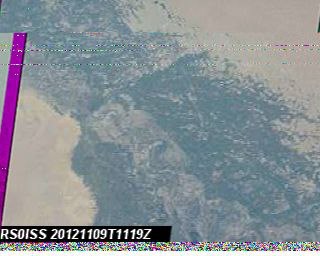
ISS SSTV image received 2012-11-09 – Credit http://www.EssexHam.co.uk/

Pete Sipple M0PSX who runs the Essex Ham and FrequencyCast websites received this Slow Scan TV  (SSTV) picture transmitted by the amateur radio station on the International Space Station on Friday, November 9.

After being tipped off via the ISS Fan Club website that SSTV was active, he calculated a suitable overhead path and connected the audio output of his 2 metre rig to the soundcard on my PC, and tuned in. The frequency in use for the downlink was 145.800MHz, and he set up a digital recorder to capture the received audio.

Continue reading

AMSAT-LU Stratospheric Amateur Radio Balloon Video

On May 19, 2012 a high altitude amateur radio balloon was launched from La Pampa, Argentina, reaching 34 km. It carried a 430 MHz to 144 MHz band 4 watt CTCSS activated FM repeater, APRS lu7aa-11, Robot-36 live SSTV, CW, and 40/20m CW telemetry beacon with 2 video cameras. (Total weight 970 grams).

It also provided a practice run for the upcoming LUSEX satellite.

Continue reading

ISS Amateur Radio CubeSats Deployed

Kibo Robot Arm CubeSat Deployment

Kibo Robot Arm CubeSat Deployment – Image Credit JAXA

On October 4, 2012 five CubeSats were successfully deployed from the International Space Station (ISS). The first pod containing RAIKO and WE-WISH was deployed at 1437 UT while the second pod containing FITSAT-1, F-1 and TechEdSat deployed at 1544 UT. Pictures can be seen at http://www.uk.amsat.org/?p=10804

October 4 was also the 55th anniversary of the launch of the first satellite Sputnik 1. Videos of Sputnik are here.

Four of the CubeSats carry Amateur Radio payloads, they are TechEdSat, F-1, FITSAT-1, and WE-WISH. As of Oct 5, 1015 UT signals had been reported from WE-WISH and FITSAT-1 as well as weak signal reports for TechEdSat.

ISS CubeSat Frequency Chart – Image Credit Mike Rupprecht DK3WN

Continue reading

SPROUT amateur radio SSTV satellite to launch in 2014

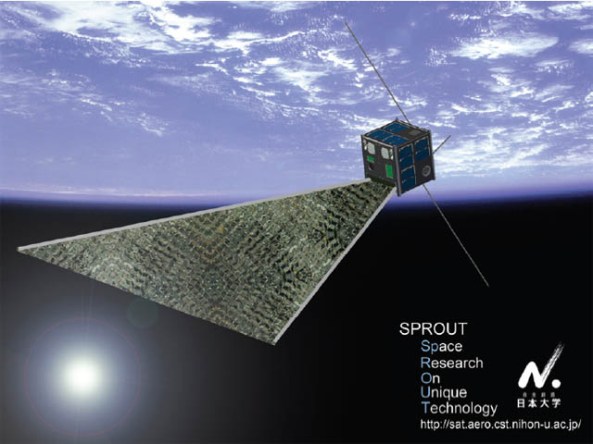
SPROUT Amateur Radio SSTV Satellite

SPROUT, a 20 x 20 x 22 cm amateur radio nano-satellite with a mass of 7.1 kg, plans to launch with the L-band (1236.5 MHz/1257.5 MHz/1278.5 MHz) Synthetic Aperture Radar (SAR) satellite ALOS-2 on May 24, 2014. [Updated May 19, 2014]

SPROUT (Space Research On Unique Technology) was built by students from Nihon University and its objectives are:

1. Operation of satellite by radio amateurs. SPROUT downlinks the digi-talker sound recorded preliminary in the satellite, the digi-peater voice and packet uploaded by radio amateurs, Slow Scan TV (SSTV) and FM packet of the picture of the Earth taken by the satellite camera, which can be received by radio amateurs. SPROUT has two downlink frequencies and two uplink frequencies, and one uplink frequency and one downlink frequency will be open for radio amateurs. They can use the digipeater and packet and use one camera mounted on SPROUT and take the pictures by themselves, and downlink the pictures by SSTV.

2. Demonstration of the deployment of the combined membrane structure and verification of the design method of the structure SPROUT has a triangular membrane supported by two tubes like framework. They are folded and stored in the satellite before the launch. After the launch, the nitrogen gas is injected into the tubes in space, and they extend, so that the membrane deploys (called “combined membrane structure”).

3. Demonstration of attitude determination and control of a nanosatellite Will conduct the attitude determination experiment on orbit by using the sun sensors, gyros, and geomagnetic sensor, and conduct the attitude control experiment by using the magnetic torquers.

It carries two UHF/VHF radio systems – one for Telemetry, Tracking & Control (TTC) using CW, 1200 bps AFSK and 9600 bps GMSK AX.25 packet and one for amateur operations using 1200 bps AFSK AX.25 packet.

SPROUT plans to launch from the Tanegashima Space Center into a 628 km Sun Synchronous Orbit (SSO) on May 24, 2014.

Callsign: JQ1ZJQ
Size:     214x210x220 mm
Weight:   7.1 kg
Mode: 1200bps AFSK, 9600bps GMSK
CW downlink          437.525 MHz
FM packet downlink   437.525 MHz
Digi-peater uplink   437.600 MHz
Digi-talker downlink 437.600 MHz
SSTV downlink        437.600 MHz

Sprout Satellite English website http://sat.aero.cst.nihon-u.ac.jp/sprout-e/

Sprout Satellite Japanese website http://sat.aero.cst.nihon-u.ac.jp/sprout/

Nihon-Univ. Miyazaki Laboratory on Facebook
https://www.facebook.com/pages/Nihon-Univ-Miyazaki-Laboratory/406566642818860

JE9PEL website http://www.ne.jp/asahi/hamradio/je9pel/jaxalos2.htm

Read the Overview of the L-band SAR Onboard ALOS-2 here.

NEE-01 Pegasus – a window to see the Earth from the classroom

Ecuador’s first satellite NEE-01 Pegasus, built by the Ecuadorian Space Agency EXA, is currently planned to launch in the 1st quarter of 2013 on a DNEPR rocket from Yasny.

Continue reading