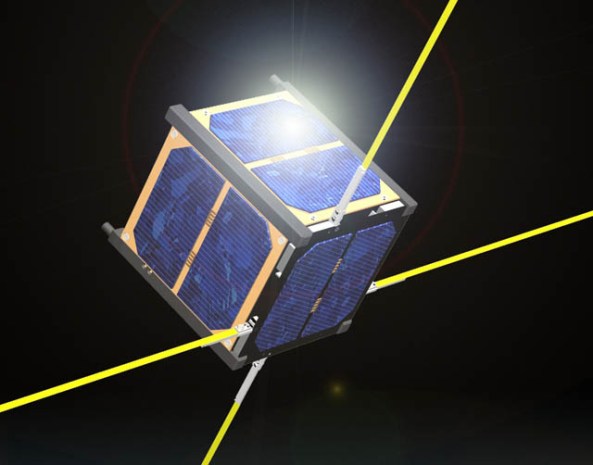
CubeSats, Isle of Man and STEM in SatMagazine

Topics covered in the July/August issue of the free publication SatMagazine include CubeSats, the space industry in the Isle of Man and Science, Technology Engineering and Mathematics (STEM).

Erik Mumm’s Insight article Advances In CubeSats Enable New Apps starts on page 56.

The Isle Of Man—Onward, Onward, Onward on page 68 is the third in the series about the space industry in the Isle of Man.

A Video Pathway To Learning starts on page 72 and describes STEM Flix™ which is a new, interactive video series.

Download the July/August 2012 SatMagazine at http://www.satmagazine.com/2012/SM_JulAug2012.pdf

SatMagazine http://www.satmagazine.com/

Reform of the Outer Space Act 1986: Consultation

The UK Space Agency has issued a public consultation seeking views of stakeholders on proposed changes to the Outer Space Act 1986.

This is in response to the Government Growth Review published in March 2011, in which the Government set out its wish to reform the Outer Space Act 1986 by introducing an upper limit on liability for UK operators.

The Outer Space Act covers all UK satellites irrespective of size, from tiny low cost educational CubeSats up to large commercial £500 million satellites.

The key aspects of the consultation are the proposals to waive the capped liability and insurance requirement for in-orbit operation of any satellite that meets the criteria of a CubeSat and to remove the requirement for unlimited indemnity from satellite operators.

The existing Outer Space Act imposes heavy additional costs (>£50,000 per annum) on those wishing to launch small educational CubeSats. The additional costs act as a major deterrent and to-date no such UK CubeSat has been launched.

The public consultation closes August 31, 2012.

Further information at
http://www.bis.gov.uk/ukspaceagency/news-and-events/2012/May/
reform-of-the-outer-space-act-1986-consultation

Unveiling of Florida Student CubeSat SwampSat

The amateur radio SwampSat satellite, built by students at the University of Florida (UF) was recently unveiled.

Its downlink will use 1200 bps AX25 packet radio on 437.385 MHz with 1 watt of RF.

The team are planning on a December 2012 launch on the SpaceX Falcon 9 into a 450 km orbit with an inclination of 45 degrees. [Update: SwampSat launched on Minotaur-1 on November 20, 2013]

Watch SwampSat Unveiling

SwampSat on TV News http://www.amsat-uk.org/?p=8464

SwampSat – Florida’s small satellite programs brings STEM jobs
https://www.facebook.com/media/set/?set=a.10150734814267248.435445.121264742247&type=3

UF shows off its small satellite http://www.gainesville.com/article/20120406/articles/120409715

Gator Amateur Radio Club http://www.gatorradio.org/

University of Florida Small Satellite Design Club (SSDC) http://www.ufsmallsat.com/

//

Students Build Supercapacitor Battery for next ARISSat

Penn State Behrend students Jacob Sherk, Kathleen Nicholas and David Jesberger put final touches to the amateur radio satellite supercapacitor battery – Image Credit Pennsylvania State University

On Feb. 3, 2006, astronauts tossed an old spacesuit off the International Space Station. Inside was an amateur radio transmitter, a temperature sensor and some batteries.

The suit was a DIY satellite. It circled the Earth twice, repeating a greeting recorded in multiple languages; ham radio operators listened in as it passed overhead.

Then the batteries died.

The Radio Amateur Satellite Corporation, or AMSAT, tried again in 2011. The battery in that satellite, a more traditional box design, also failed.

Penn State Nittany Lions Paw Print

For the next model, AMSAT, a volunteer group, turned to the School of Engineering at Penn State Erie, The Behrend College. Three students designed a brand-new battery: a 1.8 kg cube powered by 15 supercapacitors, each roughly the size of a film canister.

The battery was built to handle 16 charge cycles in a 24-hour period. That will power the satellite in dark orbits, when the solar panels are not facing the sun.

To activate the battery before those solar panels charge, the students – David Jesberger, of St. Marys; Kathleen Nicholas, of Pittsburgh; and Jacob Sherk, of Elizabethtown – added four 9-volt Duracells.

AMSAT hopes to fit the satellite into a rocket payload and onto the International Space Station sometime in 2013. The astronauts won’t have to do much with it.

“It’s simple by design. They flip a switch, and they throw it out,” said Dakshina Murthy Bellur, an assistant professor of electrical and computer engineering at Penn State Behrend. He supervised the battery work, which counted as the students’ senior capstone project.

All three students have since graduated. All three have jobs: Nicholas and Jesberger signed on with defense contractors, and Sherk works at the Three Mile Island nuclear power plant.

They continue to track the AMSAT project. They want to know when their battery, upon which they laser-etched with their names and a Nittany Lion paw print, gets a launch date.

“That’s going to be cool,” Jesberger said. “We’ll have our signatures in space.”

Source Pennsylvania State University http://live.psu.edu/story/60125

ARISSat http://www.arissat.org/

Encouraging Science, Technology, Engineering and Mathematics

First US Woman Astronuat Sally Ride on STS-7 - Image Credit NASA

The Women in STEM High School Aerospace Scholars  (WISH) project is sponsoring two six-day summer camps for rising high school seniors that should feature a presentation by astronaut Shannon Walker KD5DXB and an Amateur Radio contact with the International Space Station (ISS).

Eighty-four female high school students from 29 states will plan a simulated mission to Mars and experience life as an engineer or scientist when NASA’s Johnson Space Center in Houston hosts two events focused on science, technology, engineering and mathematics (STEM) in June and July.

Shannon Walker KD5DXB - Image Credit NASA

The young women will work in teams with female NASA mentors to develop mission plans for launching to Mars, living and working there, and integrating the many components necessary for a successful planetary mission. They will work within the confines of a fictitious budget and build several small mockups of vehicles to demonstrate a successful launch and landing of the Mars spacecraft.

“WISH gives some of our brightest future innovators a chance to experience some of the exciting challenges that NASA engineers and scientists face on a daily basis,” said Johnson Deputy Director and four-time space shuttle astronaut Ellen Ochoa KB5TZZ. “It shows the young women that there are a variety of opportunities for them in technical fields.”

Young women participating June 24-29 will hear a first-hand account of life in space from NASA astronaut and radio amateur Shannon Walker KD5DXB. Participants July 8-13 will have a chance to speak with a current space station astronaut via ham radio as part of the Amateur Radio on the International Space Station program, a NASA educational initiative that facilitates direct links between students and astronauts.

The young women were selected based on completion of interactive, online lessons focused on space exploration and mapped to national education standards, academic merits and geographic diversity. The WISH program encourages young women to pursue science, technology, engineering and mathematics degrees and exposes them to the real-world applications of STEM careers at NASA. This program is in its second year. It began as a NASA accompaniment to the White House Council on Women and Girls.

For more information about WISH and a list of student participants, visit:
http://www.nasa.gov/audience/foreducators/teachingfromspace/students/wish.html

WISH: Women in STEM High School Aerospace Scholars http://www.wish.aerospacescholars.org/

Source NASA http://www.nasa.gov/home/hqnews/2012/jun/HQ_12-209_WISH.html

Amateur Radio on the International Space Station ARISS http://ariss.rac.ca/

Interview with author of DIY Satellite Platform

Tubesat - Image Credit Interorbital Systems

Have you ever wanted to build your own personal satellite but your last name doesn’t start with Gates or Branson? Well, now there’s good news. For the price of a car you can now build, test and launch your own personal satellite at home.

Dr. Sandy Antunes, Author of DIY Satellite Platform, talks about building his own amateur radio personal spacecraft Project Calliope. The best part (besides having your own satellite) is that you can now do some serious science.

Find out what kind of satellite Dr. Antunes is building and how he’s running the same kinds of tests the large Aerospace companies do, but for a fraction of the cost.

Project Calliope: http://www.projectcalliope.com/

Watch How to build your own personal satellite

Dr. Sandy Antunes used Kickstarter to raise funds for the project
http://www.kickstarter.com/projects/ghostlibrary/capturing-the-ionosphere-ground-station-calliope

Amazon – DIY satellite Platform
http://www.amazon.co.uk/DIY-Satellite-Platforms-Space-Ready-Picosatellite/dp/1449310605/

Interorbital Systems http://www.interorbital.com/