How drones teach young people science & math

Parrot AR Drone 2.0Fox News reports that drones (UAV’s) are a new tool that teaches youngsters some pretty sophisticated science and math concepts.

Read the Fox story at http://www.foxnews.com/tech/2013/03/20/how-drones-teach-kids-science-math/

Middlesex Foundation Radio Hams success in UAV (Drone) competition
https://amsat-uk.org/2012/07/12/middlesex-radio-hams-success-in-uav-competition/

BBC – ESA seeks help to control robot spacecraft

Parrot AR Drone 2.0

Parrot AR Drone 2.0

BBC News report that the European Space Agency (ESA) is turning to owners of terrestrial robot aircraft to aid those that journey into space.

The agency has released an App that makes use of the cameras on the Parrot drone to simulate docking with a virtual space station.

The Parrot drone quadcopter has proved popular with many iPhone owners as it can be controlled via the 2.4 GHz WiFi signal from the handset.

Data generated by the agency’s App will be analyzed to help fine tune navigation software for its own drones.

Read the BBC story at http://www.bbc.co.uk/news/technology-21828807

ESA Smartphone App Turns Drone into Spacecraft
http://www.esa.int/Our_Activities/Technology/Smartphone_app_turns_home_drone_into_spacecraft

Middlesex Foundation Radio Hams success in UAV (Drone) competition
https://amsat-uk.org/2012/07/12/middlesex-radio-hams-success-in-uav-competition/

AMSAT-UK to provide Amateur Radio payload for ESEO satellite

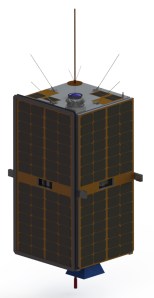
The ESEO spacecraft Copyright ALMASpace - ESA

The ESEO spacecraft Copyright ALMASpace – ESA

AMSAT-UK will be providing a 1260/145 MHz FM transponder and a 145 MHz BPSK telemetry beacon for the European Student Earth Orbiter (ESEO). This is the third mission within the European Space Agency’s Education Satellite Programme.

The satellite, which has a mass of 40 kg and measures 33x33x63 cm, is planned to launch in 2015-16 into a low Earth orbit.

Nine European universities will be working with the prime contractor ALMASpace, Italy, on the mission. Cranfield University in Bedfordshire will be supplying a small sail that will be deployed to demonstrate the de-orbiting of spacecraft at the end of the mission.

The primary purpose of the AMSAT-UK payload is to provide a downlink telemetry that can be easily received by schools and colleges for educational outreach purposes. The data will be displayed in an attractive format and provide stimulation and encouragement for students to become interested in all STEM subjects in a unique way.

The target audience is primarily students at both primary and secondary levels and the project includes the development of a simple and cheap “ground station” operating on VHF frequencies in the Amateur Satellite Service. This station is an omni-directional antenna feeding a FUNcube DonglePRO+ SDR receiver which will receive the signals direct from the satellite and transfer the data to specially developed graphical software running on any Windows laptop.

Continue reading

KySat-2 CubeSat plans to fly Summer 2013

KySat-2 (K2) is a 1U CubeSat to fulfill the education and public outreach mission of the original KySat-1 CubeSat that was lost during a launch vehicle failure of ELaNa I and accompanying NASA GLORY mission.

Continue reading

FITSAT-1 LEDs to Flash Morse Code over USA and Europe

Artistic impression of FITSAT-1 signaling in Morse code

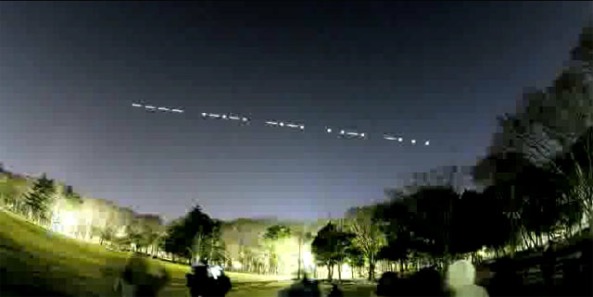
On December 12-13 FITSAT-1 will be using its optical LED beacon to flash a message in Morse Code over the USA and the British Isles/Europe which should be visible using binoculars.

Continue reading

Government delays response to Reform of the Outer Space Act 1986 consultation

A statement on the UK Space Agency (UKSA) site says:

Due to the range of views received during the Reform of the Outer Space Act 1986 consultation the Government response has been delayed.

We hope to be in a position to publish it during the first half of 2013.

Further details will be posted in due course.

The Outer Space Act covers all UK satellites irrespective of size, from tiny low cost educational CubeSats up to large commercial £500 million satellites.

The key aspects of the consultation are the proposals to waive the capped liability and insurance requirement for in-orbit operation of any satellite that meets the criteria of a CubeSat and to remove the requirement for unlimited indemnity from satellite operators.

The existing Outer Space Act imposes heavy additional costs (>£50,000 per annum) on those wishing to launch small educational CubeSats. The additional costs act as a major deterrent and to-date no such UK CubeSat has been launched.

Reform of the Outer Space Act 1986: Consultation http://www.uk.amsat.org/?p=8783