Sir Arthur Clarke Awards – Nominations Sought

Arthurs 2011 Winners – Image Credit British Interplanetary Society

The British Interplanetary Society are seeking nominations for this years Sir Arthur Clarke Awards.

In recognition of notable or outstanding contributions made to all space activities, the Sir Arthur Clarke Awards have been presented annually since 2005.  In the past the Award Ceremony has been an integral part of the UK Space Conference, but as the Conference is now held every other year, to avoid conflicting with the Farnborough Air Show, it has been decided to go ahead with this year’s “Arthurs” Awards to provide complete continuity.  The Award Ceremony will take place at a lunch in the House of Lords in October.

Though primarily designed to reward UK teams and individuals for their achievements over the past year, 2011-2012, the Awards will include International and Lifetime Achievement categories.

Further information and online nomination form at
http://www.bis-space.com/2012/07/25/6282/sir-arthur-clarke-awards-nominations-open

British Interplanetary Society http://www.bis-space.com/

Astronaut Tim Peake invites students to apply for space class of 2013

European Space Agency (ESA) astronaut of British nationality Tim Peake is encouraging school children to get fit and stay active at the Farnborough International Airshow this week. Budding young astronauts aged 8 to 13 from across the UK are invited to take part in the international challenge Mission X: Train Like an Astronaut – a programme to encourage school students to focus more on fitness and nutrition.

Tim Peake.

The programme developed by the partners of the International Space Station (ISS) uses astronaut training to teach how good diet and exercise play an important role in human performance in space and on the Earth. The programme is free and the activities can be used by individuals, schools or community groups. The international challenge will start in January 2013.

Mission X logoTim Peake is taking a short break from his own astronaut training to attend the Airshow and invite schools to participate in the Mission X: Train Like an Astronaut 2013 challenge. At Farnborough Airshow Tim spoke to teachers, students and families about his own astronaut training and challenged them to take part in the astronaut fitness programmes available as part of Mission X.

Tim as well as being a test pilot and ESA astronaut is also a keen runner, skier and scuba diver.
4000 UK students from over 44 British schools have already taken part in the Mission X challenges in 2011 and 2012. Students had the opportunity to take part in live link-ups with the International Space Station and find out about life in space. As well as Tim Peake, Mission X UK has been supported by ESA astronauts Andr Kuipers and Paolo Nespoli, NASA astronaut Piers Sellers and private astronaut Richard Garriott.
Jeremy Curtis, Head of Education at the UK Space Agency noted:

The UK Space Agency is enabling children to access astronaut training and nutrition regimes and learn about the science behind them

“This is a unique opportunity to find out first hand about astronaut training and to find out how you can get involved in Mission X – Train Like An Astronaut. The UK Space Agency is enabling children to access astronaut training and nutrition regimes and learn about the science behind them. The children taking part will also learn about space and could be the space explorers of the future.”

Tim Peake commented:
Spaceflight can be physically demanding and part of my job is to train hard so that I‘m always ready to go into space

“Being fit and healthy is a key requirement for future astronauts. Spaceflight can be physically demanding and part of my job is to train hard so that I‘m always ready to go into space. It’s much easier to exercise on earth than in microgravity! The real mission is to encourage kids today to exercise and eat a healthy diet, and astronaut training exercises are an exciting, fun way to do it.”

People have been flocking from around the world to visit the UK Space Agency in the Space Zone at Farnborough. The latest industry developments and cutting edge technology are on display to demonstrate the work being done to layout the future direction for space. Space is a growing industry with a bright future. One of the ways the Agency nourishes and supports it is by inspiring the next generation of space scientists, engineers and enthusiasts.

The next Mission X challenge will be launching in January 2013 – with the expectation of doubling the intake from 4000 to 8000 students across the UK. To find out more about how your children or school can be involved, register your interest.

Reform of the Outer Space Act 1986: Consultation

The UK Space Agency has issued a public consultation seeking views of stakeholders on proposed changes to the Outer Space Act 1986.

This is in response to the Government Growth Review published in March 2011, in which the Government set out its wish to reform the Outer Space Act 1986 by introducing an upper limit on liability for UK operators.

The Outer Space Act covers all UK satellites irrespective of size, from tiny low cost educational CubeSats up to large commercial £500 million satellites.

The key aspects of the consultation are the proposals to waive the capped liability and insurance requirement for in-orbit operation of any satellite that meets the criteria of a CubeSat and to remove the requirement for unlimited indemnity from satellite operators.

The existing Outer Space Act imposes heavy additional costs (>£50,000 per annum) on those wishing to launch small educational CubeSats. The additional costs act as a major deterrent and to-date no such UK CubeSat has been launched.

The public consultation closes August 31, 2012.

Further information at
http://www.bis.gov.uk/ukspaceagency/news-and-events/2012/May/
reform-of-the-outer-space-act-1986-consultation

50 Years of the UK in Space

Anu Ojha Director, National Space Academy

The UK Space Agency has released a YouTube video celebrating the UK’s 50 years in space

Watch 50 Years of the UK in Space

First UK Astronaut Helen Sharman GB1MIR on the MIR Space Station

UKube-1 is Taking Shape

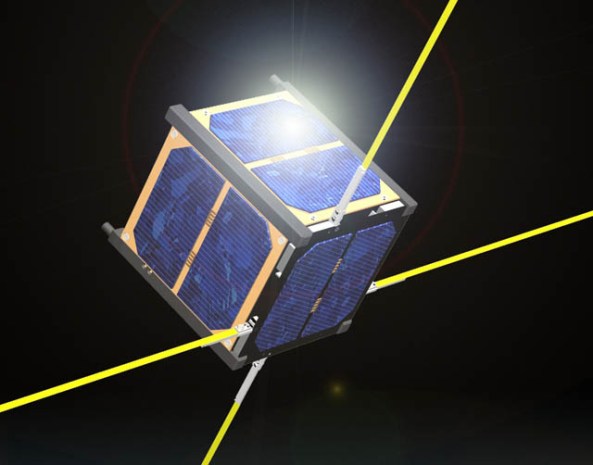
UKube-1, the programme to launch the UK Space Agency’s first Cubesat mission, has reached an important milestone. Two payloads have now undergone pre-integration testing at Clyde Space’s facilities in Glasgow.

UKube-1. Credit: Clyde Space.

UKube-1. Credit: Clyde Space.

Miniature satellite UKube-1, is a collaboration between the UK Space Agency, industry and academia. Open University payload C3D and University of Bath payload TOPCAT were the first of the four payloads selected to be tested. These workshops provided the first opportunity to carry out physical and functional testing between the protoflight payloadsand platform subsystems.C3D imager. Credit: Clyde Space/Open University. (JPG, 2.7 Mb) 

The tests confirmed physical, electrical and operational interfaces between the subsystems. The tests represent the successful handover to flight integration and delivery from the interface emulator (supplied to payload teams by Clyde Space at the start of the program to facilitate rapid parallel development of subsystems).

C3D is a small imager which will take pictures of the earth and investigate radiation damage effects in space. It uses new sensor technology developed for space conditions.

TOPCAT (Topside Ionosphere Computer Assisted Tomography) will measure space weather conditions to inform users of the Global Positioning System (GPS) users using a dual-frequency GPS receiver designed especially for use in space.

With the remaining payloads due to be tested over the coming few weeks, the program continues confidently towards full integration in July.

UKube-1 will also take an educational subsystem called FUNcube, developed by the voluntary organisation AMSAT-UK, to encourage young people to learn about radio, space, physics and electronics. It contains a 1200 bps BPSK telemetry beacon and a 435/145 MHz linear transponder.

UKube-1 on BBC TV http://www.uk.amsat.org/5983

UKube-1 to launch in 2013 http://www.uk.amsat.org/5933

'Kinect' STRaND-2 at UK Space Agency Conference

Tim Peake at UKSA Conference 20120426

Prospective UK Astronaut Tim Peake addressed the conference via Skype

On the anniversary of the launch of Ariel-1, April 26, the UK Space Agency and the Science Museum co-hosted a two-day conference celebrating 50 years of the UK in space. It brought together those who started the UK on the road to being a world-renowned centre for space technology and research with the scientists and engineers of the next fifty years.

Vince Cable at UKSA Conference 20120426

Vince Cable Secretary of State for Business, Innovation and Skills

Ariel-1 was the world’s first international satellite. The United Kingdom stepped up to an offer from NASA to launch scientific satellites at an international meeting on space research in 1959. From this point, the UK took the lead in satellite technology as well as beginning the UK’s long history of international collaboration.

As part of the programme on the 26th, there were personal insights from scientists and engineers involved in the original design and build of the Ariel series of satellites, as well as those teams developing the flagship programmes of today and tomorrow. The Science Museum will be highlighting historic milestones in the UK space sector over the course of the week.

Shaun Kenyon at UKSA Conference 20120426

Shaun Kenyon of the STRaND project

The future is set to be as innovative and inspirational as the last 50 years. There is a vast potential for space technology. From the growing need for Earth observation satellites to monitor urgent social and environmental issues; to the emerging reality of space tourism; to our ever-improving capability to see deep into the Universe, the UK space sector is at the forefront of facing up to these challenges.

During the conference prospective UK astronaut Tim Peake, currently in the USA, addressed the conference via a Skype video link.

Shaun Kenyon, who has worked on the innovative STRaND-1 SmartPhone satellite project, gave a well received presentation about the future opportunities for the UK Space Industry. He also described another UK first – STRaND-2 – twin 3U CubeSats with docking capabilities using a gridded Lidar system based on that used in the Kinect games controller.

Surrey Space Centre http://www.surrey.ac.uk/ssc/
STRaND on Facebook http://www.facebook.com/nanosats