A chat with Bob Twiggs KE6QMD, father of the CubeSat

First-MOVE_Students_with_Bob_Twiggs_KE6QMD_2560

First-MOVE CubeSat students with Bob Twiggs KE6QMD

Radio amateur Bob Twiggs KE6QMD is interviewed by Stephen Clark in Spaceflight Now.

Read the interview at http://spaceflightnow.com/news/n1403/08cubesats/

The team behind the recently launched $50sat PocketQube programmed the satellite’s FM CW beacon to send “TNX KE6QMD” to thank their mentor Bob Twiggs KE6QMD.

$50sat Ham Radio Challenge
http://www.southgatearc.org/news/2014/february/$50sat_ham_radio_challenge.htm

Radio amateurs receive NASA ISEE-3 / ICE Spacecraft

Radio amateurs have received signals over a distance of 43 million km from the NASA ISEE-3 / ICE deep space probe which was retired from service in 1997.

AMSAT-DL have released this statement:

ISEE-3 - ICE Spacecraft - Image credit NASA

ISEE-3 – ICE Spacecraft – Image credit NASA

On March 1st and 2nd, 2014 radio amateurs were able to detect the beacon signal from the retired NASA deep space probe ICE (International Cometary Explorer) at the Bochum Observatory (Germany). After some changes to the ground equipment and aligning the receive antenna to the predicted position in the sky, the beacon signal could positively be identified due to its frequency, the position in the sky and the frequency shift due to the radial velocity (Doppler shift).

For this detection the 20m radio telescope from the Bochum Observatory was used. In 2003, AMSAT-DL converted this former industrial monument into a fully functional groundstation for deep space probes. Since 2009 the facility is being used by volunteers almost full time as ground receive station for data from the STEREO mission with its two spaceprobes monitoring the sun from different viewing angles.

The International Sun-Earth Explorer 3 (ISEE-3) was launched in 1978 and became the first spacecraft to orbit the Earth-Sun L1 Lagrange point, measuring the interaction between the Earth’s magnetic field and the Sun. It was the first spacecraft to detect the stream of particles (“solar wind”) approaching Earth. In 1982, the spacecraft was renamed the “International Cometary Explorer” (ICE) and diverted to the Moon, where its gravitational pull placed ICE on a heliocentric orbit. In 1985, the comet Giacobini-Zinner was visited (the first time a comet had been encountered by a spacecraft), followed by observation of Halley’s Comet in 1986.
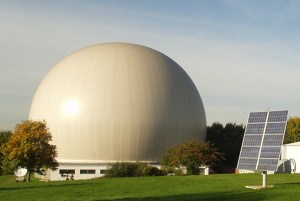
Amateur Radio Facility at Bochum

Amateur Radio Facility at Bochum

While the instrumentation on board was still functional and fuel for more trajectory maneuvers was available, support for the ICE mission was terminated in 1997, though the spacecraft transmitter was left on. It was last detected by the NASA Deep Space Network in 2008. Its orbit however results in the spacecraft returning to Earth-Moon space in August of 2014. A small propulsive maneuver and lunar flyby could allow ICE to be directed into an Earth-Sun L1 halo orbit and perhaps resume a science mission, depending on instrument health. However in February 2014 a NASA study determined that the required resources to contact the spacecraft were not available anymore and due to budgetary constraints no further contact attempts were planned. In light of the recent observations and the available facilities in Bochum, additional studies about the economic feasibility to add a suitable uplink are being done.

We would like to thank Jeremy Bauman from KinetX Aerospace (Tempe AZ, USA) for providing the ICE trajectory solution which was essential in finding the spacecraft and Jon D. Giorgini from the Jet Propulsion Laboratory (Pasadena CA, USA) for his support.

AMSAT-DL
Dr. Achim Vollhardt DH2VA
email: ICEteam at amsat-dl.org

ISEE-3 ICE spacecraft signal spectrum March 2, 2014 at 1822 UT

ISEE-3 ICE spacecraft signal spectrum recorded on March 2, 2014 at 1822 UT using the 20m dish antenna of Bochum Observatory, Germany. Range 43M km, azimuth 230°, elevation 49°. Average of 2 spectra spanning 2.1 seconds. With a bin bandwidth of 1.6 Hz, the SNR of 15.8 dB equates to a CNR of 17.8 dB. Indicated frequency is relative to the programmed center frequency of 2217.5 MHz of the measurement equipment.

The satellite carries Redundant S-band transponders, each with 5 Watt RF output but it is now only transmitting a carrier signal. The following information is from the ISEE-3/ICE Telecommunications Summary http://mdkenny.customer.netspace.net.au/ISEE-3.pdf

Transponder A:
2090.66 MHz RHCP uplink, command or ranging
2270.40 MHz RHCP downlink, telemetry or ranging

Transponder B:
2041.95 MHz LHCP uplink, command
2217.50 MHz LHCP downlink, telemetry

Transmit antenna: medium gain with dual inputs for simultaneous right and left hand circular polarization downlink, 8 rows of 4 elements, 7 dBi, ±6° beamwidth, multibeam, electronically steerable, four lobe, omni directional coverage in azimuth

Receive antenna: 2042 MHz, intermediate gain, 1 row of 4 elements, 0 dBi, ±45° beamwidth

Read the Planetary Society ISEE-3/ICE post at
http://www.planetary.org/blogs/emily-lakdawalla/2014/02070836-isee-3.html

ISEE-3/ICE Telecommunications Summary
http://mdkenny.customer.netspace.net.au/ISEE-3.pdf

ISEE-3/ICE on Facebook https://www.facebook.com/ISEE3returns

Can Radio Hams Receive NASA’s ISEE-3/ICE ?
https://amsat-uk.org/2014/02/07/can-radio-hams-receive-nasas-isee-3ice/

LitSat-1 Transponder Test Successful

LitSat-1 CubeSat

LitSat-1 CubeSat

The 435/145 MHz SSB/CW linear transponder on the Lithuanian  amateur radio CubeSat LitSat-1, call sign LY1LS, was successfully tested on Sunday, March 9.

LitSat-1 was deployed from the International Space Station (ISS) on Friday, February 28 at 0730 UT by astronaut Koichi Wakata KC5ZTA.

Listen to the recording made by Mike Rupprecht DK3WN http://www.dk3wn.info/p/?p=42732

LitSat-1 Transponder - Mike Rupprecht DK3WN

LitSat-1 Transponder – Mike Rupprecht DK3WN

LitSat-1 frequencies:

Inverting linear transponder for SSB/CW communications
• Uplink 435.135-435.165 MHz
• Downlink 145.935-145.965 MHz

The team list a CW beacon but it appears the beacon was not active during the test.

AX.25 packet radio transceiver
• Uplink 435.550 MHz
• Downlink 145.850 MHz

LitSat-1 uses a modified version of the LE005-R2 CubeSat linear transponder developed by William Leijenaar PE1RAH http://www.leijenaarelectronics.nl/leijenaar_electronics_009.htm

Facebook LitSat-1 Lituanica80 https://www.facebook.com/Lituanica80

LitSat-1 Palydovas https://www.facebook.com/palydovas

President Congratulates Lithuanian Amateur Radio CubeSat Builders
https://amsat-uk.org/2014/01/12/president-congratulates-amateur-radio-cubesat-builders/

Satellite TLE Object ID’s

TLEsNico Janssen PA0DLO reports the process of producing Object ID’s for newly launched satellites has changed recently.

Writing on the AMSAT Bulletin Board (AMSAT-BB) he says:

It seems that the Joint Space Operations Center (JSpOC) has changed some of their policies lately. After the launch of multiple small satellites late last year it took a long time to get them all identified. Apparently they don’t want to leave all the TBAs in their database for a long time, so now they use a different approach: they randomly assign the names of all satellites of a launch to the observed objects and then wait for reactions from the users of the satellites to see if the assignments are correct.

This is how e.g. the Cubesats, that recently were launched from the ISS, got ‘identified’ only a few days after their launch. So of course now we find that some identifications are wrong.

Doppler measurements clearly show that the following IDs are correct:
Object 39568, 1998-067EM, is LitSat 1
Object 39569, 1998-067EN, is LituanicaSat 1.

I am trying to get these corrected.

In the past the policy was to assign the ‘A’ object to the main payload of a launch. Secundary payloads, like Cubesats, would then get ‘B’, ‘C’, etc. So if the main payload initially was linked to the wrong TLE set, this required some swapping of TLE sets some time after the launch. Now they have decided to prevent this confusion by simply leaving the main payload assigned to another object than ‘A’ if required. Therefore the GPM satellite now is assigned to 2014-009C and this will not change anymore.

Satellite TLE Lottery Begins https://amsat-uk.org/2014/03/01/satellite-tle-lottery-begins/

Satellite Tracking https://amsat-uk.org/beginners/satellite-tracking/

ISS HamTV Success

ISS HamTV screenshot by Stefan VE4NSA March 8, 2014

ISS HamTV screenshot by Stefan VE4NSA March 8, 2014

On Saturday, March 8 test transmissions were made on 2422.0 MHz using the HamTV equipment on the International Space Station (ISS).

BATC Webstream of ISS HamTV by Stefan VE4NSA March 8, 2014

BATC Webstream of ISS HamTV by Stefan VE4NSA March 8, 2014

The Digital TV signal was successfully received and web streamed to a global audience via the Britsh Amateur Television Club (BATC) server at http://batc.tv/ch_live.php?ch=4 There were four live web streams each from different receivers.

The HamTV transmitter is the culmination of over ten years work by dedicated volunteers to establish an amateur radio TV transmitter on the ISS. It uses patch antennas fixed on the Meteorite Debris Panels (MDP) protecting the hull of the ISS Columbus module. These antennas were installed while the Columbus module was being constructed. A fund-raising campaign took place during 2005-7 to raise over 65,000 Euros for the antennas. Individual radio amateurs from around the world donated generously as did several organisations including AMSAT-UK and the RSGB.

The main mission of HamTV is to perform contacts between the astronauts on the ISS and school students, not only by voice as now, but also by unidirectional video from the ISS to the ground.

Watch HamTV Commissioning received from IK1SLD Telebridge Station Casale Monferrato, Italy

HamVideo is the name of the onboard DATV S-band transmitter. HamTV is the name of the complete system, comprising DATV downlink and VHF voice uplink. Kaiser Italia SRL was the prime-contractor for the design and development of the flight and ground segment http://www.kayser.it/index.php/exploration-2/ham-tv

Watch HAM TV commissioning, VLBI Control Room – ASI Matera, Italy – March 8, 2014

Read the HamTV overview by Gaston Bertels ON4WF http://tinyurl.com/HamTVoverview

Join the ISS HamTV Yahoo Group http://groups.yahoo.com/group/HamTV

Webstream of the TV transmissions http://batc.tv/ch_live.php?ch=4

ARISS-EU HamTV Bulletins http://www.ariss-eu.org/

HamTV on Facebook https://www.facebook.com/Hamtvproject

Front panel of the HamTV transmitter

Front panel of the HamTV transmitter

‘Travel’ to Space for £40 / $70

VR2Space Payload Module

VR2Space Payload Module

Researchers from the Surrey Space Centre, University of Surrey have launched a unique campaign that will enable the public to ‘travel’ to space for the cost of a pair of trainers.

VR2Space BalloonVirtual Ride to Space will use cutting-edge virtual technology and a specially designed spacecraft to deliver a three-dimensional, immersive experience, allowing everyone to see what astronauts experience on an ascent to space.

The experience will be created by capturing HD footage of space, via a weather balloon which will carry a cluster of twenty-four HD video cameras to a height of 20km – twice the height of a commercial airplane. During ascent these cameras will capture panoramic footage of the balloon’s journey to space.

Following the flight, specialised software will stitch this footage together to recreate a panoramic view of the space trip. The subsequent space ride will then be viewed using Oculus Rift, a state-of-the-art virtual reality, head-mounted display. The system is designed to deliver high definition 3D virtual environments that can be explored by the wearer, as if they are in space  themselves.

The £30,000 project will be funded by public contributions through the crowd-sourcing funding platform, Kickstarter.

Surrey Space Centre University of Surrey, Guildford

Surrey Space Centre
University of Surrey, Guildford

“Only 530 people have ever travelled to space. For most of us it’s a distant and very expensive dream but this project is about enabling the remaining 99.999992% to see the world like never before,” said lead researcher Dr Aaron Knoll from the University of Surrey.

“Ride to Space will give all aspiring astronauts the chance to be a virtual passenger, riding the balloon to space, and unlike other Galactic flights, it won’t cost the earth to be on board!”

The project team are also developing a smartphone application that will allow users to experience the journey using the phones’ built-in gyroscope and accelerometer data, as well as a computer programme that will allow users to experience space via their PCs.

Investment for Virtual Ride to Space is being sought via Kickstarter. Please visit the Virtual Ride to Space page for more information.
https://www.kickstarter.com/projects/1592839372/virtual-ride-to-space-using-the-oculus-rift

Channel 5 Gadget Show
http://gadgetshow.channel5.com/gadget-show/gadget-news/travel-to-space-with-the-oculus-rift

Facebook https://www.facebook.com/VR2Space

The Bring Your Own Board BYOB CubeSat Workshop and the AMSAT-UK International Space Colloquium take place in Guildford, Surrey on July 25-27, see https://amsat-uk.org/colloquium/colloquium-2014/