The AMSAT-UK net is held every Sunday morning at 10am local time on a nominal frequency of 3.780 MHz. Due to interference the net may move either side of that frequency so tune around. Newcomers are most welcome to call-in.
You Dont have to be a AMSAT-UK member to join in with the chat.
The Italian microsat UniSat-5 will itself deploy a number of additional amateur radio satellites. Among them should be the CubeSats PUCP-SAT-1, HumSat-D, Icube-1, Dove-4 (Planet Labs Inc. non-amateur) and PocketQubes Wren, Eagle-1 (BeakerSat), Eagle-2 ($50Sat), QB-Scout1. PUCP-SAT-1 intends to subsequently release a further satellite Pocket-PUCP.
The Japan Aerospace Exploration Agency (JAXA) would like to announce that the Small Demonstration Satellite-4 (SDS-4) completed its critical phase operations and moved to the initial phase. The SDS-4 was launched by the H-IIA F21 at 1:39 a.m. on May 18, 2012 (Japan Standard Time) as a secondary payload with the Global Change Observation Satellite 1st – Water “SHIZUKU” (GCOM-1.)
The satellite is currently in good health.
The initial functional verification operations will continue for about one month.
The 2012 Bay Area Maker Faire in San Mateo took place May 19-20 and among the stands was one displaying the PhoneSat amateur radio satellites.
There are two types of of these satellites both of which run the Android operating system and will be enclosed in a standard 1U CubeSat structure.
PhoneSat 1.0 cost about $3500 and is built around the Nexus One smartphone, it operates on battery power only with a mission lifetime of approx 1 week.
PhoneSat 2.0 is more expensive at $8000. It is built around the Nexus S smartphone and has solar panels on each face and a mission lifetime until de-orbit of approximately 2 weeks.
The IARU has coordinated a frequency of 437.425 MHz for the AX.25 AFSK downlink.
The first launch is scheduled for the third quarter of 2012 on Antares-110. It will carry two PhoneSat 1.0 satellites and one PhoneSat 2.0. A second PhoneSat launch is expected to occur in 2013.
Watch NANOSATHTC smart Phone-Satellite OS Android in a 10cm cube
Phonesat was also at the 2011 Maker Faire. In this video Ben explains the concept of a Phonesat.
Watch Android Phone as Autonomous Micro-Satellite: PhoneSat
Abubakr S. Eltayeb ST2AB is an Electrical Engineer specializing in communications systems. He is currently a member of the Cube Satellite Project which belongs to the Faculty of Engineering at University of Khartoum.
The team includes his colleagues Hala M. Othman, Mustafa Atta Mohamed and Yasir M. Osman ST2YM, and together they constructed the first satellite in Sudan with the help of Dr. Tahani Abdalla, their project manager and Dr. Nader Abdelhameed, the team manager. They designed, tested and experimentally launched a fully functional Cube Satellite prototype named KN-SAT1.
The team is now developing the Flight Model of the KN-SAT1, in preparation for its launch into outer space.
This TEDxKhartoum presentation is not in English, however, the segment from 09:12 until 13:25 contains video showing the development of the KN-SAT1 CubeSat including a test of the deployment of the antennas.
Watch TEDxKhartoum 2012: Abubakr S. Eltayeb, A Sudanese Satellite


 The Japan Aerospace Exploration Agency (JAXA) would like to announce that the Small Demonstration Satellite-4 (SDS-4) completed its critical phase operations and moved to the initial phase. The SDS-4 was launched by the H-IIA F21 at 1:39 a.m. on May 18, 2012 (Japan Standard Time) as a secondary payload with the Global Change Observation Satellite 1st – Water “SHIZUKU” (GCOM-1.)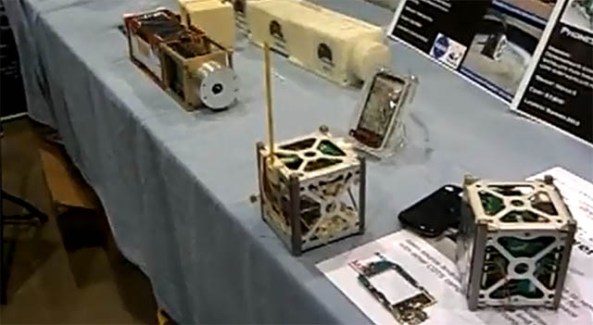


 AMSAT-UK
You must be logged in to post a comment.