Sound artist Caroline Devine sent the show Between the Ears into orbit in this celebration of amateur radio and space exploration that was broadcast on BBC Radio 3 on Saturday, January 19 at 2130 UT. A recording of the show is available until January 26 at http://www.bbc.co.uk/programmes/b01pyfhm. It starts 3:15 into the recording.
Author Archives: m0xtd
Open Source Satellite Initiative OSSI CubeSat Wiki
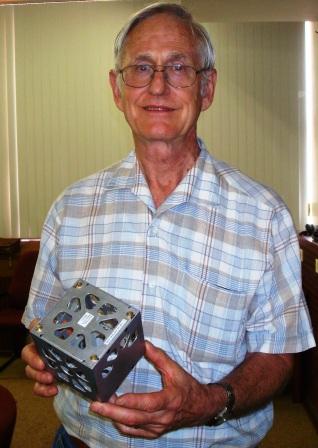
Professor Hien Vo of the Inter American University, Puerto Rico, visited Korea and met Hojun Song DS1SBO who has developed the Open Source Satellite Initiative OSSI-1 CubeSat.
OSSI-1 is planned to launch in the 2nd quarter of 2013 into a 575 km 63° inclination orbit on a Soyuz-2-1b rocket from the Baikonur launch facility in Kazakhstan along with the Bion-M1 satellite and the SOMP, BEESAT 2, BEESAT 3 and Dove-2 CubeSats. The Soyuz-2-1b launch had originally been planned for August 2012 but was delayed.
The development of the satellite has been documented on the Open Source Satellite Initiative Blog http://opensat.cc/blog/ and the Wiki http://opensat.cc/wiki/
WARP DRiVE for UK STRaND-1 CubeSat
The SSTL Space Blog reports on WARP DRiVE (Water Alchohol Resistojet Propulsion system), a novel new propulsion system that will help the STRaND-1 cubesat to perform manoeuvres. STRaND-1 is the first cubesat to have two types of propulsion system. As well as the WARP DRiVE, it will be equipped with a pulsed plasma thruster system which will provide full-axis control with low power, mass and volume requirements.
WARP DRiVE works by pushing water alcohol out of a tiny hole (just 0.2mm across) to produce thrust. The main advantage of this system is that it’s much smaller than regular space propulsion systems measuring in at about the same width as a drinks coaster. The WARP DRiVE will also provide more thrust than other similar systems whilst maintaining a comparable specific impulse (the efficiency of the propulsion system).
Read the SSTL Space Blog at http://www.sstl.co.uk/Blog/January-2013/WARP-speed-ahead
STRaND stands for Surrey Training, Research and Nanosatellite Demonstration and the programme is intended to be a long-term arrangement between the space company SSTL and academic researchers at the Surrey Space Centre (SSC), with STRaND-1 the first of a long line of STRaND nanosatellites.
STRaND-1 aims to carry a NEXUS Android Smartphone into space and plans to use data rates of 9k6 or 19k2 bps for the AX.25 packet radio downlink on 437.575 MHz. A software-based speech synthesiser will be included to pay homage to the UOSAT family of satellites.
The SSTL employees involved with the STRaND programme are volunteers. It is a condition of the programme that volunteers from SSTL and SSC use their own, free time for STRaND activities (such as lunches and breaks). The project has no budget for staff so is entirely dependent on volunteers.
To watch a presentation about STRaND-1 given by Dr. Chris Bridges to the AMSAT-UK 2012 International Space Colloquium following these steps:
• Go to http://www.batc.tv/
• Click on “Film Archive”
• Select “AMSAT 2012″ in the Category box and click on Select Category
• Select “A03 – STRaND-1” in the Stream box and click on Select Stream
• Click the play button on the video player window
The videos can be downloaded for later use, for instance at a club meeting, by clicking on the “Click Here” link underneath the video player.
Alba Orbital make Shell top 10
Glasgow based Alba Orbital, who aim to use CubeSats for Space Burials, have got through to the national round of a major start-up competition.
They now need your help to go one better and win £1000 for their Space Start-up.
There is a 1 minute elevator pitch video on the Shell Livewire site describes their plans for the company.
You can vote for Alba Orbital at http://www.shell-livewire.org/awards/grand-ideas-awards
Alba Orbital believe Space is important and more start-up satellite companies should be succeeding!
Thanks for your support,
Tom Walkinshaw
Founder, Alba Orbital
Shell LiveWIRE Grand Ideas Awards http://www.shell-livewire.org/awards/grand-ideas-awards
BBC Radio Scotland interview with Tom Walkinshaw of Alba Orbital
http://www.youtube.com/watch?v=Ft6i_7FSdko
Alba Orbital use the MAKlab Studio in Glasgow, for manufacturing their prototype satellites http://www.maklab.co.uk/
Alba Orbital http://www.albaorbital.com/
SA AMSAT Accelerating the KLETSkous CubeSat Project
SA AMSAT has decided to accelerate their CubeSat project, named KLETSkous and expect to have the first prototype version of the 435/145 MHz linear transponder and control system on the table for testing by end February.
“One of the reasons to speed up development is the quest to have the transponder included as an experimental payload on the ARMC project.” Hannes Coetzee, ZS6BZP, said. Jacques Roux, ZR1ADC, is working on the transponder while Brian McKenzie, ZS1BMN, is responsible for the control systems.
As part of South Africa’s contribution to the African Resource and Environmental Management Constellation (ARMC) of satellites, SANSA, in collaboration with local industry and academic experts, have been in discussions on the specifications for the new satellite (ZA-ARMC1) and its associated benefits for South Africa and the continent. SA AMSAT is making representation to SANSA to have an amateur payload included in the project.
Radio Hams BBC Stargazing Live Balloon Picture
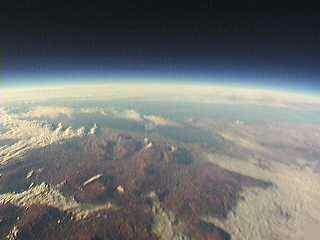
Graeme 2I0WGM and Philip MI0VIM got some publicity for the Mid-Ulster Amateur Radio Club by submitting a picture received from a BBC balloon on 434.650 MHz.
It was a BBC Stargazing Live experiment to send a balloon to the stratosphere that would tweet data from near space. The SWIFT balloon carried a transmitter on 434.650 MHz that sent pictures using 300 bps FSK and reached an altitude of 18.982 km.
Graeme 2I0WGM and Philip MI0VIM submitted their picture to the BBC which can be seen at
https://twitter.com/BBCSkyBalloon/status/289016211143016448/photo/1


You must be logged in to post a comment.