FUNcube-1 (AO-73) 100+ days in orbit

FUNcube-1 (AO-73) Spin Period

FUNcube-1 (AO-73) Spin Period

Last weekend FUNcube-1 (AO-73) reached the milestone of having been in space for 100 days – actually that should be clarified to mean “terrestrial” days as the spacecraft itself has been subjected to more than 1500 day/night cycles during this time.

FUNcube-1 (AO-73) - Image credit Wouter Weggelaar PA3WEG

FUNcube-1 (AO-73) – Image credit Wouter Weggelaar PA3WEG

We are very grateful to the 500+ stations who have been providing FUNcube-1 telemetry data to our Data Warehouse. We now have more than 1GB of data in the repository – this is an amazing effort and achievement from a spacecraft which is only transmitting at 1200bps. Thanks everyone and please keep it coming:)

From all the telemetry we can see that the spin rate decreased for a time but now is speeding up again. External temperatures span a range of 50C between the end of the sunlit phase and the end of the eclipse period. Even inside the spacecraft the temperatures range over 25C.

All the subsystems continue to work well and are “well in the green”.

Scintillation MapThe increased solar activity is certainly having an effect on the downlinked signal on many occasions. During such disturbances the signal appears to be being affected by ionospheric scintillation which distorts the BPSK stream and makes decoding much harder for some minutes at a time.  This effect is not just apparent near the magnetic poles as can be seen in this paper:  http://waas.stanford.edu/papers/IWG/sbas_iono_scintillations_white_paper.pdf

Users in the Northern hemisphere will have noticed that the evening passes in amateur mode are becoming shorter as the spacecraft enters sunlight again near the pole. This effect will increase as the season progresses and we will be testing a plan to change the operating schedule in a few weeks time. This test will involve placing the spacecraft into continuous amateur/transponder mode for a number of orbits – probably over a weekend.

Especially for educational users of FUNcube, we have placed all our schools outreach material on one page for easy reference. It can now all be found here: http://funcube.org.uk/education-outreach/

OSCAR-11 / UoSAT-2 Celebrates 30 Years in Orbit

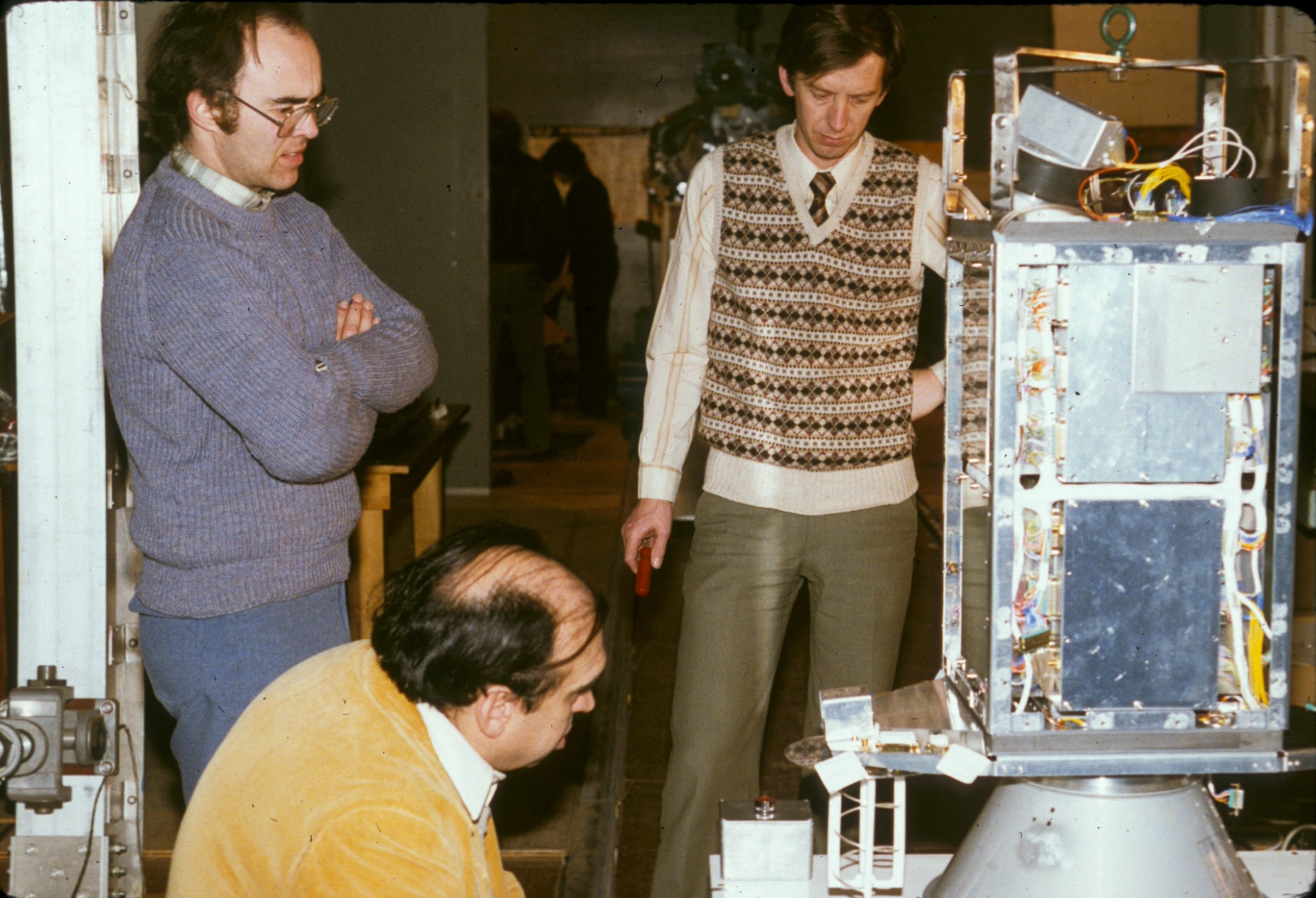
UOSAT-2 / OSCAR-11 with Dave Brock UoS kneeling, Christine Sweeting G6APF and Neville Bean G8NOB

UoSAT-2 / OSCAR-11 with Dave Brock UoS kneeling, Christine Sweeting G6APF and Neville Bean G8NOB

UoSAT-OSCAR-11 has now been in orbit for 30 years and remarkably its signal on 145.826 MHz FM (AFSK 1200 bps ASCII) is still being received.

UOSAT-2 / OSCAR-11 1984 Martin Sweeting G3YJO and Dave Bocks UoS standing

UoSAT-2 / OSCAR-11 Martin Sweeting G3YJO and Dave Bocks UoS standing

UoSAT-2, also known as UoSAT-OSCAR-11 or UO-11, was the second satellite designed and built by a team of engineers at the University of Surrey in Guildford, Surrey, UK and was the successor to UoSAT-1 / UoSAT-OSCAR-9 (see Hobby Electronics August 1981). It was launched from the Western Test Range at Vandenberg Air Base, in Lompoc, California along with LANDSAT-5 on a Delta 3920 rocket on March 1, 1984.

UO-11 was the most rapidly designed OSCAR, going from inception to launch in only five months. It was also the first amateur satellite to carry a digital communications package into Earth orbit, and the first to be controlled by a CPU running software written in the high-level programming language “Forth”.

UOSAT-2_OSCAR- 11UO-11 carries beacons in three amateur radio bands.

The 145.826 MHz beacon transmits FM Audio Frequency Shift Keying (AFSK) 1200 bps ASCII data. It the early years it also transmitted a voice message from the digitalker experiment.

The 435.025 MHz beacon transmitted either 1200 bps FM AFSK or 4800 bps PSK data. This beacon was used to downlink information from the Digital Store and Readout (DSR) Experiment, which includes CCD Earth image data, results from the Particle Wave Experiment, and engineering data from the RCA COSMAC 1802 CPU.

The 2401.5 MHz beacon transmitted FM and PSK signals. Antenna polarization for all three beacon transmitters is left-hand circular (LHCP). Only the 145.826 MHz beacon is now operational.

Read Usenet messages from 1984 about UoSAT-B / UoSAT-2

Martin Sweeting G3YJO listening to the UO-11 Digitalker

Martin Sweeting G3YJO listening to the UO-11 Digitalker

Information compiled by Clive Wallis G3CWV
https://web.archive.org/web/20150413193503/http://g3cwv.co.uk/oscar11.htm

UO-11 page on the DK3WN satellite blog at http://www.dk3wn.info/p/?cat=47

SSTL Blog – Happy 30th Birthday to UoSAT-2
http://www.sstl.co.uk/Blog/March-2014/Happy-30th-Birthday-to-UoSAT-2-

OSCAR-9 and OSCAR-11 TV News Reports
https://amsat-uk.org/2011/10/30/oscar-9-and-oscar-11-tv-news-reports/

BBC Micro ASTRID UoSAT receiver and AMSAT-UK Software Library
https://amsat-uk.org/2011/12/11/bbc-micro-and-amsat-uk-software-library/

UOSAT_OSCAR-11

Galileo GPS closes down 23cm ATV Repeater DB0QI

AMSAT-UK Logo

AMSAT-UK Logo

The new Galileo GPS system that broadcasts across 1260-1300 MHz has resulted in the closure of a German ATV repeater.

The DARC report the Munich ATV repeater DB0QI has been closed down due to it jamming the Galileo Satnav Control Centre.

DB0QI was located 18 km from the Galileo GNSS receiver, another repeater that has been shut down is DB0ITV which was located 55 km from the receiver. It is believed both repeaters were running about 15 watts ERP.

DARC in Google English http://tinyurl.com/GermanyDARC

A 2006 Galileo GPS article by Peter Blair G3LTF highlighted the problems this system could cause, see
http://www.southgatearc.org/articles/galileo.htm

The Amateur Satellite Service has an important allocation at 1260-1270 MHz for Earth-to-Space (Uplink) communications. The Amateur Satellite Service has already seen its allocations at 2.4 and 5 GHz rendered unusable in urban areas due to WiFi and other licence exempt devices. The Amateur Satellite Service does not have any other global spectrum allocations in the key 915 MHz to 6 GHz region.

While the German announcement may relate to a single Galileo command station being used to test the initial satellites it clearly raises concerns about what will happen in a few years time when the full Galileo constellation is deployed and 1260-1300 MHz GPS units are in widespread use.

Ham Radio Will Play Role in Simulated Mars Mission

Late Spring on MarsThe ARRL report when Ron Williams, N9UIK, and his team of “astronauts” head to “Mars” this spring, they’ll be taking Amateur Radio along, just as NASA space travelers have done.

Williams is part of Mission 2 (of four) in the Hawaii Space Exploration Analog and Simulation — HI-SEAS, in which participants will simulate living and working within a Martian outpost — actually a solar-powered dome at a remote site some 8000 feet up on the slopes of Mauna Loa. Conducted by the University of Hawaii and Cornell University, the project has partial funding from NASA.

“I am confident that when we eventually go to Mars, there will be some type of involvement with the Amateur Radio community,” Williams said, noting Amateur Radio’s long-standing role in space missions, including the International Space Station. “We would like to simulate this on this mission.” Part of that will mean integrating a 20 minute signal delay into all communications, whether via Amateur Radio or the Internet.

“This will simulate the distance, when greatest, between Earth and Mars,” explained Williams, a clinical neuropsychologist from Indiana. At 60, he’s the oldest member of the team; the youngest is 26. Williams, is one of two hams on this crew increment. The other is Ross Lockwood, VA6RLW, of Alberta.

“Our proposed outreach simulation to the Amateur Radio community will also involve this signal delay,” Williams continued. “To the best of our knowledge, this will be unique to any Amateur Radio special event ever conducted.” HI-SEAS also was able to obtain the special event call sign K6B for the project for nearly the entire length of the mission, instead of the typical 15 days.

Read the full ARRL story at
http://www.arrl.org/news/ham-radio-will-play-a-role-in-hi-seas-simulated-mars-mission

Having FUN in space

AMSAT-UK FUNcube Mission Patch Rev4 20100609

AMSAT-UK FUNcube Mission Patch

In this video David Johnson G4DPZ describes the AMSAT-UK FUNcube satellite project.

Watch Having FUN in space

FUNcube-1 (AO-73) - Image credit Wouter Weggelaar PA3WEG

FUNcube-1 (AO-73) – Image credit Wouter Weggelaar PA3WEG

FUNcube Power Point Slides http://funcubetest2.files.wordpress.com/2010/11/funcube_oct2013fin.ppt

FUNcube Handbook http://funcubetest2.files.wordpress.com/2010/11/funcube-handbook-en_v13.pdf

FUNcube Yahoo Group https://amsat-uk.org/funcube/yahoo-group/

FUNcube Forum http://forum.funcube.org.uk/

FUNcube Website http://www.funcube.org.uk/

Radio Astronomy Magazine Available

RAGazine March 2014 Front CoverThe March 2014 issue of the free Radio Astronomy Group publication RAGazine is now available for download.

This issue includes:
– RAG 2014 Meeting, Leicester
– Book review: “Space Has No Frontier”
– VLF quarterly observing report
– Brief note on the comparison of bright meteors
– Engineering maths, and more
– Frequency ranges
– The state of flux – an Arduino based magnetometer
– Jansky’s seminal paper that started RA
– Intro. to radio objects that can be detected by the amateur radio astronomer: Part 1
– Technology watch
– Solar flare

The publication by the British Astronomical Association Radio Astronomy Group (BAA-RAG) can be downloaded now from
https://dl.dropboxusercontent.com/u/5266466/RAGazine/RAGazine%20March%202014%20rD.pdf

Back editions of RAGazine are available at http://www.britastro.org/radio/downloads.html

Join the BAA-RAG Yahoo Group at http://groups.yahoo.com/group/baa-rag