Youngest radio ham in Gujarat state

Sakshi Vagadia VU3EXP

Sakshi Vagadia VU3EXP

In 2012 St. Paul’s school student Sakshi Vagadia spoke to astronaut Sunita Williams KD5PLB as part of an ARISS school contact. Now, at 15, she has received her amateur radio licence VU3EXP.

Sakshi has just finished her 9th grade in St. Paul’s School, Rajkot and is the fourth member of her family to get an amateur licence. Her father is Rajesabhai Vagadia VU2EXP, her uncle Prakash Vagadia VU3PLJ and cousin Priyesa Vagadia VU3GLY.

Sunita Williams KD5PLB on the ISS

Sunita Williams KD5PLB on the ISS

A year after speaking to Sunita Williams KD5PLB via the ARISS school contact Sakshi was able to meet her in person when Sunita visited the Government Science College (GSC) in Ahmedabad.

Sakshi did her training at the Gujarat Institute of Amateur Radio in Gandhinagar and took her amateur radio examination on February 25, 2013 received her pass result on April 2, 2013. It took the Government of India (WPC Wing) over two years to issue her amateur radio licence which she  finally received on April 24, 2015.

Sakshi’s achievement was reported in the local press. See the article written in Gujarati at
http://www.divyabhaskar.co.in/news/SAU-RJK-smallest-ham-operator-of-rajkot-sakshi-vagadia-4982404-PHO.html

It can be difficult to get an amateur radio licence in India. The archaic licensing system appears to have changed little since the 1940’s and is plagued with bureaucracy. After passing the exam it can take 12-24 months for Government officials to process the licence application. Among the information required on an Indian licence application are things such as height, eye colour, occupation and details of your Father, although not your Mother. There are even police checks on the suitability of an applicant. There are some parts of the country where Government simply refuses to issue any amateur radio licences.

Indian Ham Radio Licensing http://www.qsl.net/vu2msy/Ham_Licencing_Info.htm

India seeks relaxation of red-tape provisions
http://www.southgatearc.org/news/2014/september/india_seeks_relaxation_of_red_tape_provisions.htm

2012 Sunita Williams KD5PLB ARISS school contact
http://www.southgatearc.org/news/november2012/excited_kids_go_on_space_talk_with_sunita.htm

ISS HamTV now transmitting on 2395 MHz

Samantha Cristoforetti IZ0UDF with ISS HamTV Transmitter

Astronaut Samantha Cristoforetti IZ0UDF with ISS Ham Video Transmitter

Friday, May 1, 2015 the Ham Video transmitter on board the Columbus module of the International Space Station was powered on and started transmitting in “Blank Transmission” (BT) mode.

HamTV Antennas at ARISS Telebridge Station IK1SLD in Casale Monferrato, Italy

HamTV Antennas at ARISS Telebridge Station IK1SLD in Casale Monferrato, Italy

In this mode, the transmitter is operated without camera. The digital TV signal is fully formatted, but the content of the video is black and the content of the audio is at zero level. From a technical perspective, the BT signal is all that is needed for testing and fine tuning ground stations.

The European network of chained ground stations is presently nearly complete. Six ground stations span the continent in “X”  formation. For each ascending pass over Europe, four stations provide about ten minutes of solid copy and the same is true for descending passes:

– Ascending passes: Lisbon (Portugal ==> Poitiers (France) ==> Casale Monferrato (North Italy ==> Kolo (Poland)
– Descending passes : Cork (Ireland) ==> Poitiers (France) ==> Casale Monferrato (North Italy ==> Matera (South Italy.

The chained ground stations are streaming the digital video to the BATC server (British Amateur Television Club). BATC set up a multiviewer page, accessible at:

http://www.batc.tv/iss/

The page shows all six streams from the chained  ground stations. Each view can be maximized to full screen and the audio of each stream can be set to level or muted.

International Space Station - Image Credit NASA

International Space Station – Image Credit NASA

Presently, active stations stream technical data provided by the software developed by Jean Pierre Courjaud F6DZP. Several data are most interesting to observe:
–    the “constellations”, which visualize the QPSK (quaternary PSK) modulated signal
–    the  digital Signal/Noise ratio = MER (dB) (Modulation Error Ratio)
–    the control LEDs that change from red to green on decoding the digital signal.

The Ham Video transmitter frequency is 2395 MHz and the symbol rate is 2.0 Ms/sec.
More information is available at:

http://www.ariss-eu.org/columbus.htm

The Ham Video transmitter will stay on as long as on board operations permit. When the ground stations will be operating reliably, the Ham Video transmitter will be used to enhance ARISS school contacts. Uplink will remain VHF audio only. This operational mode is dubbed ARISS Ham TV.

73,
Gaston Bertels – ON4WF
ARISS-Europe chairman

ARISS FSTV gallery http://www.spaceflightsoftware.com/ARISS_FSTV/

HamTV Transmitter in the ISS Columbus Module

HamTV Transmitter in the ISS Columbus Module

EO-79 (FUNcube-3) Transponder Test May 4

QB50p1 and QB50p2 - Image Credit ISIS

QB50p1 and QB50p2 – Image Credit ISIS

On Monday, May 4 at around 0830 UT it is intended to activate for one orbit the AMSAT-NL FUNcube-3 transponder on QB50p1 / EO-79.

TLEs are in the normal repositories, COSPAR 2014-033-R, Object# 40025. Real-time tracking at http://www.n2yo.com/satellite/?s=40025 (Click All Passes on Predictions)

We would like people to try the following frequencies if possible:
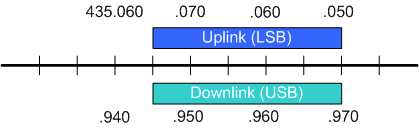
DOWNLINK: 145.960 MHz USB
UPLINK: Tune to match downlink +/- 435.065 MHz LSB
The transponder is linear inverting, nominally 30 kHz wide, and approximately 500 mW output.

If you find the transponder busy on those frequencies, feel free to move around and use the entire transponder passband.

AMSAT-UK FUNcube Mission Patch Rev4 20100609

AMSAT-UK FUNcube Mission Patch

The passband seems to have a “dip” in the middle which is bigger than expected, but we do welcome feedback about the usability. Also, please limit your uplink power, as it looks like this transponder is as sensitive as FUNcube-1. The spacecraft antenna is a monopole, so we would also be interested in signal fading reports.

The commissioning of the transponder done to date is very limited, three activations for 5, 10 and 8 minutes respectively. So your reports are greatly appreciated.

We do understand this is a very short notice, but hope that some of you will be able to participate. This was a take-it-or-leave-it opportunity offered by the ISIS engineers for our consideration, and we are again very grateful to ISIS and VKI for giving us this opportunity.

Please report contacts and signal reports to pa3weg@amsat.org

Wouter PA3WEG
FUNcube Team

QB50p1 EO-79 FUNcube-3 Transponder - Credit Mike Rupprecht DK3WN

QB50p1 EO-79 FUNcube-3 Transponder – Credit Mike Rupprecht DK3WN

Can you help identify this picture ?

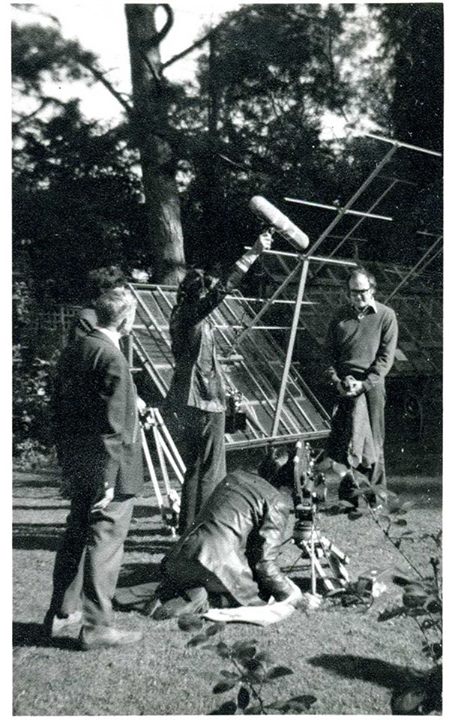
Antenna used in a BBC TV showThe Radio Society of Great Britain (RSGB) have requested help in identifying this picture (click for full size version).

The person on the far right looks rather like the television presenter James Burke.

Could it be possibly be the BBC Tomorrows World TV show from the 1970’s ?

Do you know which programme was being filmed and what was it about ?

It certainly looks satellite related. If you have any thoughts please post them on the RSGB Facebook page at

https://www.facebook.com/theRSGB/photos/a.1428072244150628.1073741830.1425012191123300/1473066029651249/

Another FUNcube transponder!

QB50P1 FUNcube Transponder April 27, 2015 - Credit Mike Rupprecht DK3WN

QB50P1 FUNcube Transponder April 27, 2015 – Credit Mike Rupprecht DK3WN

AMSAT-NL has announced that an initial series of tests of the FUNcube transponder payload aboard the QB50p1 CubeSat have been successfully completed.

QB50p1 is one of two QB50 precursor spacecraft that were launched from Yasny in Russia in June 2014.

QB50p1 and QB50p2 - Image Credit ISIS

QB50p1 and QB50p2 – Image Credit ISIS

The primary science payloads are still being extensively tested but it has now been possible to undertake a short test of the transponder payload as well. The transponder is intended as a long term secondary mission following the initial technology demonstration and de-risking phase.

After spending ten months in space, the transponder was commanded on for short periods during each of the three morning passes over Europe on Monday, April 27, 2015. A number of FUNcube team members in the Netherlands and in the UK were standing by to run through a predefined test plan.

The transponder has a similar performance to that of FUNcube-1 but the passband is nominally 5 kHz wider by design.

It is not yet known when this transponder may be available for regular usage but AMSAT-NL is delighted to be able to report that the hardware is functioning and is very grateful to the QB50 project, the Von Karman Institute and ISIS B.V. for their ongoing support.

More information about the QB50 project can be found at https://www.qb50.eu/

AMSAT-NL http://amsat-nl.org/

AMSAT-UK https://amsat-uk.org/
Twitter https://twitter.com/AmsatUK
Facebook https://www.facebook.com/AmsatUK
Flickr https://www.flickr.com/groups/AmsatUK
YouTube https://youtube.com/AmsatUK
FUNcube Yahoo Group https://amsat-uk.org/funcube/yahoo-group/

2016 launch for UniSat-7 with CubeSats and PocketQubes

UniSat-7 GAUSS Srl

UniSat-7 GAUSS Srl

GAUSS Srl is preparing a Dnepr launch of a new satellite, UniSat-7, into a Sun Synchronous Orbit (SSO), carrying CubeSats and PocketQubes.

The launch is planned for December 2016 and they are currently looking for payload to include in their satellite.

If you are interested in including your own payload you can contact GAUSS Srl to assess the impact on the mission at launch@gaussteam.com there might be space left for your own payload/satellite.

Characteristics of the UniSat-7 mission:
• Total mass: 32 kg
• Sun-Synchronous orbit: (550 – 600 km)
• LTAN: 10:30 (confirmed)

Watch UniSat-7 Satellite
Music by Kostantinos Geradimos, Album Stereofloat, Song Crashed

UniSat-7 http://www.gaussteam.com/satellites/unisat-7/