Tomsk-TPU-120 CubeSat Video

Tomsk-TPU-120 CubeSat - Credit Tomsk Polytechnic University

Tomsk-TPU-120 CubeSat – Credit Tomsk Polytechnic University

The Russian space agency Roscosmos has released a video of the Tomsk-TPU-120 CubeSat commemorative transmission from the International Space Station.

The satellite was developed by students at the Tomsk Polytechnic University to test new space materials technology and is the world’s first space vehicle with a 3D-printed structure. It was launched from Baikonur to the ISS on March 31, 2016 in a Progress-MS-2 cargo vessel. It will be deployed by hand during a future Russian spacewalk (EVA), which is why unlike other CubeSats this one has a handle. The call sign of the satellite is RS4S.

Tomsk-TPU-120 CubeSat Callsign RS4SIn May 2016 the Tomsk Polytechnic University celebrated its 120th anniversary. As part of the celebrations on May 10/11 the Tomsk-TPU-120 was activated in the ISS and transmitted a greeting to Earth inhabitants, recorded by students of the university in 10 languages: Russian, English, German, French, Chinese, Arabic, Tatar, Indian, Kazakh and Portuguese.

The greeting message was transmitted once a minute on 437.025 MHz FM. One of the Kenwood transceivers on the ISS provided a cross-band relay, re-transmitting the signal on 145.800 MHz FM.

The video, recorded in the Russian ISS Service Module, shows the CubeSat and the amateur radio station.

Watch Микроспутник ТОМСК ТПУ 120 на МКС

The next Russian spacewalk appears to be EVA-43 which is expected to take place in early 2017 http://spaceflight101.com/iss/iss-calendar/

World’s First 3D-printed Satellite http://tpu.ru/en/news-events/760/

Dmitry R4UAB operates a WebSDR which you can use to receive the transmissions when the ISS is over Russia http://websdr.r4uab.ru/

Es’Hail-2 Geostationary P4-A Transponder Frequencies

Es'Hail-2 Geostationary P4-A Transponder Frequencies

Es’Hail-2 Geostationary P4-A Transponder Frequencies

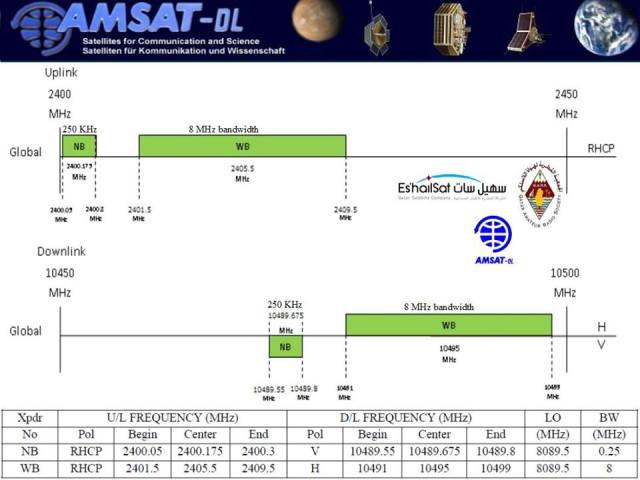
The launch of the Es’Hail-2 satellite into a geostationary orbit at 25.5 degrees East is planned for the 3rd quarter of 2017. The coverage area of the amateur radio Narrowband (NB) and Wideband (WB) transponders should extend from Brazil to Thailand.

Es'hail-2 coverage area

Es’hail-2 coverage area

Es’hail 2 will carry two “Phase 4” amateur radio non-inverting transponders operating in the 2400 MHz and 10450 MHz bands. A 250 kHz bandwidth linear transponder intended for conventional analogue operations and an 8 MHz bandwidth transponder for experimental digital modulation schemes and DVB amateur television.

Narrowband Linear transponder
 2400.050 -  2400.300 MHz Uplink
10489.550 - 10489.800 MHz Downlink

Wideband digital transponder
 2401.500 -  2409.500 MHz Uplink
10491.000 - 10499.000 MHz Downlink

Equipment requirements:

X-Band 10 GHz Downlink:
– 89 cm dishes in rainy areas at EOC like Brazil or Thailand
– 60 cm around coverage peak
– 75 cm dishes at peak -2dB
– NB: linear vertical polarisation
– WB: linear horizontal polarisation

S-Band 2.4 GHz NB-Uplink:
– narrow band modes like SSB, CW
– 5W nominal Uplink power (22.5 dBi antenna gain, 75cm dish)
– RHCP polarisation

S-Band 2.4 GHz WB-Uplink (DATV):
– wide band modes, DVB-S2
– peak EIRP of 53 dBW (2.4m dish and 100W) required
– RHCP polarisation

Presentation on Es’hail by Peter Guelzow DB2OS, President of AMSAT-DL, at the 2013 AMSAT-UK Colloquium http://www.batc.tv/streams/amsat1306

25th anniversary of first UK astronaut

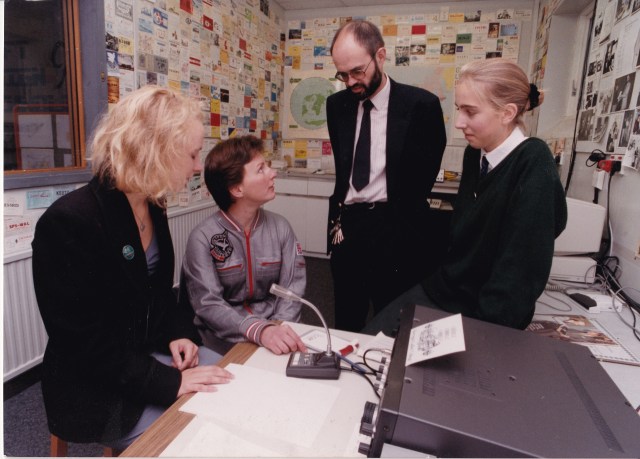
From left to right are Anna-Karin G7IRR, Helen Sharman GB1MIR, Richard Horton G3XWH and Katy G7NST - Image Credit G3XWH

After her return to Earth the first UK astronaut Helen Sharman visited the Harrogate Ladies’ College club station G0HCA From left to right are Anna-Karin G7IRR, Helen Sharman GB1MIR, Richard Horton G3XWH and Katy G7NST – Image Credit G3XWH

On May 20, 1991 Britain’s first astronaut Helen Sharman GB1MIR arrived on the Mir Space Station.

She launched from Baikonur in Kazakhstan on May 18, 1991 arriving at the space station 2 days later. During her 6 day stay on Mir she used amateur radio to linkup with students at 9 schools in the UK.

Using the callsign, GB0JUNO, six students who held Full amateur licences established the initial contact with Helen from the Harrogate Ladies’ College and then passed transmission to the other eight schools involved in the experiment. Katy G7NST asked Helen the first question: “If you had no clock on board Mir, what would give you sense of time in space?”.

In addition to the school linkups Helen also made some random contacts on 2m FM, one of those fortunate to speak to her was Chris Lorek G4HCL.

Read more about the amateur radio side of Helen’s mission and download the RSGB RadCom article about the JUNO project at https://amsat-uk.org/about/history/first-uk-astronaut-helen-sharman-gb1mir/

Astronaut Helen Sharman is appearing at the Science Museum May 21 to talk about her work in space and answer questions from the public https://londonist.com/2016/05/meet-astronaut-helen-sharman-at-the-science-museum

Probable UKHASnet launch May 21/22

UKHASnet LogoJames Coxon M6JCX reports he is hoping to launch a UKHASnet node from East Anglia this weekend.

On the UKHAS Google Group he writes:

I’ve put together a GPS enabled, temperature controlled node AJ2 which will be launched on a latex balloon (rather than pico).

Due to the pattern of the winds the aim will be to float the balloon at around 30-35 km and current predictions suggest that it’ll drift east first then turn around and come back across the UK travelling west. This should give pretty good coverage of the UK and at a push across the sea towards the Netherlands so it would be great if any UKHASnet nodes could be brought online.

The node itself will be in repeater mode as well as transmitting its own packets every 30 seconds with GPS and other data. Previous tests and flights have had a mixture of results, the EMF launch allowed for 65 km downlink range and recent tests on the IoW made a solid 2 way link over 18 km however other flights haven’t been successful. Hopefully the temperature control will stabilise the radio to stop it drifting too much (both on tx and rx) and the node will recalibrate its noise floor etc as well as reset the rx loop of the radio to stop it locking up (a previous issue). The more nodes that we can have online the better (it is even possible to setup an RTLSDR dongle as a UKHASnet gateway)

There will be a backup tracker providing a RTTY downlink on 434.300 MHz (Atlas) which will be uploaded to spacenear.us This will be RTTY, ASCII 7, 425 Hz shift and is an old pAVA R7 board with a RFM22 so be prepared for some drift.

Current plan is to launch around 1100 on Sat 21/05/16 though the window will be the whole weekend and launch will be from Preston St Mary, Suffolk.

Flight data will be on the UKHASnet map https://ukhas.net/map

I’ve made a grafana page for the node
https://grafana.ukhas.net/dashboard/db/21-05-16-balloon-launch-aj2
and as always there will be discussions on #ukhasnet on freenode.

Thanks

James

Useful High Altitude Balloon links https://amsat-uk.org/beginners/balloons/

ÑUSAT-1 SSB/CW Transponder Satellite

LU Satellite Experiment Payload ÑUSAT-1, carrying an amateur radio 435/145 MHz linear transponder and a 436 MHz telemetry beacon, was launched May 30, 2016 at 0317 UT on a CZ-4B rocket from Taiyuan into 500 km 97 degree inclination  polar orbit. With ÑUSAT-1 on the launch was its sister satellite ÑUSAT-2 which has a 437 MHz beacon.

ÑuSAT-1 and ÑuSAT-2 beacons

ÑuSAT-1 and ÑuSAT-2 beacons

UPDATE May 30, 2016 at 1300 UT: ÑUSAT-1 and ÑUSAT-1 launched and deployed successfully, signals reported from both telemetry beacons. Satellogic reports “All Systems: Nominal”.

AMSAT-LU reports both satellites are sending strong TLM on 436.445/437.445 at 9K6/19K2 GFSK. During first few days they are being stabilized, after that the U/V linear transponder will be activated on ÑUSAT-1. A notice will be given on the AMSAT Bulletin Board (AMSAT-BB).

AMSAT Argentina say:

As we quoted when the announcement of the launching of this experiment, Amsat Argentina has been working for several years to keep alive the dream of many Argentine amateurs to get back into Space with their own satellite as a follow-on of the legendary 1990’s LUSAT-1, reaping the benefits of Technological advancement of our days.

We believe technical activities and developments of experiments in near space share the same goals: preserving the human group, enhancing their capabilities as well as disseminate and guiding the education and development of the activity, meanwhile contributing to Space available resources.

Our agreement with Satellogic Enterprises, which already launched three low orbit satellites: Captain Beto, Manolito y Tita, two of which transmit telemetry and data currently in UHF identifying themselves with callsign LU7AA, allowed us to ride a linear analog amateur radio transponder and corresponding antenna aboard one of their next satellite, ÑUSAT-1

AMSAT-LU provides simultaneously, support for this mission and the ÑUSAT-2 mission, by operating one of the control stations at Tortuguitas, Prov. Of Bs.As.

The experiment Amsat-LU developed, evolved from original design of our colleague and partner William, PE1RAH, while electronic adaptation, mechanical and software was made by the LU Satellite Experiment group, mounted on a 10 x 10 centimeters radiating plate, in which components of the power supply as well as a duplexer and dual band antenna where also incorporated.

This set was installed on the Ñusat-1 bus, which supplies power and becomes part of several other experiments this satellite will make.

The transponder receives UHF which is broadcasted in VHF, has a bandwidth of 30 kHz. with an output power of 250 mW.

435.935 ~ 435.965 are LSB/CW uplink passband
145.965 ~ 145.935 are USB/CW downlink passband
145.900 Basic CW Telemetry

Telemetry beacons:
ÑUSAT-1 436.445 MHz 9k6 GFSK
ÑUSAT-2 437.445 MHz 9k6 GFSK

73 AMSAT ARGENTINA

http://www.amsat.org.ar
https://www.facebook.com/Amsat.LU
http://lusex.org.ar
http://amsat.org.ar/pass.htm
info [at] amsat.org.ar

CubeSats with Amateur Radio payloads deploy from ISS

MinXSS-1 and CADRE CubeSats deployed by Tim Peake KG5BVI / GB1SS on May 5, 2016

MinXSS-1 and CADRE CubeSats deployed by Tim Peake KG5BVI / GB1SS on May 5, 2016

Monday, May 16, 2016 saw the deployment of five CubeSats carrying amateur radio payloads.

STM students building antenna to receive data from STMSat-1 - Credit Saint Thomas More Cathedral School

STM students building antenna to receive signal from STMSat-1 – Credit Saint Thomas More Cathedral School

UK astronaut Tim Peake KG5BVI / GB1SS deployed the first two satellites MinXSS-1 and CADRE from the Japanese ISS Kibo module at 1005 UT. The Slow Scan Television (SSTV) satellite STMSat-1, built by Elementary students at Saint Thomas More Cathedral School (STM), was deployed along with the pair of NODES CubeSats built by students at Santa Clara University at 1440 UT.

STM is thought to be the first Elementary school to build their own satellite, even Pre-Kindergarten, Kindergarten, and First Grade students were involved in the project. It is designed to transmit a Robot36 SSTV signal.

UPDATE May 18: STMSat-1 Twitter feed suggests listening 437.000 MHz FM.

UPDATE May 20: STMSat-1 Twitter feed suggests listening 437.800 MHz FM.

CubeSat Frequency Chart - Credit Mike Rupprecht DK3WN

CubeSat Frequency Chart – Credit Mike Rupprecht DK3WN

IARU Coordinated Frequencies:
http://amsat.org.uk/iaru
• STMSat-1 437.800 MHz FM SSTV Robot36
• MinXSS-1 437.345 MHz 9600 bps FSK
• CADRE 437.485 MHz 9600 bps FSK and 3.404 GHz
• NODES 437.100 MHz 1200 bps AX.25 and 2401.2-2431.2 MHz 115.2 kbps spread spectrum FSK

Watch NASA video on the First Elementary School Built CubeSat

How Did 400 Grade School Students Built A Nano-Satellite?
http://jewelbots.tumblr.com/post/134465599599/how-did-400-grade-school-students-built-a

First CubeSat Built by an Elementary School Deployed into Space
https://www.nasa.gov/feature/first-cubesat-built-by-an-elementary-school-deployed-into-space

Deployment of two NODES satellites and STMSat-1

Deployment of two NODES satellites and STMSat-1

STMSat-1
https://twitter.com/STMSAT11
https://www.facebook.com/stmsat1/
https://www.facebook.com/groups/491135804399695/
http://www.stmsat-1.org/

MinXSS CubeSat http://lasp.colorado.edu/home/minxss/

CADRE CubeSat http://exploration.engin.umich.edu/blog/?page_id=961

NODES mission dashboard http://nodes.engr.scu.edu/

School SSTV CubeSat to deploy from ISS
https://amsat-uk.org/2016/03/03/school-sstv-cubesat-to-deploy-from-iss/

MinXSS and CADRE CubeSats ISS Deployment
https://amsat-uk.org/2016/05/14/minxss-cadre-cubesats/

CADRE video – Meet an Aerospace Engineering Student: Prince Kuevor
https://amsat-uk.org/2016/04/21/cadre-cubesat-iss/

Students at Saint Thomas More Cathedral School awaiting deployment of their CubeSat STMSat-1

Students at Saint Thomas More Cathedral School awaiting deployment of their CubeSat STMSat-1