EO-79 CubeSat Update

QB50p1 and QB50p2 - Image Credit ISIS

QB50p1 and QB50p2 – Image Credit ISIS

Wouter Weggelaar PA3WEG has provided this update on the status and plans for QB50p1 – EO-79.

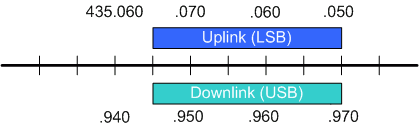
Earlier testing campaigns indicate that the AMSAT-UK/AMSAT-NL transponder on board of this spacecraft is in good health. We have activated the transponder on various occasions for testing purposes.

At the moment we believe the power system is capable of sustaining transponder operations indefinitely. ISIS (the satellite designer and operator) still needs to write and apply a software patch that would keep the transponder running. The current logic in the satellite will switch off the transponder if a reset occurs of the On Board Computer or power system.

Efforts are being made to allow usage of the transponder in the mean time and also allow select command stations to take the satellite out of safe mode if it does reset. ISIS will continue to monitor all telemetry and the satellites health.

QB50p1 EO-79 FUNcube-3 Transponder - Credit Mike Rupprecht DK3WN

QB50p1 EO-79 FUNcube-3 Transponder – Credit Mike Rupprecht DK3WN

The precursor satellites have gathered valuable data about the sensor payloads, and the lessons learnt are being implemented in the flight units for the QB50 main mission.

We will still have to wait until procedures are in place and the activation is cleared by the operator and owners of the satellite, but we are nearly ready for the activation of another transponder!

Transponder activations will be announced on the AMSAT Bulletin Board.

On behalf of AMSAT-NL and the ISIS operations team I would like to thank the community for supporting our mission and thank you for your patience.

73s,
Wouter Weggelaar PA3WEG
AMSAT-NL

EO-79 (FUNcube-3) Transponder Test May 4
https://amsat-uk.org/2015/05/03/eo-79-transponder-may-4/

JE9PEL QB50 CubeSat Spreadsheet

Planet Lab Dove CubeSats leaving the Nanoracks Deployer on February 11, 2014

Planet Lab Dove CubeSats leaving the ISS Nanoracks Deployer on February 11, 2014

The QB50 constellation of  fifty CubeSats should be shipped to the International Space Station (ISS) in December 2016 for subsequent deployment.

QB50p1 and QB50p2 Precursor 2U CubeSats - Image Credit ISIS

QB50p1 and QB50p2 Precursor 2U CubeSats – Image Credit ISIS

The CubeSats are planned to be deployed from the ISS using the Japanese Experiment Module (JEM) and the Nanoracks CubeSat Deployers.

Eight NanoRacks deployers are installed on the Multi-Purpose Experiment Platform (MPEP). Each deployer has a capacity of 6U and so can hold up to six 1U, three 2U or two 3U CubeSats. They are carried by Japanese Experiment Module-Remote Manipulator System (JEM-RMS).

Mineo Wakita JE9PEL has made available a spreadsheet showing the 50 satellites and their frequencies. A copy can be downloaded from the JE9PEL site.

QB50 project https://www.qb50.eu/

QB50 CubeSats to be deployed from ISS
https://amsat-uk.org/2015/09/08/qb50-cubesats-to-be-deployed-from-iss/

Launch of QB50 precursor CubeSats QB50p1 (EO-79) and QB50p2 (EO-80)
https://amsat-uk.org/2014/06/19/successful-launch-of-amateur-radio-satellite-payloads/

January 2014 original QB50 CubeSat launch contract signed
https://amsat-uk.org/2014/01/28/qb50-cubesat-launch-contract-signed/

Mineo Wakita JE9PEL satellite frequency list http://www.ne.jp/asahi/hamradio/je9pel/satslist.htm

Geosynchronous Ham Radio Project Video

A video from the Palomar Amateur Radio Club presents a panel discussion on the AMSAT Phase IV geosynchronous project.

00:00 Introductions
03:00 What is AMSAT Phase IV?? — Overview by Michelle Thompson, W5NYV
Michelle is leading the Phase IV Ground Team
Open source project: RF hardware, antennas, applications, servers, and digital hardware.

05:30 Sponsors and Assistance from AR Clubs, Manufacturers, Universities, and Gov’t Agencies
24:30 Technical Side (How It Works) — Phil Karn, KA9Q
34:30 Downlink (10.45 GHz)
38:30 Uplink (5.6 GHz)
42:00 Black Box
45:00 Question and Answers
57:00 Closing Comments

Watch PARC November Club Meeting – AMSAT Phase IV project

Slides http://www.ntms.org/files/Feb2016/PARC_4on4.pdf

What is a Geosynchronous orbit ? https://amsat-uk.org/satellites/geosynchronous/na-gso-sat/

AAUSAT5 communicates with students on Earth

AAUSAT5 Team in their Control Centre - Credit ESA

AAUSAT5 Team in their Control Centre – Credit ESA

With the help of amateur radio operators, Aalborg University engineering students have established two-way communication with their home-built, ESA-sponsored satellite AAUSAT5.

The European Space Agency (ESA) report:

Deployment of AAUSAT5 and GomX-3 from the ISS Kibo robot arm - Credit NASA, NanoRacks

Deployment of AAUSAT5 and GomX-3 from the ISS Kibo robot arm – Credit NASA, NanoRacks

AAUSAT5 was launched from the International Space Station on October 5, 2015. Following initial difficulties in establishing a two way communication link with the satellite from the control centre in Aalborg and attempts to improve the ground station performance, the investigation revealed that the northern location of Aalborg, relative to the satellite’s orbit, was a contributor to the communication issue. Therefore the project team reached out to ham operators in more southern locations in Europe for help.

Aalborg University sent special equipment down to a German ham radio operator. From his location south of Frankfurt, this operator now acts as the relay station between the student’s control centre in Aalborg and the satellite whenever it passes over Europe. In this way, communication has been established.

Several of the ham radio operators who assisted the AAUSAT5 team have been given the status of external crew members. They are: Mike Rupprecht DK3WN (Germany), Lars Mehnen OE3HMW (Austria), Jan Van Gils PE0SAT (The Netherlands) and Lars-Christian Hauer DJ3BO (Germany).

AAUSAT5 and Deployer - Credit ESA

AAUSAT5 and Deployer – Credit ESA

“Two-way communication is a very big step for the mission. AAUSAT5 can easily be heard in Aalborg via equipment in Germany, and the satellite can receive and respond to commands sent from Aalborg. So we’ve been able to reprogramme the radio transmitter and receiver on board as a first step towards optimizing the connection,” says Associate Professor Jens Dalsgaard Nielsen OZ2JDN, who is supervising the team.

“We celebrated with champagne when we managed both to hear the satellite and send commands to it,” says fourth-year engineering student Anders Kalør from the AAUSAT5 team. Although he admits it was disappointing when they did not initially hear from the satellite, Kalør says that the team never lost heart.

In some ways the communication challenges proved to be a blessing in disguise, forcing the team to work even harder and learn even more. “I’ve learned more about radio communication the past three weeks than in the entire rest of the programme. So as training it has been perfect.” says team member Lasse Bromose.

AAUSAT5, a small satellite of 10cm x 10cm x 10cm with a mass of 1 kg, is one of the first two ESA satellites ever sent into orbit directly from the International Space Station, the other satellite was GomX-3.

AAUSAT5’s main mission is to test an improved receiver for detecting Automatic Identification System signals emitted by ships. The next major goal is to determine whether the satellite is capable of registering ships as planned and, if so, whether it can then relay the ships’ positions down to the control centre.

AAUSAT5’s deployment could be the first in a new programme offered by the ESA Education Office called Fly Your Satellite from the ISS!

Story source ESA
http://www.esa.int/Education/CubeSats_-_Fly_Your_Satellite/AAUSAT5_communicates_with_students_on_Earth

AAUSAT5 http://www.space.aau.dk/aausat5/

ISS Astronauts Link-Up with ITU WRC-15 in Geneva

ARISS contact between 4U1WRC and OR4ISS November 3, 2015

ARISS contact between 4U1WRC and OR4ISS November 3, 2015

The ITU World Radiocommunication Conference 2015 (WRC-15) is taking place in Geneva from November 2-27. On Tuesday, November 3 at 1241 UT there was an amateur radio link-up between WRC-15 and two astronauts on the International Space Station (ISS).

The contact took place using the permanent amateur radio station at the ITU. The station’s normal call sign is 4U1ITU but during the conference the special call sign 4U1WRC is being used.

Students from Institut Florimont were able to use the ITU station to talk to astronauts Kjell Lindgren KO5MOS and Kimiya Yui KG5BPH who were using the  amateur radio station in the ISS Columbus module, call sign OR4ISS.

The Amateur Radio on the International Space Station (ARISS) program established the first permanent amateur radio presence in space 15 years ago. The inaugural ARISS contact took place on December 21, 2000, between a member of the ISS Expedition 1 crew and youngsters at Luther Burbank Elementary School near Chicago. Several pupils and a teacher got to chat using amateur radio with “Space Station Alpha” Commander William “Shep” Shepherd KD5GSL.

Watch ARISS contact with WRC-15 and Institut Florimont

The ARISS program lets students worldwide experience the excitement of talking directly with crew members of the International Space Station, inspiring them to pursue interests in careers in science, technology, engineering and math, and engaging them with radio science technology through amateur radio.

ARISS http://ariss-eu.org/

ARISS Celebrates 1000th Event, 15 Years of Permanent Ham Radio Presence in Space
http://www.arrl.org/news/view/ariss-celebrates-1000th-event-15-years-of-permanent-ham-radio-presence-in-space

RSGB WRC-15 information http://rsgb.org/wrc-15

Radio amateurs to help London children talk to ISS

International Space Station - Image Credit NASA

International Space Station – Image Credit NASA

On Wednesday, November 4 pupils at the Eleanor Palmer Primary School in Camden, London should have the opportunity to speak to an astronaut in space thanks to an Amateur Radio Telebridge link via Australia. The audio will be streamed via the web and Echolink.

ARISS LogoAn International Space Station school contact has been planned with participants at Eleanor Palmer School, London, United Kingdom on Wednesday, November 4. The event is scheduled to begin at approximately 09:51 GMT. It is recommended that you start listening approximately 10 minutes before this time. The duration of the contact is approximately 9 minutes and 30 seconds.

The contact will be a telebridge between astronaut Kjell Lindgren KO5MOS, using the callsign NA1SS from the amateur radio station in the ISS Columbus module, and Martin Diggens VK6MJ in Western Australia. The contact should be audible over portions of Australia and adjacent areas.  Interested participants are invited to listen in on the 145.800 MHz FM downlink.

Audio from this contact will be available via the amateur radio Echolink system on node *AMSAT* (101377) and via the IRLP Node 9010 Discovery Reflector.

Streaming Audio will be able on the web at https://sites.google.com/site/arissaudio/

Audio on Echolink and web stream is generally started around 20 minutes prior to the contact taking place so that you can hear some of the preparation that occurs. IRLP will begin just prior to the ground station call to the
ISS.

Contact times are approximate. If the ISS executes a reboost or other manoeuvre, the AOS (Acquisition Of Signal) time may alter by a few minutes

Eleanor Palmer Primary School, a non-selective community school, is located in central London in the United Kingdom. London is an exciting and dynamic capital city and its schools are the best in the country, attributed to the social and ethnic diversity, excellent local leadership and the quality of teaching.

Eleanor Palmer is a relatively small school of around 220 pupils with single classes of 30 children per year. The youngest pupils are 3 years old and the oldest 11 years old. Due to the central London location it is a highly diverse and inclusive school with staff and children from many different backgrounds.

The pupils achieve highly as judged by national benchmarks. One of the core aims of the school is to inspire in all pupils a love of learning and the desire to continue to learn and they therefore seek to provide a rich and broad curriculum opening minds and creating opportunities. The school hope that their contact with the ISS will inspire pupils to go on to learn more about space through the study of Science, Technology, Engineering and Math.

Participants will ask as many of the following questions as time allows:

1.  What have you seen that is more beautiful than earth?

2.  Who or what inspired you to choose this job?

3.  Does being in space make you feel differently about earth?

4.  What can you learn from the ISS that you cannot learn on earth?

5.  Will normal people who are not astronauts be able to visit space in the ISS one day?

6.  How do you sleep?

7.  Is it quiet up there in the ISS?

8.  When you get back to earth, do you have to re-train your muscles?

9.  Can you call home?

10.  Do you all have to be scientists?

11.  What do you think is the most important things children should know about space?

12.  What time zone do you use?

13.  Do you have plants on the ISS?

14.  What has been your favourite experiment?

15.  How does your brain respond to micro gravity?

16.  How do you wash your clothes?

17.  If you cry in space, with laughter, what happens to your tears?

18.  What do you want to do when you come back to earth?

19.  How do you get enough oxygen?

20.  Is it more scary taking off from earth or returning to earth?

21.  What is your energy source on the ISS?

22.  What does it feel like to be in space?

23.  Is it always dark in space?

Amateur Radio on the International Space Station (ARISS) lets students worldwide experience the excitement of talking directly with crew members of the International Space Station, inspiring them to pursue interests in careers in science, technology, engineering and math, and engaging them with radio science technology through amateur radio. http://www.ariss-eu.org/

A telebridge contact is where a dedicated ARISS amateur radio ground station, located somewhere in the world, establishes the radio link with the ISS. Voice communications between the students and the astronauts are then patched over regular telephone lines.
http://www.ariss-eu.org/ARISS%20Telebridge%20Guidelines.doc

What is Amateur Radio ? http://www.essexham.co.uk/what-is-amateur-radio

Eleanor Palmer Primary School
http://www.eleanorpalmer.camden.sch.uk/news/countdown-to-iss-link-up/
Twitter @eleanorpalmersc