‘Travel’ to Space for £40 / $70

VR2Space Payload Module

VR2Space Payload Module

Researchers from the Surrey Space Centre, University of Surrey have launched a unique campaign that will enable the public to ‘travel’ to space for the cost of a pair of trainers.

VR2Space BalloonVirtual Ride to Space will use cutting-edge virtual technology and a specially designed spacecraft to deliver a three-dimensional, immersive experience, allowing everyone to see what astronauts experience on an ascent to space.

The experience will be created by capturing HD footage of space, via a weather balloon which will carry a cluster of twenty-four HD video cameras to a height of 20km – twice the height of a commercial airplane. During ascent these cameras will capture panoramic footage of the balloon’s journey to space.

Following the flight, specialised software will stitch this footage together to recreate a panoramic view of the space trip. The subsequent space ride will then be viewed using Oculus Rift, a state-of-the-art virtual reality, head-mounted display. The system is designed to deliver high definition 3D virtual environments that can be explored by the wearer, as if they are in space  themselves.

The £30,000 project will be funded by public contributions through the crowd-sourcing funding platform, Kickstarter.

Surrey Space Centre University of Surrey, Guildford

Surrey Space Centre
University of Surrey, Guildford

“Only 530 people have ever travelled to space. For most of us it’s a distant and very expensive dream but this project is about enabling the remaining 99.999992% to see the world like never before,” said lead researcher Dr Aaron Knoll from the University of Surrey.

“Ride to Space will give all aspiring astronauts the chance to be a virtual passenger, riding the balloon to space, and unlike other Galactic flights, it won’t cost the earth to be on board!”

The project team are also developing a smartphone application that will allow users to experience the journey using the phones’ built-in gyroscope and accelerometer data, as well as a computer programme that will allow users to experience space via their PCs.

Investment for Virtual Ride to Space is being sought via Kickstarter. Please visit the Virtual Ride to Space page for more information.
https://www.kickstarter.com/projects/1592839372/virtual-ride-to-space-using-the-oculus-rift

Channel 5 Gadget Show
http://gadgetshow.channel5.com/gadget-show/gadget-news/travel-to-space-with-the-oculus-rift

Facebook https://www.facebook.com/VR2Space

The Bring Your Own Board BYOB CubeSat Workshop and the AMSAT-UK International Space Colloquium take place in Guildford, Surrey on July 25-27, see https://amsat-uk.org/colloquium/colloquium-2014/

ISS Ham Video now installed and ready for commissioning

Front panel of the HamTV transmitter

Front panel of the HamTV transmitter

The Ham Video transmitter was installed in the Columbus module of the International Space Station (ISS) on March 6, 2014 at approximately 10.00 UT.

HamTV Antennas at ARISS Telebridge Station IK1SLD in Casale Monferrato, Italy

HamTV Antennas at ARISS Telebridge Station IK1SLD in Casale Monferrato, Italy

The transmitter was powered on briefly and all control LEDs were nominal. Ham Video is declared ready for Commissioning.
The first Commissioning step is planned March 8, 2014. Using call sign OR4ISS, crew will power on the Ham Video transmitter in configuration 1:

– ARISS antenna 41
– Frequency 2.422 GHz
– Symbol rate 1.3 Ms/s

The transmission will start shortly before the pass of the ISS over Western Europe at approximately 13.27 UT.

Acquisition of signal (AOS) at Matera ground station in south Italy will be at approximately 13.29 UT.

Matera will receive the Ham Video signals with 3 different receivers. The output of each receiver will be web streamed over BATC channels ISS1, ISS2 and ISS3.

The ARISS ground station IK1SLD, located in Northern Italy, will also receive the Ham Video signals and stream the video over BATC channel ISS4.

A basic amateur radio station that should be able to receive HamTV from ISS - Image AMSAT-Italia

A basic amateur radio station that should be able to receive HamTV from ISS – Image AMSAT-Italia

The BATC server is available at http://www.batc.tv/

On BATC you can do the following:

– select ISS
– click on one of the ISS channels
– click on Multi screen selector
– select the channels you wish to watch
– click on Watch.

When multiscreen appears, volume is turned down by default. Turn the volume up using the volume control slider below the image.

During the pass, different configurations will be tested with ARISS antenna 41. After the pass, the Ham Video transmitter will stay powered on in configuration 1 (see above) till the following Commissioning step, which is planned Sunday March 9, 2014 at approximately 12.40 UT.

International Space Station ISS 2011For about 24 hours, the DATV signal will be transmitted permanently, but the camera will be powered off. The reason is, that the camera is battery powered and no provisions are made for frequent battery replacement. This mode is called “blank” transmission.

Sunday March 9, the transmission will start shortly before the pass of the ISS over Western Europe at approximately 12.39 UT.
During Commissioning step 2, different configurations will again be tested, this time with ARISS antenna 43. The Matera ground station and IK1SLD will stream the video over the BATC server.

The plan is to resume blank transmission immediately after the pass over Matera and to continue permanent transmission for one week, till Sunday March 16, 2014. The frequency will remain 2.422 GHz, but antenna ARISS 43 will be used.

Reports on reception of blank transmissions are very welcome. Reports can be filed via this webpage:
http://www.spaceflightsoftware.com/ARISS_FSTV/submit.php

Participants using the Tutioune receiving software, developed by Jean Pierre Courjaud F6DZP, can record as well as stream detailed parameters of the received signal. Please see:
http://www.vivadatv.org/

Thank you for your participation

73,
Gaston Bertels, ON4WF
ARISS Europe chair

Webstream of the TV transmissions http://batc.tv/ch_live.php?ch=4

ARISS-EU HamTV Bulletins http://www.ariss-eu.org/

HamTV https://www.facebook.com/Hamtvproject

Two Close Calls For ZACUBE-1 CubeSat

ZACUBE-1, FUNcube-1 and HiNCube in the deployment pod - Image credit Wouter Weggelaar PA3WEG

ZACUBE-1, FUNcube-1 and HiNCube in the deployment pod – Image credit Wouter Weggelaar PA3WEG

The amateur radio ZACUBE-1 satellite, launched with FUNcube-1 on November 21, 2013, recently had two close encounters with space debris. The ZACUBE-1 team have issued this press release:

CPUT ZACUBE-1 TshepisoSat

CPUT ZACUBE-1 TshepisoSat

Week nine of the year will go down as quite an eventful week for ZACUBE-1 (TshepisoSat), literally dodging two bullets involving speeds in the kilometres per second range.

The first close approach notification arrived the morning of 25 February 2014 from the United States Joint Space Operations Center (JSpOC) through the The South African National Space Agency (SANSA) (A close approach notification is generated by the JSpOC to warn spacecraft operators when their spacecraft will come in close proximity to another object). The first order of business was the identification of the other object. In this case “SCC# 21422″. Our dance of death would be with the, now defunct, 2000 kg Russian built COSMOS 2151 launched in 1991. As ZACUBE-1 carries no propulsion system and with the COSMOS 2151 no longer functioning the only course of action was to closely monitor the situation.

TShepisosat ZACUBE-1 prior to being shipped to the Netherlands

TShepisosat ZACUBE-1 prior to being shipped to the Netherlands

It was determined that the close approach event would occur over the Antarctic and a search was started for possible ground stations that could listen for signals from ZACUBE-1 directly after the event. Help arrived in the form of our friends from the California Polytechnic State University in San Luis Obispo, California, United States. The Cal Poly ground station would see ZACUBE-1 approximately 30 minutes after the event and be able to listen for its transmitted telemetry beacon signal. In preparation ZACUBE-1 would be tracked and checked on the last two passes over South Africa (22:50 SAST 26/02/2014 and 00:26 SAST 27/02/2014) a few hours before the event to ensure that everything was OK and then again by the Cal Poly station.

With everything checking out and all systems nominal on the last pass over South Africa all we could do was wait for news from California.

Great success! With Cal Poly confirming that ZACUBE-1 was alive and well. We were able to further confirm this on the first pass over South Africa.

ZACUBE-1 TshepisoSat HF beacon antenna deployment unit - Image credit CPUT

ZACUBE-1 TshepisoSat HF beacon antenna deployment unit – Image credit CPUT

This would have been enough excitement for the week, but soon after verifying that ZACUBE-1 was OK we received our second close approach notification! This time involving a piece of debris from a METEOR 2-5 satellite. The plan would be much the same, but with the event taking place over Brazil we tried to make contact with some stations in Brazil. Unfortunately nothing was heard over Brazil, but we received notification of ZACUBE-1′s signal from the University of Florida and again from the California Polytechnic State University.

We would like to thank everyone that helped out during this time, hopefully I did not leave anybody out. The folks from Cal Poly, University of Florida, the Brazilian radio amateurs that tried on very short notice and SANSA.

ZACUBE-1 carries a UHF beacon on 437.345 MHz and an HF beacon on 14099 kHz used to characterise the Superdarn antennas at the Antarctic which study the ionosphere.

ZACUBE-1 information
http://www.cput.ac.za/fsati
and
http://www.amsatsa.org.za/

First image captured by TshepisoSat (ZACUBE-1)
https://amsat-uk.org/2013/12/15/first-image-captured-by-tshepisosat-zacube-1/

FUNcube-1 (AO-73) 100+ days in orbit

FUNcube-1 (AO-73) Spin Period

FUNcube-1 (AO-73) Spin Period

Last weekend FUNcube-1 (AO-73) reached the milestone of having been in space for 100 days – actually that should be clarified to mean “terrestrial” days as the spacecraft itself has been subjected to more than 1500 day/night cycles during this time.

FUNcube-1 (AO-73) - Image credit Wouter Weggelaar PA3WEG

FUNcube-1 (AO-73) – Image credit Wouter Weggelaar PA3WEG

We are very grateful to the 500+ stations who have been providing FUNcube-1 telemetry data to our Data Warehouse. We now have more than 1GB of data in the repository – this is an amazing effort and achievement from a spacecraft which is only transmitting at 1200bps. Thanks everyone and please keep it coming:)

From all the telemetry we can see that the spin rate decreased for a time but now is speeding up again. External temperatures span a range of 50C between the end of the sunlit phase and the end of the eclipse period. Even inside the spacecraft the temperatures range over 25C.

All the subsystems continue to work well and are “well in the green”.

Scintillation MapThe increased solar activity is certainly having an effect on the downlinked signal on many occasions. During such disturbances the signal appears to be being affected by ionospheric scintillation which distorts the BPSK stream and makes decoding much harder for some minutes at a time.  This effect is not just apparent near the magnetic poles as can be seen in this paper:  http://waas.stanford.edu/papers/IWG/sbas_iono_scintillations_white_paper.pdf

Users in the Northern hemisphere will have noticed that the evening passes in amateur mode are becoming shorter as the spacecraft enters sunlight again near the pole. This effect will increase as the season progresses and we will be testing a plan to change the operating schedule in a few weeks time. This test will involve placing the spacecraft into continuous amateur/transponder mode for a number of orbits – probably over a weekend.

Especially for educational users of FUNcube, we have placed all our schools outreach material on one page for easy reference. It can now all be found here: http://funcube.org.uk/education-outreach/

OSCAR-11 / UoSAT-2 Celebrates 30 Years in Orbit

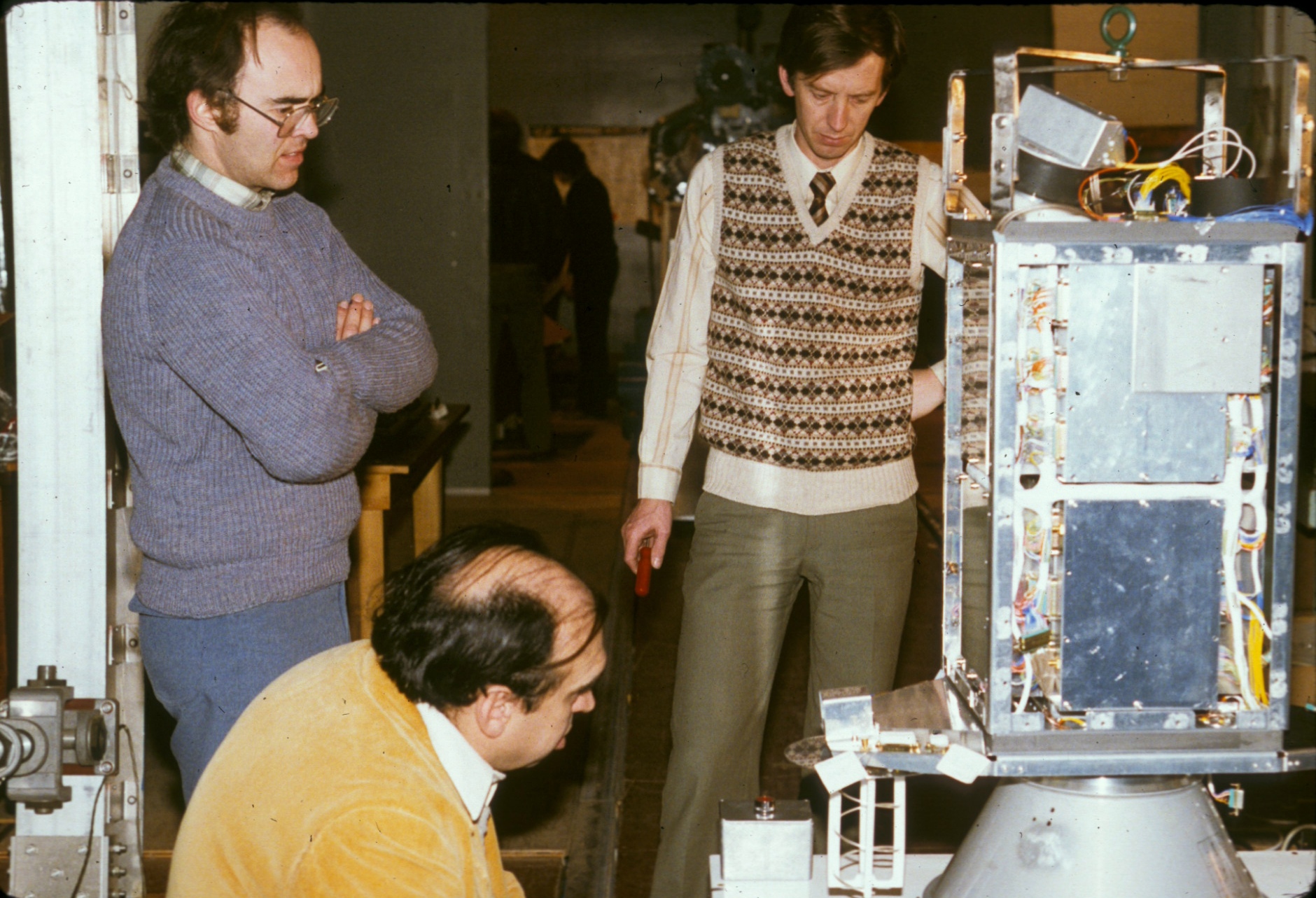
UOSAT-2 / OSCAR-11 with Dave Brock UoS kneeling, Christine Sweeting G6APF and Neville Bean G8NOB

UoSAT-2 / OSCAR-11 with Dave Brock UoS kneeling, Christine Sweeting G6APF and Neville Bean G8NOB

UoSAT-OSCAR-11 has now been in orbit for 30 years and remarkably its signal on 145.826 MHz FM (AFSK 1200 bps ASCII) is still being received.

UOSAT-2 / OSCAR-11 1984 Martin Sweeting G3YJO and Dave Bocks UoS standing

UoSAT-2 / OSCAR-11 Martin Sweeting G3YJO and Dave Bocks UoS standing

UoSAT-2, also known as UoSAT-OSCAR-11 or UO-11, was the second satellite designed and built by a team of engineers at the University of Surrey in Guildford, Surrey, UK and was the successor to UoSAT-1 / UoSAT-OSCAR-9 (see Hobby Electronics August 1981). It was launched from the Western Test Range at Vandenberg Air Base, in Lompoc, California along with LANDSAT-5 on a Delta 3920 rocket on March 1, 1984.

UO-11 was the most rapidly designed OSCAR, going from inception to launch in only five months. It was also the first amateur satellite to carry a digital communications package into Earth orbit, and the first to be controlled by a CPU running software written in the high-level programming language “Forth”.

UOSAT-2_OSCAR- 11UO-11 carries beacons in three amateur radio bands.

The 145.826 MHz beacon transmits FM Audio Frequency Shift Keying (AFSK) 1200 bps ASCII data. It the early years it also transmitted a voice message from the digitalker experiment.

The 435.025 MHz beacon transmitted either 1200 bps FM AFSK or 4800 bps PSK data. This beacon was used to downlink information from the Digital Store and Readout (DSR) Experiment, which includes CCD Earth image data, results from the Particle Wave Experiment, and engineering data from the RCA COSMAC 1802 CPU.

The 2401.5 MHz beacon transmitted FM and PSK signals. Antenna polarization for all three beacon transmitters is left-hand circular (LHCP). Only the 145.826 MHz beacon is now operational.

Read Usenet messages from 1984 about UoSAT-B / UoSAT-2

Martin Sweeting G3YJO listening to the UO-11 Digitalker

Martin Sweeting G3YJO listening to the UO-11 Digitalker

Information compiled by Clive Wallis G3CWV
https://web.archive.org/web/20150413193503/http://g3cwv.co.uk/oscar11.htm

UO-11 page on the DK3WN satellite blog at http://www.dk3wn.info/p/?cat=47

SSTL Blog – Happy 30th Birthday to UoSAT-2
http://www.sstl.co.uk/Blog/March-2014/Happy-30th-Birthday-to-UoSAT-2-

OSCAR-9 and OSCAR-11 TV News Reports
https://amsat-uk.org/2011/10/30/oscar-9-and-oscar-11-tv-news-reports/

BBC Micro ASTRID UoSAT receiver and AMSAT-UK Software Library
https://amsat-uk.org/2011/12/11/bbc-micro-and-amsat-uk-software-library/

UOSAT_OSCAR-11

Galileo GPS closes down 23cm ATV Repeater DB0QI

AMSAT-UK Logo

AMSAT-UK Logo

The new Galileo GPS system that broadcasts across 1260-1300 MHz has resulted in the closure of a German ATV repeater.

The DARC report the Munich ATV repeater DB0QI has been closed down due to it jamming the Galileo Satnav Control Centre.

DB0QI was located 18 km from the Galileo GNSS receiver, another repeater that has been shut down is DB0ITV which was located 55 km from the receiver. It is believed both repeaters were running about 15 watts ERP.

DARC in Google English http://tinyurl.com/GermanyDARC

A 2006 Galileo GPS article by Peter Blair G3LTF highlighted the problems this system could cause, see
http://www.southgatearc.org/articles/galileo.htm

The Amateur Satellite Service has an important allocation at 1260-1270 MHz for Earth-to-Space (Uplink) communications. The Amateur Satellite Service has already seen its allocations at 2.4 and 5 GHz rendered unusable in urban areas due to WiFi and other licence exempt devices. The Amateur Satellite Service does not have any other global spectrum allocations in the key 915 MHz to 6 GHz region.

While the German announcement may relate to a single Galileo command station being used to test the initial satellites it clearly raises concerns about what will happen in a few years time when the full Galileo constellation is deployed and 1260-1300 MHz GPS units are in widespread use.