ISS Columbus Module VHF Radio Discussed at ARISS Meeting

International Space Station

In the July 17 ARISS meeting Kenneth Ransom N5VHO reported that his group is in the final stages of preparing the certification for flight of the replacement hardware for the degraded Ericsson VHF [145 MHz] radio.

The Ericsson rig is part of the second ISS amateur radio station that is located in the Columbus module.

The team had hoped for a launch of the equipment on flight 33-S [Dec. 5], but it may be launched on flight 49-P [Nov. 1], which is a month sooner than 33-S. The team is endeavoring to finish the certification in time for this earlier flight option. The degraded Ericsson VHF radio may be returned on flight 32-S in October. The team is very interested in trying to determine what the problem has been with this radio.

Read the minutes of the July 17 ARISS meeting at http://ariss.rac.ca/arisstel2012-07-17.htm

OSSI CubeSat to Launch in December

Funds for the OSSI CubeSat have been raised by selling T-shirts

The amateur radio CubeSat OSSI is planned to launch in December according to an Antara News article. [UPDATE rocket launch has been delayed and may now be April 2013]

The article describes how Korean artist Hojun Song DS1SBO developed his own home made satellite and says radio operators will be able to communicate with the satellite. If all goes well, it will repeat a message in Morse code using its LED lights at a set time and location.

The DIY satellite OSSI is planned to launch on a Soyuz-2-1b from the Baikonur launch facility in Kazakhstan in December with the Bion-M 1 and Dove 2 satellites. (The Dove 2 CubeSat will transmit images on a 2.4 GHz downlink). The satellites will be placed into an orbit with an apogee of 575 km, perigee of 290 km and inclination of 64.9 degrees. They are expected to remain in orbit for about a year before burning up on re-entry into the Earth’s atmosphere.

The OSSI uplink is in the 145 MHz band and the downlink in the 435 MHz band.

Read the Antara News story Homemade Korean satellite to go boldly into space
http://www.antaranews.com/en/news/83628/homemade-korean-satellite-to-go-boldly-into-space

Read the Telegraph newspaper article South Korean artist set to launch homemade satellite http://www.telegraph.co.uk/news/worldnews/asia/southkorea/9428047/South-Korean-artist-set-to-launch-homemade-satellite.html

Daily Mail newspaper Watch out, Nasa! Korean launches $500 satellite built from scavenged parts – and could kick off a DIY space race http://www.dailymail.co.uk/sciencetech/article-2179151/DIY-space-race-South-Korean-artist-launches-500-satellite-built-scavenged-parts.html

The Times of India Artist makes satellite at home in just $500 http://timesofindia.indiatimes.com/tech/personal-tech/computing/Artist-makes-satellite-at-home-in-just-500/articleshow/15162830.cms

BBC TV report South Korean artist has high hopes for his homemade satellite http://www.bbc.co.uk/news/world-asia-19007475

Open Source Satellite Initiative (OSSI) http://opensat.cc/

OSSI CubeSat – Ground Station Video http://www.uk.amsat.org/7218

OSSI Art CubeSat to Launch in August http://www.uk.amsat.org/6993

Korean artist Hojun Song DS1SBO creator of the OSSI CubeSat

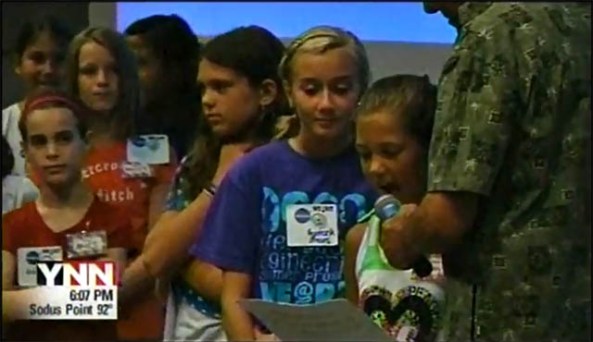
Video of TV News Report on ISS Contact

Engineers of the future talk to the International Space Station using Amateur Radio

YNN (channel 9) reports on an “out of this world” amateur radio contact between campers attending RIT’s Everyday Engineering Program in Rochester and astronaut Sunita Williams KD5PLB

Sunita was operating the Kenwood TM-D700 ham radio station located in the International Space Station’s Service Module using the callsign NA1SS on 145.800 MHz. The Everyday Engineering Program station at the Rochester Institute of Technology had the callsign W2RIT.

The Women in Engineering Program at Rochester Institute of Technology (WE@RIT) is dedicated to increasing the representation of women engineers and women leaders within the engineering profession. Founded in 2003, WE@RIT strives towards achieving gender parity within the Kate Gleason College of Engineering and hosts a comprehensive series of pre-engineering outreach, recruitment, and community building programs in support of this vision.
http://www.rit.edu/http://www.rit.edu/

Watch RIT on TV News: Chat with International Space Station
http://www.youtube.com/watch?v=wDvQnA4WTxI

Working the ISS

Wendy Quinn W1DY explains how to go about hearing and talking to the International Space Station (ISS).

The video shows the ISS frequencies used in most of the world, uplink 144.490 MHz, downlink 145.800 MHz, however, in IARU Region 1 (Europe/Africa) the uplink is 145.200 MHz. So just tune to 145.800 MHz and activate the standard -600 kHz repeater shift.

Watch ISS

The current location of the ISS and the status of its amateur radio stations can be found at http://www.issfanclub.com/

Listening to the International Space Station http://www.uk.amsat.org/3491

Amateur Radio Lunar Rover

Google X-Prize Team – Part-Time Scientists

It’s 43 years since Apollo 11 landed on the moon. Now a group of volunteer hackers and engineers are about to send a privately-built amateur radio rover to the Moon.

Part Time Scientists Lunar Rover

Writing on ZD-Net Simon Bisson tells how the Part-Time Scientists team aim to win the Google Lunar X-Prize by landing their lunar rover on the Moon.

Simon says the Part-Time Scientists are putting together a cloud-linked global communications network [COMRAY] to handle radio links to their lander and rover (using amateur radio bands), there’s still too much lag in the system to deliver a hands-on driving experience. The rover needs to have some smarts in order to process information about its environment, while still handling input from a driver on Earth.

Read Simon Bisson’s article Home-brew hackers cook up Europe’s return to the Moon
http://www.zdnet.com/europes-return-to-the-moon-7000001306/

Watch Part-Time Scientists testing their Lunar Rover

Part-Time Scientists http://www.ptscientists.com/

Deep Space Communications Array (COMRAY) (Project Leader Michael Doornbos N4LNX of Evadot) http://www.comray.net/

Google Lunar X-Prize http://www.googlelunarxprize.org/

Tethersat-1 & 2 to test Electrodynamic Tether Propulsion

Illustration of the EDT concept – image Wiki


The amateur radio satellite Tethersat is a 3U CubeSat that splits into two joined by a 1 km tether to test electrodynamic tether propulsion.

Both spacecraft will use 9600 bps AX25 GFSK packet downlinks on UHF. A launch is planned on ORS-3 in July 2013 from the Wallops Flight Facility on Wallops Island, Va.

Electrodynamic tether propulsion propulsion has the potential to make space travel significantly cheaper. It is a simplified, very low-budget magnetic sail. It can be used either to accelerate or brake an orbiting spacecraft. When direct current is pumped through the tether, it exerts a Lorentz force against the magnetic field, and the tether accelerates the spacecraft.

Potentially this technique could be used to raise the orbit of a satellite from 600 to 1000 km using a Ward Spiral maneuver. See the 2009 paper Tethered Satellite Dynamics, Mission Design and Applications by Chadwick Healy http://ccar.colorado.edu/asen5050/projects/projects_2009/healy/

Wiki http://en.wikipedia.org/wiki/Electrodynamic_tether

IARU Satellite Frequency Coordination Panel status http://www.amsat.org.uk/iaru