New OSCAR-7 DX Record

Wyatt AC0RA and Bill OM3BD have broken the AMSAT-OSCAR-7 (AO-7) long distance (DX) record set in 2010.

Their GPS-measured 7849km QSO between grid squares EN31vx and JN88mf surpassed the prior 7843km record set by PY5LF and K3SZH in 2010.

Bill says that Wyatt did all the hard work by waking up at 3am, driving to a hill an hour away from his home, setting up his station, and working Bill before sunrise at 0955 UT on July 2.

Bill was running an FT847, 2 x 10 element yagi on 2m with SP2000 preamp, and an 8 element yagi for 70cm while Wyatt had an FT-847, a 7 element yagi on 2 meters and a 12 element yagi on 70cm.

It appears that an even longer distance is attainable, and Wyatt is looking for a suitable place from which they can try before Bill leaves Slovakia in mid-July.

Further information, pictures and recordings of the contact are at http://www.qsl.net/nz5n/AO7record.htm

2010 PY5LF and K3SZH AO-7 distance record http://www.southgatearc.org/news/january2010/new_ao7_record.htm

10th Anniversary of OSCAR 7′s Return To Life http://www.uk.amsat.org/8524

// < ![CDATA[
// < ![CDATA[
//

Unveiling of Florida Student CubeSat SwampSat

The amateur radio SwampSat satellite, built by students at the University of Florida (UF) was recently unveiled.

Its downlink will use 1200 bps AX25 packet radio on 437.385 MHz with 1 watt of RF.

The team are planning on a December 2012 launch on the SpaceX Falcon 9 into a 450 km orbit with an inclination of 45 degrees. [Update: SwampSat launched on Minotaur-1 on November 20, 2013]

Watch SwampSat Unveiling

SwampSat on TV News http://www.amsat-uk.org/?p=8464

SwampSat – Florida’s small satellite programs brings STEM jobs
https://www.facebook.com/media/set/?set=a.10150734814267248.435445.121264742247&type=3

UF shows off its small satellite http://www.gainesville.com/article/20120406/articles/120409715

Gator Amateur Radio Club http://www.gatorradio.org/

University of Florida Small Satellite Design Club (SSDC) http://www.ufsmallsat.com/

//

Amateur Radio TV and CW Beacons for ISS

The minutes of the ARISS International Monthly Teleconference for June 19 carry this report on the status of the amateur radio equipment for the ISS Columbus module.

Kenneth [N5VHO] reported that an onboard power issue somewhat impacted ARISS radio operations. The air purifier for the ATV [Automated Transfer Vehicle] has needed to be plugged in, recently, in the Service Module (SM). The ARISS radio in the SM was turned off while the purifier was being used. The radio is turned on by the crew for school contacts and when the crew gets on the air for random contacts, as Astronaut Kuipers has done in the past few weeks. The ATV will be docked at the ISS until late September.

Gaston [ON4WF] said the HamTV project is progressing. There have been discussions with ESA about the possibility of adding extra units to the HamTV transmitter that is being developed by Kaiser Italia. This is acceptable in as far as the KI unit under construction does not need to be modified.

A so called “Video Beacon” will be added externally to the HamTV unit. This beacon will allow automated DATV transmissions more or less permanently. The content of these DATV transmissions will be uploaded from the ground through existing channels and transferred to the Video Beacon on request. This function will also be used for educational purposes. Moreover, astronauts could record footage and load it into the Video Beacon for automated transmission.

Another additional unit will be a CW beacon transmitter delivering a small band low power signal (100 mW) on a frequency nearby the HamTV frequency. This beacon will transmit permanently and use the second ARISS L/S-band antenna. This offers ground stations signal reception with large S/N margins, facilitating antenna tracking and signal acquisition, especially at the beginning of a pass. The CW Beacon will transmit telegraphy signals, alternating its identification (call sign), a continuous carrier and possibly some telemetry comprizing onboard parameters (temperature, pressure, humidity, ambient sound level, etc.).

Lou W5DID suggested that we may be able to power it from the packet module already on the ISS, making it simple to operate.

ESA is being asked to address the cost of the Safety Package and testing such as EMI tests and outgassing tests for these additional units, but development and manufacturing will be supported by ARISS. A cost estimate is being developed for our team to build the units. A funding campaign will be set up to collect donations to cover the cost.

Amateur Radio on the International Space Station (ARISS) http://ariss.rac.ca/

// < ![CDATA[
//

KiwiSAT hoping for launch mid-2013

The development of the amateur radio satellite KiwiSAT is completed and it is now ready for a LEO launch.

It carries a 435 or 1268 MHz to 145 MHz  linear transponder for SSB/CW operation.
* Transmit Power: 2 Watts PEP.
* Beacon frequency: 145.885 MHz
* Uplink: (U-Band) 435.265 to 435.235 MHz LSB or
* Uplink: (L-Band) 1268.880 to 1268.850 MHz LSB
* Down link: 145.850 to 145.880 MHz USB

The KiwiSAT website says the team have been in discussion with ISC Kosmatras for a DNEPR launch. They hope the satellite will be launched mid-2013.

The KiwiSAT team released a status update which can be read at http://www.kiwisat.org/status.html

In addition to the transponder KiwiSAT also carries an Atitude Determination And Control (ADAC) experiment developed by students at Massey University.

Read the article Massey students create space satellite software at http://www.massey.ac.nz/massey/about-massey/news/article.cfm?mnarticle_uuid=238ABC1A-FC7C-B944-8CC0-987538B6B665

KiwiSAT http://www.kiwisat.org/

AMSAT-ZL http://www.amsat-zl.org.nz/

// < ![CDATA[
// < ![CDATA[
// < ![CDATA[
// < ![CDATA[
// < ![CDATA[
// < ![CDATA[
//

New CAMSAT Satellite CAS-2

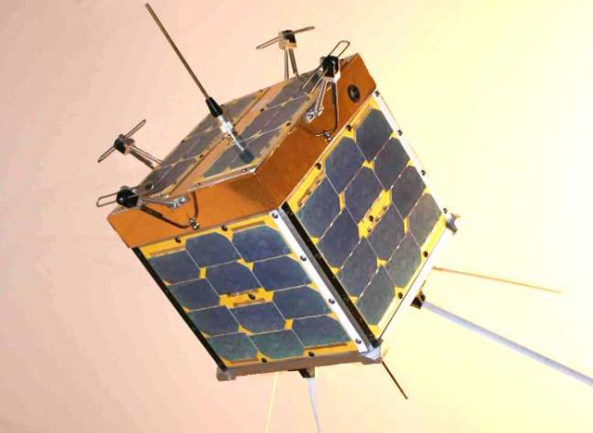
CAMSAT CAS-2 at Friedrichshafen Ham Radio 2012 Event – Image Credit ARRL

The first CAMSAT amateur radio satellite CAS-1 (aka XW-1, HO-68) carried a linear transponder and proved very popular with radio amateurs world-wide.

Fan Shaomin BA1EO with CAS-2 A1

Fan Shaomin BA1EO with CAS-2 A1

CAMSAT and students at the Qian Youth Space Academy have been working on the next satellite CAS-2.

The launch of CAS-2 is planned for 2014 into a 1000 km orbit with an inclination of 12 degrees. This orbit means it may not be receivable in those countries at high latitudes.

It is understood that most of the room in CAS-2 will be taken up by the primary (non-amateur) payload and it has only been possible to fit a single channel FM amateur transponder in the satellite.

The announcement of May 20 indicates that two separate CAS-2 satellite structures are being built – A1 and A2.

Further information in Google English can be seen at http://tinyurl.com/CAMSAT-CAS-2-Satellite

The CAMSAT delegation to Ham Radio 2012 in Friedrichshafen was led by Gong Wancong BA1DU. A group picture taken at the CAMSAT and AMSAT-DL stands and a picture of the engraved glass plaque that CAMSAT presented to AMSAT-DL can be seen on the AMSAT Deutschland Facebook page at https://www.facebook.com/media/set/?set=a.420116544697800.90571.168177559891701&type=3

Randy Hall K7AGE visited Beijing in March 2008. Among the people he visited was Fan Shaomin BA1EO.

Watch Randy’s video which provides an insight into amateur radio in Beijing. The BA1EO visit is at 12:55

Read more about Ham Radio in that part of the world from Larry’s, KH6ITY, article at ARRL – http://www.arrl.org/news/cq-china

ARISS unable to do Beijing contacts http://tinyurl.com/ARISS-Cancel-Beijing

F-1 CubeSat Delivered to Tsukuba Space Center

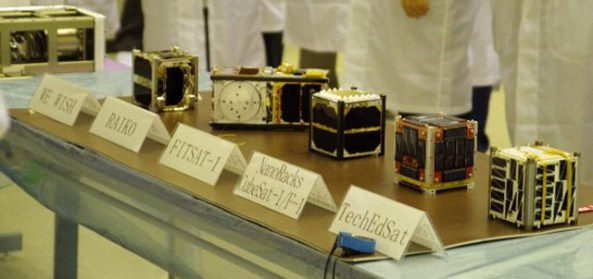
CubeSats ready for HTV-3 Launch – Image Credit Koumei Shibata

The amateur radio CubeSat F-1 built by students at the FPT University in Hanoi, Vietnam has now been delivered to the Tsukuba Space Center in Japan.

F-1 CubeSat – Image Credit Koumei Shibata

F-1 and the other four CubeSats  (RAIKO, WE WISH, FITSAT-1 and TechEdSat) will be integrated with the small satellite deployer J-SSOD before leaving for Tanegashima launch pad.

The CubeSats should be launched to the International Space Station (ISS) on July 21 in the HTV-3 cargo vessel.  It is planned that they will be deployed from the ISS in September by Japanese astronaut Akihiko Hoshide KE5DNI using the Kibo robot arm.

F-1 carries a low-resolution camera (640×480), a 3-axis magnetometer and two Yaesu VX-3R transceivers using 145.980 and 437.485 MHz.

See the story on the FPT University website http://tinyurl.com/FTP-F-1-To-Launch

Further pictures of the CubeSats by Koumei Shibata can be seen at http://fspace.edu.vn/?p=633

An NHK TV News video showing the CubeSats shows the LED’s on FITSAT-1 that will be used to flash Morse Code from space. See http://www3.nhk.or.jp/news/html/20120625/t10013095191000.html

For the latest news on F-1 see the FSpace website http://fspace.edu.vn/

Video depicting F-1 CubeSat XV1VN deployment from the ISS http://www.uk.amsat.org/?p=8446

Vietnam Student CubeSat F-1 http://www.uk.amsat.org/?p=5025