Hey, kids! Send your stuff into orbit

International Space Station

Wanna do some space science? You no longer have to be a professional researcher, or even a grown-up, to get your experiment into orbit.

MSNBC reports that a new program called DreamUp is offering slots on the International Space Station’s experimental racks to school groups for as little as $15,500 a pop, and you can use credit-card reward points to help cover the cost.

“We are committed to lowering the barriers for entry to space research,” Jeffrey Manber, managing director of NanoRacks, said in a news release announcing the program. “This is a double win. This first-of-its-kind student experiment donation platform will help create a world-class experience for students.”

Read the full MSNBC story at http://cosmiclog.msnbc.msn.com/_news/2012/06/15/12245222-hey-kids-send-your-stuff-into-orbit

Spacelab – STS-50 Mission 1992 Video

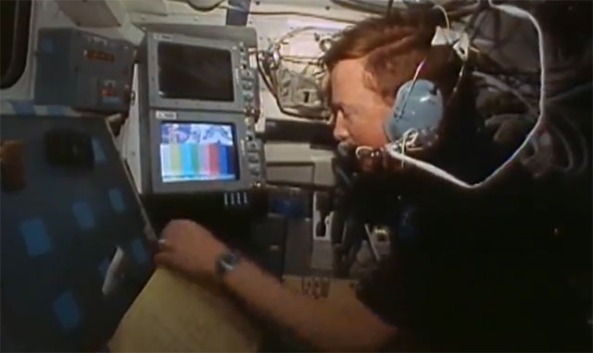
Richard Richards KB5SIW Receiving SSTV on Space Shuttle STS-50

Richard Richards KB5SIW Receiving SSTV on Space Shuttle mission STS-50

The 1992 space shuttle STS-50 mission was the first time that astronauts received an amateur radio fast-scan television video. It was sent by the ham radio club station W5RRR at the Johnson Space Center (JSC).

Narrated by the Commander and crew, this video contains footage selected by the astronauts, as well as their comments on the mission. Footage includes launch, onboard crew activities, and landing.

The amateur radio aspect of the mission gets a mention at 11:32 into this video.

Watch Space Shuttle STS-50 Columbia Spacelab USML pt1-2 Post Flight Press 1992 NASA

Watch Space Shuttle STS-50 Columbia Spacelab USML pt2-2 Post Flight Press 1992 NASA

Video of Jay Leno – SAREX – Shuttle Amateur Radio Experiment 1992 http://www.uk.amsat.org/?p=8172

Vintage Spacelab 2 video featuring Amateur Radio http://www.uk.amsat.org/?p=7639

Vintage Videos of STS-9 Columbia Mission and Spacelab http://www.uk.amsat.org/?p=7265

Shuttle Amateur Radio experiment (SAREX) past missions

Astronaut Radio Hams http://www.w5rrr.org/ astros.html

ArduSat Arduino CubeSat Update

The NanoSatisfi team is building an Arduino CubeSat ArduSat. On this satellite they plan to put up to 5 Arduino’s and plug in 50+ sensors into them as well as 2 optical and 1 IR camera.

Once the satellite is on orbit they aim to give access to the general public/citizen scientists to the payload (Arduinos, sensors and camera) to upload their own scientific experiments.

The team want to capture the attention of the DIY community, hackers and makers, amateur astronomers and in general those interested in space exploration and the next frontier.

Sensor wise they have so far magnetometers, O3 sensors, GPS , gyros, plasma sensors, photometer, thermometer, pressure sensor, space radiation (bitflip) sensor, Geiger counter and 2 optical and 1 IR camera etc. The idea is that people can rent scientific packages for a week, during the week they run their experiment the team will send data constantly back to them to analyze.

Imagine general public, including teachers having access to experiment platform in space for a couple of hundreds of dollar and they analyze data and engage students, friends etc., it could revolutionize the way people see space and perceive space exploration.

The team are also looking for feedback from people interested in the project and want to hear ideas on sensors and experiments!

Watch ArduSat Kickstarter Video

Watch Sensor prototype demo

Watch The DISCOVER Space Challenge & ArduSat: Invent an experiment and run it in space!

Watch SciStarter & Science Cheerleader Join ArduSat as Community Partner

NanoSatisfi was founded by Austrian-born Peter Platzer a former high-energy physicist (CERN), former Hedge Fund Quantitative Trader, avid HP-41 hacker and Arduino enthusiast, along with Belgian aerospace engineer Jeroen Cappaert intern at NASA Ames Research Center, Canadian aerospace engineer Joel Spark intern at EADS Astrium and Hungarian Reka Kovacs intern at NASA Ames Research Center working on alternative methods of public outreach for space science. The four founders met at the International Space University in Strasbourg and thought that they could do something to provide affordable, open-source space exploration for everyone.

Check out the ArduSat Kickstarter page here:
http://www.kickstarter.com/projects/575960623/ardusat-your-arduino-experiment-in-space

SimpleSat Look Down satellite tracking software now available

SimpleSat Look Down is a free easy to use software app for satellite tracking.

Written by Tom Doyle W9KE it includes a satellite look down window that displays the view from the satellite looking down at the earth as it moves along.

It uses .NET 4 and runs on Windows 8, Windows 7, Vista and XP.

Tom has released this collection of videos that explain how SimpleSat Look Down works:

Watch SimpleSat Look Down – best viewed full screen HD

Watch SimpleSat Look Down – Setup  – Best Viewed Full Screen HD

Watch SimpleSat Look Down – General Operation – Best Viewed Full Screen HD

Watch SimpleSat Look Down – Rotor Setup – best viewed full screen in HD

You can download SimpleSat Look Down from
http://www.tomdoyle.org/SimpleSatLookDown/SimpleSatLookDown.html

F-1 CubeSat is scheduled for launch in July, 2012

Latest update on F-1 CubeSat project:

At the moment, the flight safety review is coming to an end. The FSpace team together with their partner NanoRacks LLC has satisfied the technical requirements and standards set by the launch vehicle provider.

If everything goes according to plan, the F-1 CubeSat will be delivered to Japan by the end of June. Then along with four other CubeSats (RAIKO, WE-WISH, FITSAT-1 and TechEdSatF-1 will be loaded onboard HTV-3 “Kounotori” transfer vehicle for integration with the JAXA HII-B launch vehicle.

F-1 plans to launch to the International Space Station (ISS) on July 21 from Tanegashima, Japan, then in September the Japanese astronaut and radio amateur Akihiko Hoshide KE5DNI should deploy it into space from the ISS using the Kibo robot arm.

It carries two Yaesu VX-3R transceivers using 145.980 and 437.485 MHz.

The FSpace team are offering the public a chance to send their name/callsign and a message into space onboard the F-1 CubeSat. You will also be presented with a certificate! See this link http://fspace.edu.vn/?page_id=31

JAXA http://iss.jaxa.jp/kibo/about/jssod/ Google English http://tinyurl.com/7x79o6p

FSpace http://fspace.edu.vn/

Vietnam Student CubeSat F-1 http://www.uk.amsat.org/5025

Video of HTV-3 “Kounotori” and CubeSat Deployer http://www.uk.amsat.org/8078

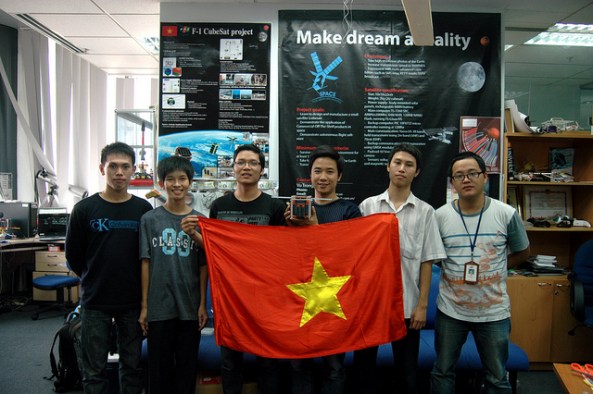
F-1 CubeSat Students

CPUT satellite HF beacon – a new tool for radio amateurs.

In this monthly feature, Hans van de Groenendaal ZS6AKV, executive chairman of the South African Amateur Radio Development Trust (SAARDT), looks at various technologies and activities that drive amateur radio. SAARDT is dedicated to the development of amateur radio in South Africa with a special interest in the youth. The organisation is funded by donations and supports the South African Radio League and SA AMSAT.

The two satellites being built by students of the Cape Peninsula University of Technology (CPUT) include a beacon operating in the 20 m amateur band. The first of the two is a single CubeSat 10 x 10 x 10 cm with a mass of one kilogramme.

While the single CubeSat will be dedicated to the Hermanus Magnetic Observatory science payload supporting the HMO operations in Antarctica, it will provide interesting antenna characterisation opportunities for radio amateurs.

The beacon operating on 14 099 kHz will be used for optimising the SuperDarn HF radar system operated by the National Space Agency Space Science (previously the Hermanus Magnetic observatory).

The electrically conductive upper layer of the Earth’s atmosphere (known as the ionosphere) sometimes connect directly to the solar wind. If there is a strong coupling then there is an increased chance that the space environment immediately surrounding our planet will be disrupted – the fast-moving solar wind blowing past the Earth can drag the polar ionosphere with it. Scientists use the SuperDARN radar system to measure how the ionosphere is moving above the polar cap by detecting echoes reflected by patches of electrically charged particles.

In our increasingly high-tech society, space research is becoming an important research area because some modern technologies, both in space and on the ground, are vulnerable to rapid changes in the space environment known as “space weather”.

Why satellite signals?

As with all radio systems phase characteristics change with time. The phase path through the system needs to be calibrated on a regular basis and this can be achieved by introducing another signal into the system and then measure the phase coming out.

As the CubeSat passes over the Antarctic it will be in full view of the radar antennas. Scientists will then measure the signal and determine what the phase difference is.

Ean Retief ZS1PR, a Cape Town radio amateur with a special interest in radio propagation, suggested that the signal be used for determining the coverage (beam) pattern of 20 m antennas. Currently obtaining a reasonable coverage pattern for an antenna takes a long time as testing with other radio amateurs introduces a number of variables such as variation in ionospheric propagation conditions (day to day, seasonal, time of the day and the stage of the sunspot cycle), different power levels of the distant stations and different antennas being used by the distant stations.

The CubeSat HF beacon will be a known unchanging (same output and same antenna) source and with a known flight path the angle and range of the cube-sat will be known for the entire traverse. Therefore the observer simply needs to note time and received signal strength every few moments.

A “lobe pattern” can be drawn for the particular path followed by the CubeSat during a pass. With three to six passes available daily a rough estimate of the antenna pattern can be estimated after only one day of monitoring.

After a week of observation it should be possible to draw quite a good “in situ” coverage pattern, as not only will the lobes of the antenna be recorded but also any local screening effects of mountains, hills and nearby buildings.

If the antenna is then modified in any way, the effects of such modifications will be easily detectable after observing a few passes.

Propagation research

The beacon signal can also be used for the study of various modes of propagation. Questions such as “how does an HF signal above the ionosphere behave during various times of the day and sunspot cycle” can be answered. Will it penetrate through the ionosphere as the layers change or will it travel along the upper layer before penetrating?

As monitoring of the CubeSat signal will only require a receiver with a “S” meter and an accurate clock, the possibility also exists for constructing simple antenna configurations at youth camps or schools. By re-orienting the antenna in direction or configuration (i.e. “straight” dipole versus “inverted-V”) the effect should be noticeable during the next pass of the CubeSat and will give quick “hands on” learning. Varying the height above ground will also show the change in pattern.

The beacon signal can also be used to demonstrate the different effects of different antennas. For instance it will show the difference in signal strength during different parts of a satellite pass between different antennas (i.e. dipole giving better results at higher elevation while vertical gives better result at lower elevation). Coupled with modern antenna modelling software it will give participants the “proof of the pudding” of what they saw on a computer screen.

A simple satellite beacon can be used for so many interesting experiments and activities and add new interest to amateur radio.

http://www.amsatsa.org.za/