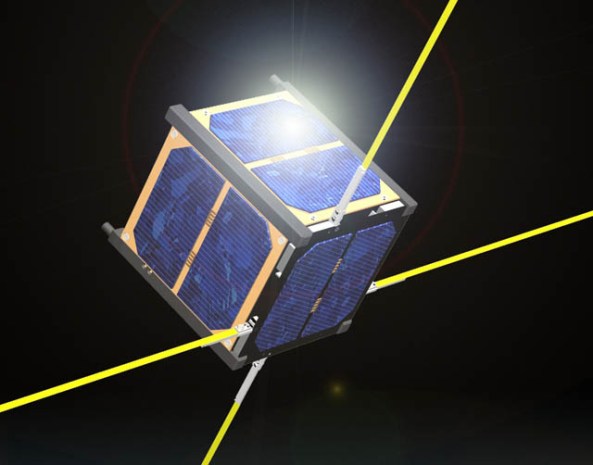
CubeBug-1 – ARM Microcomputer CubeSat

CubeBug-1 is the first technology demonstration mission for a new CubeSat platform design (mechanics, hardware and software) intended to be released as Open Source and Open Hardware for its use in Amateur projects, University projects and research labs.

The project is sponsored by the Argentinian Ministry of Science, Technology and Productive Innovation.

As payload on this first mission, some custom designed components will be tested: an ARM based on-board computer, a nano-reaction wheel with its driver circuit and a low resolution camera, all based on COTS components.

It plans to use to use half duplex communications on UHF with 9k6 GMSK data.

CubeBug-1 is a 2U cubesat and is expected to be launched later this year with around 11 other amateur radio CubeSats on a DNEPR rocket from Yasny into a 607km 98 degree polar orbit.

After the technology demonstration part of the mission is over, the satellite will enter a mode that will include services to the Amateur Radio community, including a Digipeater, science data downloads from the payload (including images if possible).

High School Students Build Amateur Radio CubeSat

TJ3Sat (pronounced TJ CubeSat) is scheduled to be the first satellite to be flown and built by high school students.

The satellite is a product of Thomas Jefferson High School for Science and Technology’s Systems Engineering class. During this three year long endeavor approximately 30 high school students ranging from sophomores to seniors will have contributed.

The project is broken down into individual subsystems that are assigned to groups of students. Each subsystem is assigned an industry representative that acts as a mentor to the students. In the end TJ3Sat will act as an educational resource for K-12 education worldwide.

The primary payload of the TJ3Sat is a TextSpeak module, which converts serial data into spoken voice. Coupled with the Stensat Radio, coded data will be transmitted to the satellite and will be relayed back to Earth over an Amateur Radio frequency.

It is understood the CubeSat uplink with be in the 435 MHz band with the downlink in the 145 MHz band.

Watch TJ CubeSat Fit Check

TJ3Sat http://tj3sat.wikidot.com/

Student CubeSat CATSAT II and Hydrogen Peroxide Propulsion

Students at the University of Vermont are working on a Cubesat project CATSAT II sponsored by the University and NASA.

The team have been experimenting with Hydrogen Peroxide Propulsion. In this video Mohamed Metwally, Eric Niebylski, Rudy Raab and Drew Swomley provide a brief overview of the project.

Watch UVM Capstone Design 2011/2012 – CATSAT II

NASA’s CubeSat program helps students take part in space experiments.

Watch Launch of Nanosatellites

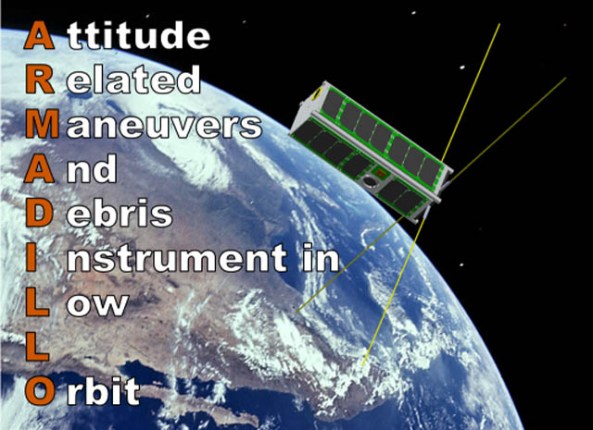
Armadillo CubeSat to use Cold Gas Thruster

The amateur radio 3U CubeSat Armadillo is a collaboration between students at University of Texas at Austin and Baylor University.

Armadillo stands for Attitude Related Maneuvers And Debris Instrument in Low (L) Orbit and the satellite is being designed for Flight Unit delivery in June 2013 with an assumed launch in January 2014.

Mission Objectives:

– Characterize the low altitude space dust environment and the orbit effects of this space dust as potential threats to military satellites.

– Operate a cold-gas thruster to extend mission lifetime and perform a controlled de-orbit maneuver in order to gather more scientific data at different altitudes.

– Establish optical navigation by taking and downloading a celestial image to obtain an independent verification of satellite position and attitude.

– Demonstrate on-orbit reprogrammable software so the satellite may use updated commands and algorithms.

– Develop a reusable 3U picosatellite bus for potential use on future missions in an effort to cut design and fabrication costs

Watch Bevo 2 / ARMADILLO Cold Gas Thruster Pendulum Test 3

Armadillo website http://armadillo.ae.utexas.edu/

Information, Videos , News and Images about Cold Gas Thruster http://www.rtbot.net/cold_gas_thruster

Cold Gas Thruster spec sheet http://austinsat.net/datasheets/Thruster%20Spec%20Sheet%20rev2.pdf

Texas CubeSat 2011 Presentation http://lightsey.ae.utexas.edu/publications/TEXAS_CubeSat_2011_Presentation.pdf

New Frequencies for AMSAT-UK FUNcube-1

The AMSAT-UK FUNcube-1 satellite is due to launch on a DNEPR rocket from Yasny later this year.

This launch could carry around 11 amateur radio satellites including FUNcube-1 into space. As a result the International Amateur Radio Union (IARU) satellite advisory panel have had to carefully coordinate the planned operating frequencies in order to minimise the risk of interference between FUNcube-1 and other payloads on the same launch.

The IARU Amateur Satellite Frequency Coordination Panel have now confirmed the following frequencies for FUNcube-1 (these frequencies replace those previously announced)

Inverting linear transponder:
Uplink            435.150 – 435.130 MHz
Downlink        145.950 – 145.970 MHz

Telemetry:     145.935 MHz   BPSK

AMSAT-UK have announced that the power of the FUNcube-1 1200 bps BPSK telemetry beacon has been increased to 400 milliwatts. This should provide a strong signal for school students to receive using simple equipment.

Read the leaflet ‘Teach Space with a Real Satellite’ at http://tinyurl.com/TeachSpaceWithFUNcube

Gunter’s Space Page 2012 launches http://space.skyrocket.de/doc_chr/lau2012.htm

IARU Amateur Satellite Frequency Coordination Status http://www.amsat.org.uk/IARU

OSSI Art CubeSat to Launch in August

Hojun Song DS1SBO and the NovaNano FlyMate™ deployer

Hojun Song DS1SBO and the NovaNano FlyMate™ deployer

Hojun Song DS1SBO is a cutting-edge, tech-obsessed Korean artist breaking boundaries with his passion for telling stories through technology. He hopes to instill a sense of empowerment in the world, through the DIY nature and uplifting undertones in each of his works.

OSSI CubeSat

OSSI CubeSat

At univeristy he studied Electrical Engineering and Computer Science after which he started working on his art.

After years of research he has found that it is indeed possible to launch and operate a personal satellite at a fairly reasonable price. For the past six years he has been exploring ways to integrate the concept of a personal satellite project into cultural contexts and into his artistic practice.

Hojun Song’s first satellite OSSI will take off on a Soyuz rocket from Baikonour in Kazakhstan this August. He obtained his rocket launch through a new French launch brokerage company NovaNano http://www.novanano.com/. In this video he shares his story, his struggles and his plans.

Watch The Open Source Satellite Initiative by Hojun Song

The OSSI CubeSat should be delivered on May 31 in preperation for its launch on August 31. The team are working hard to finish building the satellite.

Watch Building OSSI EPS / 20120429

Open Source Satellite Initiative (OSSI) http://opensat.cc/

The Creators Project http://thecreatorsproject.com/en-uk/creators/hojun-song

DIY Satellite http://opensat.cc/download/DIYSatellite_en.pdf

Studio hhjjj http://www.hhjjj.com/