Open Source CubeSat Next Phase in DIY Space Access

Space Safety Magazine reports that in recent years it has become both easier and more conceivable for students and amateurs to run experiments in space. Non-governmental space organizations are on the rise, DIY spaceflight is all the rage, and it seems the web is full of videos filmed from atop weather balloons launching someone’s favorite figurine into the stratosphere.  A recent project even allows consumers to use purchase points from American Express towards funding student experiments aboard the International Space Station.

The magazine article focuses on NanoSatisfi who launched a Kickstarter initiative on June 15 for an open source CubeSat called ArduSat (although naming rights are available in return for a $10,000 donation).

NanoSatisfi was founded by Austrian-born Peter Platzer a former high-energy physicist (CERN), former Hedge Fund Quantitative Trader, avid HP-41 hacker and Arduino enthusiast, along with Belgian aerospace engineer Jeroen Cappaert intern at NASA Ames Research Center, Canadian aerospace engineer Joel Spark intern at EADS Astrium and Hungarian Reka Kovacs intern at NASA Ames Research Center working on alternative methods of public outreach for space science. The four founders met at the International Space University in Strasbourg and thought that they could do something to provide affordable, open-source space exploration for everyone.

Read the full Space Safety Magazine article Open Source Cubesat Next Phase in DIY Space Access

The New York Observer – Former Quantitative Trader Spurns Wall Street to Explore the Final Frontier
http://observer.com/2012/06/quantitative-trader-spurns-wall-street-in-push-to-explore-the-final-frontier/

ArduSat Arduino CubeSat Update http://www.uk.amsat.org/8284

ArduSat Arduino CubeSat Update

The NanoSatisfi team is building an Arduino CubeSat ArduSat. On this satellite they plan to put up to 5 Arduino’s and plug in 50+ sensors into them as well as 2 optical and 1 IR camera.

Once the satellite is on orbit they aim to give access to the general public/citizen scientists to the payload (Arduinos, sensors and camera) to upload their own scientific experiments.

The team want to capture the attention of the DIY community, hackers and makers, amateur astronomers and in general those interested in space exploration and the next frontier.

Sensor wise they have so far magnetometers, O3 sensors, GPS , gyros, plasma sensors, photometer, thermometer, pressure sensor, space radiation (bitflip) sensor, Geiger counter and 2 optical and 1 IR camera etc. The idea is that people can rent scientific packages for a week, during the week they run their experiment the team will send data constantly back to them to analyze.

Imagine general public, including teachers having access to experiment platform in space for a couple of hundreds of dollar and they analyze data and engage students, friends etc., it could revolutionize the way people see space and perceive space exploration.

The team are also looking for feedback from people interested in the project and want to hear ideas on sensors and experiments!

Watch ArduSat Kickstarter Video

Watch Sensor prototype demo

Watch The DISCOVER Space Challenge & ArduSat: Invent an experiment and run it in space!

Watch SciStarter & Science Cheerleader Join ArduSat as Community Partner

NanoSatisfi was founded by Austrian-born Peter Platzer a former high-energy physicist (CERN), former Hedge Fund Quantitative Trader, avid HP-41 hacker and Arduino enthusiast, along with Belgian aerospace engineer Jeroen Cappaert intern at NASA Ames Research Center, Canadian aerospace engineer Joel Spark intern at EADS Astrium and Hungarian Reka Kovacs intern at NASA Ames Research Center working on alternative methods of public outreach for space science. The four founders met at the International Space University in Strasbourg and thought that they could do something to provide affordable, open-source space exploration for everyone.

Check out the ArduSat Kickstarter page here:
http://www.kickstarter.com/projects/575960623/ardusat-your-arduino-experiment-in-space

Fly your name and message in space on F-1 CubeSat!

Here is your chance to send a message into Space on board the F-1 Cubesat. Just follow this link http://fspace.edu.vn/?page_id=31 to add a message. Good Luck


Memorial items onboard F-1

SimpleSat Look Down satellite tracking software now available

SimpleSat Look Down is a free easy to use software app for satellite tracking.

Written by Tom Doyle W9KE it includes a satellite look down window that displays the view from the satellite looking down at the earth as it moves along.

It uses .NET 4 and runs on Windows 8, Windows 7, Vista and XP.

Tom has released this collection of videos that explain how SimpleSat Look Down works:

Watch SimpleSat Look Down – best viewed full screen HD

Watch SimpleSat Look Down – Setup  – Best Viewed Full Screen HD

Watch SimpleSat Look Down – General Operation – Best Viewed Full Screen HD

Watch SimpleSat Look Down – Rotor Setup – best viewed full screen in HD

You can download SimpleSat Look Down from
http://www.tomdoyle.org/SimpleSatLookDown/SimpleSatLookDown.html

F-1 CubeSat is scheduled for launch in July, 2012

Latest update on F-1 CubeSat project:

At the moment, the flight safety review is coming to an end. The FSpace team together with their partner NanoRacks LLC has satisfied the technical requirements and standards set by the launch vehicle provider.

If everything goes according to plan, the F-1 CubeSat will be delivered to Japan by the end of June. Then along with four other CubeSats (RAIKO, WE-WISH, FITSAT-1 and TechEdSatF-1 will be loaded onboard HTV-3 “Kounotori” transfer vehicle for integration with the JAXA HII-B launch vehicle.

F-1 plans to launch to the International Space Station (ISS) on July 21 from Tanegashima, Japan, then in September the Japanese astronaut and radio amateur Akihiko Hoshide KE5DNI should deploy it into space from the ISS using the Kibo robot arm.

It carries two Yaesu VX-3R transceivers using 145.980 and 437.485 MHz.

The FSpace team are offering the public a chance to send their name/callsign and a message into space onboard the F-1 CubeSat. You will also be presented with a certificate! See this link http://fspace.edu.vn/?page_id=31

JAXA http://iss.jaxa.jp/kibo/about/jssod/ Google English http://tinyurl.com/7x79o6p

FSpace http://fspace.edu.vn/

Vietnam Student CubeSat F-1 http://www.uk.amsat.org/5025

Video of HTV-3 “Kounotori” and CubeSat Deployer http://www.uk.amsat.org/8078

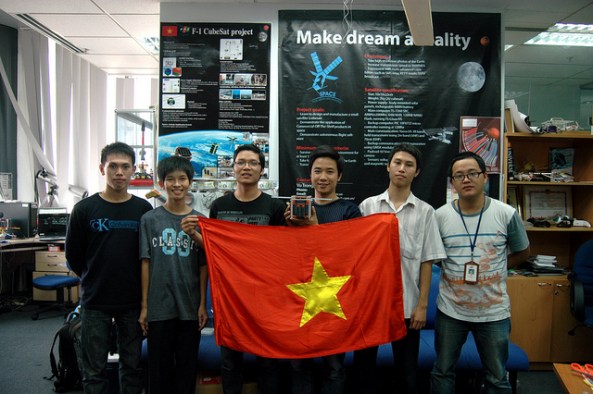
F-1 CubeSat Students

CubeSat docking planned with Kinect technology

It’s an informal conclusion, of course. But the story of Surrey’s plan to dock CubeSats using Microsoft’s Kinect technology is certainly making the rounds, appearing in traditional places like Satnews and Flightglobal, as well as consumer electronic sources such as Gizmagodo and general news sites like the BBC.

The Kinect-enabled STRaND-2 is the sister craft to the previously announced STRaND-1, which uses smartphone tech.

Developing technology that could be used to separately launch the parts of a much larger craft that would be configured on orbit might bring those larger craft, and more ambitious goals, within reach of the CubeSat community.

It’s been a while since any news was forthcoming, but Cornell has also proposed using CubeSats to test reconfigurable technology that uses “flux-pinning” (video) to achieve similar goals.

Here’s to their success.


Wayne