Rocket Engineer Starts Mojave Makerspace

What happens when rocket scientists get together in their spare time?

Michael Clive builds rockets during the day and Makerspaces at night. And this is no ordinary Makerspace, it’s in the “Silicon Valley of Space”..also known as Mojave, California. Find out how Michael gained support for this unique water hole in the desert and some unique challenges he faces.

Watch How to build a place to make cool stuff

Mojave Makerspace / Hackerspace http://mojavemakers.org/

The Space Review – Hacking space http://www.thespacereview.com/article/2068/1

Mojave Air and Spaceport http://mojaveairport.com/

STRaND-2 ‘Kinect’ Satellites Video

STRaND-2 NanosatsSTRaND-2, a twin nanosatellite mission from SSTL and the University of Surrey to test a novel in-orbit docking system using a gridded Lidar system based on the Microsoft Xbox Kinect games-controller technology.

Similar in design to STRaND-1, the identical twin satellites will each measure 30cm (3 unit Cubesat) in length, and utilise components from the Xbox Kinect games controller to scan the local area and provide the satellites with spatial awareness on all three axes – thus allowing them to dock.

The STRaND team sees the relatively low cost nanosatellites as intelligent “space building blocks” that could be stacked together and reconfigured to build larger modular spacecraft.

Watch STRaND-2 Docking Nanosatellite.wmv

STRaND stands for Surrey Training, Research and Nanosatellite Demonstration and the programme is intended to be a long-term arrangement between the space company SSTL and academic researchers at the Surrey Space Centre (SSC), with STRaND-1 the first of a long line of STRaND nanosatellites.

The SSTL employees involved with the STRaND programme are volunteers. It is a condition of the programme that volunteers from SSTL and SSC use their own, free time for STRaND activities (such as lunches and breaks). The project has no budget for staff so is entirely dependent on volunteers.

Further information at http://www.sstl.co.uk/divisions/earth-observation—science/science—exploration/strand-2-building-blocks-nanosatellite

‘Kinect’ STRaND-2 at UK Space Agency Conference http://www.uk.amsat.org/6795

Surrey Satellite to put Xbox parts in space http://www.uk.amsat.org/7771

The Register article http://www.theregister.co.uk/2012/05/28/sstl_strand_2_nanosat_xbox_kinect/

Thinking outside the box in space by BBC Science correspondent Jonathan Amos http://www.bbc.co.uk/news/science-environment-18250755

STRaND on Facebook https://www.facebook.com/nanosats

STRaND-2 ‘Kinect’ Satellites Video

STRaND-2, a twin nanosatellite mission from SSTL and the University of Surrey to test a novel in-orbit docking system using a gridded Lidar system based on the Microsoft Xbox Kinect games-controller technology.

Similar in design to STRaND-1, the identical twin satellites will each measure 30cm (3 unit Cubesat) in length, and utilise components from the Xbox Kinect games controller to scan the local area and provide the satellites with spatial awareness on all three axes – thus allowing them to dock.

The STRaND team sees the relatively low cost nanosatellites as intelligent “space building blocks” that could be stacked together and reconfigured to build larger modular spacecraft.

Watch STRaND-2 Docking Nanosatellite.wmv

STRaND stands for Surrey Training, Research and Nanosatellite Demonstration and the programme is intended to be a long-term arrangement between the space company SSTL and academic researchers at the Surrey Space Centre (SSC), with STRaND-1 the first of a long line of STRaND nanosatellites.

The SSTL employees involved with the STRaND programme are volunteers. It is a condition of the programme that volunteers from SSTL and SSC use their own, free time for STRaND activities (such as lunches and breaks). The project has no budget for staff so is entirely dependent on volunteers.

Further information at http://www.sstl.co.uk/divisions/earth-observation—science/science—exploration/strand-2-building-blocks-nanosatellite

‘Kinect’ STRaND-2 at UK Space Agency Conference http://www.uk.amsat.org/6795

Surrey Satellite to put Xbox parts in space http://www.uk.amsat.org/7771

The Register article http://www.theregister.co.uk/2012/05/28/sstl_strand_2_nanosat_xbox_kinect/

Thinking outside the box in space by BBC Science correspondent Jonathan Amos http://www.bbc.co.uk/news/science-environment-18250755

STRaND on Facebook https://www.facebook.com/nanosats

Surrey Satellite to put Xbox parts in space

Surrey-based researchers are to build Xbox Kinect hardware into twin satellites in an auto-docking experiment.

The microsatellites, to be called STRaND-2, are being developed by University of Surrey and Surrey Satellite Technology (SSTL), with the Kinect providing its 3D laser scanner.

CubeSat is a mechanical standard for miniature satellites. In this case, the spacecraft will be ‘3U’ CubeSats each measuring 10x10x30cm and weighing under 4kg.

“Docking systems have never been employed on such small and low cost missions and are usually reserved for big-budget space missions to the International Space Station or historically, the Mir space station and the Apollo programme,” said SSTL.

They will dock many times, initially with ground intervention, then increasingly automatically.

SSTL’s speciality, through extensive testing, is selecting commercial electronic hardware which can be used in space – STRaND-2’s scanners will come out of actual Kinects.

Inspiration for the flight came from an experiment at the Massachusetts Institute of Technology (MIT), where a tiny helicopter equipped with Kinect hardware was used to scan rooms as it flew through them, allowing a 3D model of the environment to be built, said SSTL project leader Shuan Kenyon.

The University of Surrey and SSTL team has already developed STRaND-1 (Surrey Training, Research and Nanosatellite Demonstrator), and was looking for a further challenge.

STRaND-1, another 3U CubeSat, will famously carry a mobile phone into orbit and send data direct to schools.

STRaND-1 is also one of the most manoeuvrable small satellites ever built, with eight micro-thrusters providing rotation in three axes as well as lateral movement in two dimensions. A separate gas jet provides thrust in the third linear dimension.

If two similar satellites can be made to dock, the team is proposing larger self-assembling structures made of many, perhaps dozens, of CubeSats.

“It may seem far-fetched, but our low cost nanosatellites could dock to build large and sophisticated modular structures such as space telescopes,” said Surrey university project head Dr Chris Bridges. “Unlike today’s big space missions, these could be reconfigured as mission objectives change, and upgraded in orbit with the latest available technologies.”

“I think by STRaND-4, we should be able to build the USS Enterprise,” quipped Kenyon.

Other ideas include using small mobile scanning satellites to inspect larger spacecraft.

‘Kinect’ STRaND-2 at UK Space Agency Conference http://www.uk.amsat.org/6795

STRaND on Facebook https://www.facebook.com/nanosats

Italian Microsat to Deploy Amateur Radio Satellites

UniSat-5 with labelsThe Italian microsat UniSat-5 will itself deploy a number of additional amateur radio satellites. Among them should be the CubeSats PUCP-SAT-1, HumSat-D, Icube-1, Dove-4 (Planet Labs Inc. non-amateur) and PocketQubes Wren, Eagle-1 (BeakerSat), Eagle-2 ($50Sat), QB-Scout1. PUCP-SAT-1 intends to subsequently release a further satellite Pocket-PUCP.

Continue reading

PhoneSat at Maker Faire

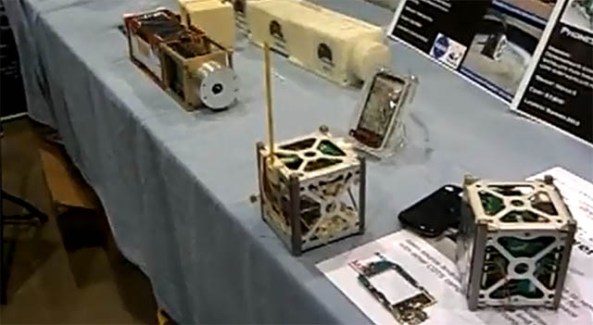
The 2012 Bay Area Maker Faire in San Mateo took place May 19-20 and among the stands was one displaying the PhoneSat amateur radio satellites.

There are two types of of these satellites both of which run the Android operating system and will be enclosed in a standard 1U CubeSat structure.

PhoneSat 1.0 cost about $3500 and is built around the Nexus One smartphone, it operates on battery power only with a mission lifetime of approx 1 week.

PhoneSat 2.0 is more expensive at $8000. It is built around the Nexus S smartphone and has solar panels on each face and a mission lifetime until de-orbit of approximately 2 weeks.

The IARU has coordinated a frequency of 437.425 MHz for the AX.25 AFSK downlink.

The first launch is scheduled for the third quarter of 2012 on Antares-110. It will carry two PhoneSat 1.0 satellites and one PhoneSat 2.0. A second PhoneSat launch is expected to occur in 2013.

Watch NANOSATHTC smart Phone-Satellite OS Android in a 10cm cube

Phonesat was also at the 2011 Maker Faire. In this video Ben explains the concept of a Phonesat.

Watch Android Phone as Autonomous Micro-Satellite: PhoneSat

IARU Amateur Satellite Frequency Coordination Status http://www.amsat.org.uk/iaru