Nayif-1 Launched

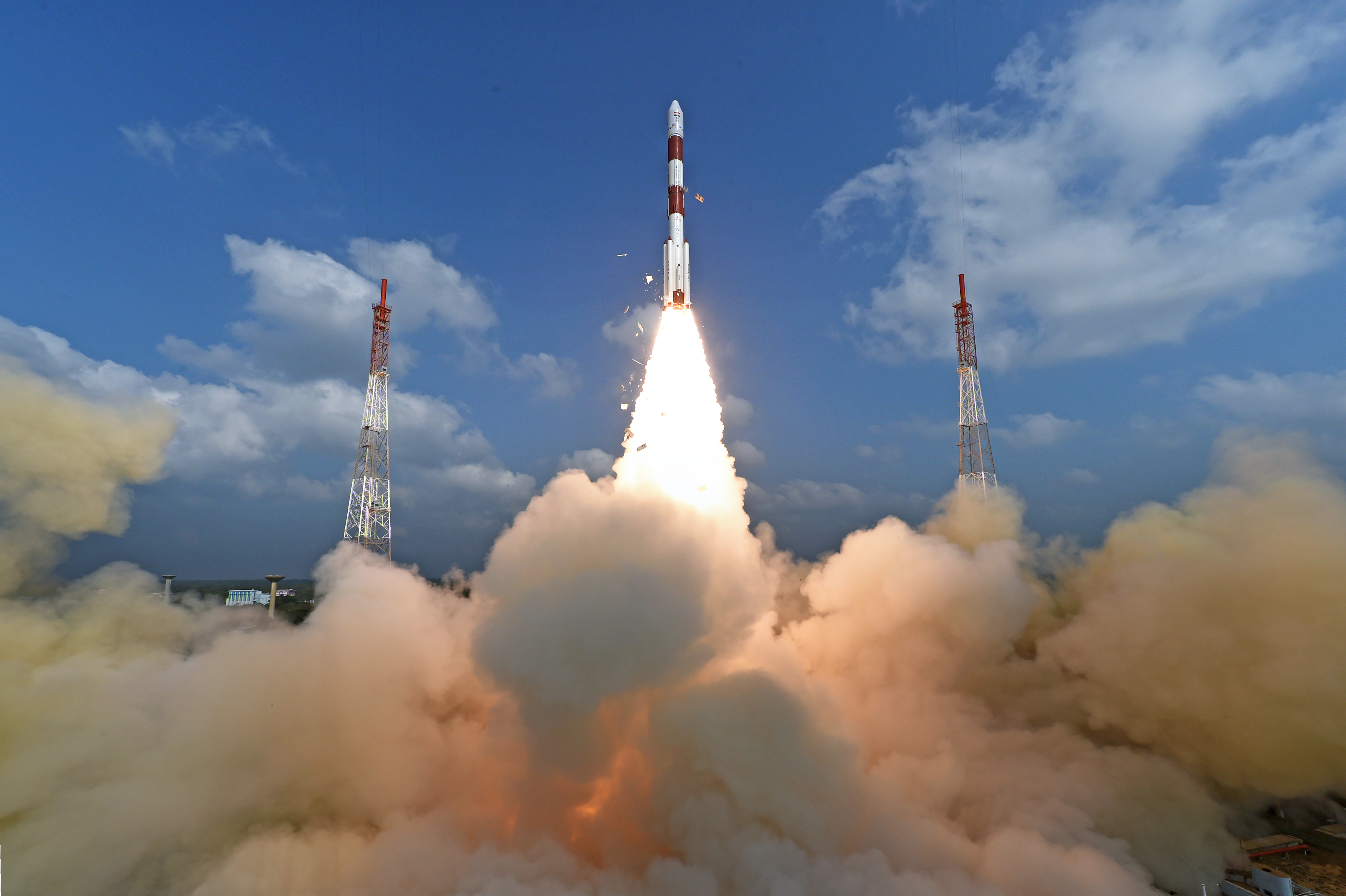
ISRO PSLV-C37 Launch at 0358 UT February 15, 2017

ISRO PSLV-C37 Launch

The Indian Space Agency ISRO successfully launched the amateur radio satellite Nayif-1 along with 103 other satellites, a record for a single launch. The PSLV-C37 lifted off from the Satish Dhawan Space Centre, Sriharikota, Andhra Pradesh at 03:58 UT on Wednesday, February 15, 2017.

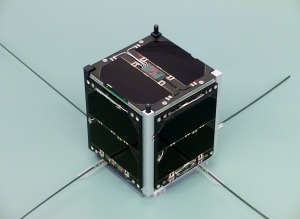
Nayif-1 was developed by UAE students - Image credit The Mohammed bin Rashid Space Centre

Nayif-1 was developed by UAE students – Image credit The Mohammed bin Rashid Space Centre

Nayif-1 started transmitting about an hour after launch and radio amateurs in the west of the USA reported the first signals. The first frame of data received at the Data Warehouse was from Christy Hunter KB6LTY. Telemetry data was also received by WA6FWF, KA7FVV, WC7V, NC7V, K6FW, KE7QPV, WA9ONY, W5PFG, KK6AYK.

Ken Eaton GW1FKY reports he received his first frames of data when the satellite came in range of the UK at 10:07 UT.

The satellite looks to be in perfect health and it was placed in autonomous mode before the end of the first day in orbit. Just like FUNcube-1, this mode has the spacecraft sending high power telemetry when in sunlight and with the SSB/CW transponder active when in eclipse. Already many contacts have been made through the transponder. As expected, the frequency stability of this spacecraft is much better than its predecessors.

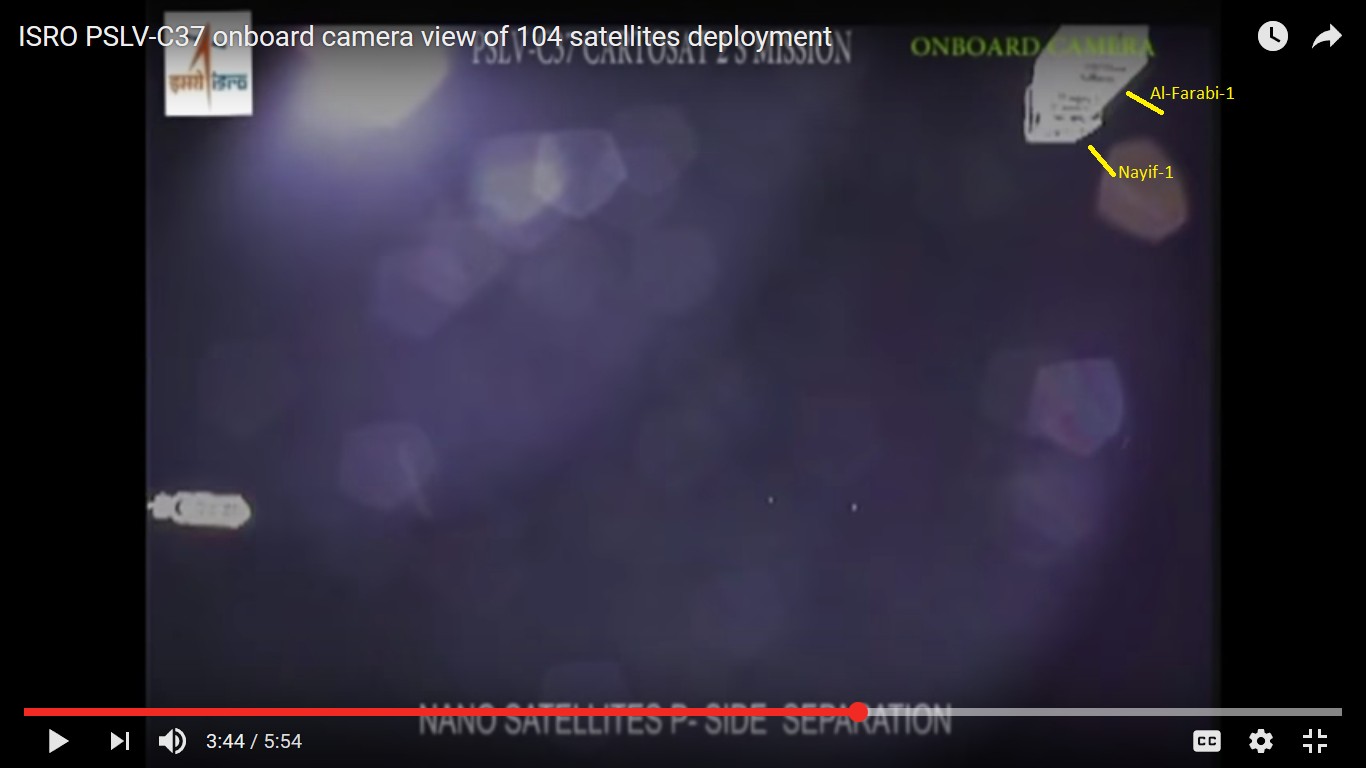
The launch provider has published a video of the deployment of the 104 satellites

A new post-launch set of TLE’s has been issued by the launch authority and it can be downloaded from http://amsat-nl.org/download/NAYIF_TLE.txt

Please note that these numbers are not based on JSpOC observations so we do not yet have a valid catalog number.

On February 24, Nico Janssen PA0DLO reported that detailed Doppler measurements show that Nayif-1 is object 42017, 2017-008BX

During the Launch and Early Operation phase (LEOP) of the mission, the Nayif-1 command team have been headquartered at the American University of Sharjah Ground station in the United Arab Emirates. They have been very grateful for all the telemetry received from around the world. It has proven to be immensely useful to the team in checking that the spacecraft is functioning correctly.
Nayif-1 Deployment

Nayif-1 Deployment

Our world-wide network has greatly impressed the many professionals that have been watching our activities. Already more than 100 ground stations are submitting data to the Nayif Data Warehouse. Please continue uploading the data as this will further enhance our knowledge about the spacecraft and the space environment through which it is traveling at 7.6 km/s.

The Nayif-1 Data Warehouse has been updated and now includes the Whole Orbit, High Resolution graphs and the upload ranking. It also includes telemetry details from the ADCS sub-system – this is called the iMTQ and is capable of actively magnetorquing. Over the coming days, we will be further tweaking the warehouse, so bear with us if it is unavailable for short periods of time.

Background
Nayif-1 has been developed by the Mohammed bin Rashid Space Centre (MBRSC) and American University of Sharjah (AUS). The UAE’s first Nanosatellite was developed by Emirati engineering students from AUS under the supervision of a team of engineers and specialists from MBRSC within the framework of a partnership between the two entities, aiming to provide hands-on experience to engineering students on satellite manufacturing.

Nayif-1 Mission PatchThe spacecraft includes a U/V linear transponder and telemetry transmitter. It employs enhanced oscillator circuitry and includes an active attitude determination and control system.

The operating frequencies for the spacecraft are:

Telemetry
145.940 MHz using 1k2 BPSK to the FUNcube standard.

SSB/CW Transponder
Uplink on 435.045 – 435.015 MHz
Downlink on 145.960 – 145.990 MHz

The Nayif-1 Telemetry Dashboard can be downloaded from
http://download.funcube.org.uk/nayif-1_Dashboard_1039_Installer.msi

Guidance notes https://funcubetest2.files.wordpress.com/2017/02/nayif-1_dashboard_notes_release_1-0b.pdf

A file to test that the Dashboard and Warehouse configuration are working correctly
http://download.funcube.org.uk/nayif1_testfile.funcubebin

Nayif-1 Data Warehouse http://data.amsat-uk.org/nayif1/

Pre-launch TLEs (use those from link above) http://download.funcube.org.uk/nayif_tle.txt

Keplerian Two Line Elements (TLEs) ‘Keps’ for satellites launched in past 30 days, Nico PA0DLO suggests using object 42017, 2017-008BX http://celestrak.com/NORAD/elements/tle-new.txt

Adding new satellites to SatPC32, Gpredict and Nova
https://amsat-uk.org/2013/11/23/adding-new-satellites-to-satpc32/

ISIS gets 101 CubeSats launched during record breaking PSLV launch
https://www.isispace.nl/dutch-nanosatellite-company-gets-101-cubesats-launched-recordbreaking-pslv-launch/

Nayif-1 CubeSat Launch Announced

Nayif-1 team members after completion of the assembly and integration of the CubeSat

Nayif-1 team members after completion of the assembly and integration of the CubeSat

AMSAT-UK and AMSAT-NL are delighted to now be able to confirm that the Nayif-1 1U CubeSat, which has a full FUNcube payload, is now scheduled for launch on an Indian PSLV launch vehicle at 03:58 UT on February 15, 2017. The flight, PSLV-C37, will be carry a total of 104 satellites into orbit.

UPDATE Feb 14: Nayif-1 TLEs for tracking are at http://download.funcube.org.uk/nayif_tle.txt
Join in the Nayif-1 launch day chat on the FUNcube IRC channel, your reception reports are most welcome, see http://irc.lc/freenode/funcube (If you have a Callsign put it in the nickname field)

The 145.940 MHz 1k2 BPSK telemetry beacon, running 50mW output, should activate  at approximately 04:54 UT on Wednesday, February 15 when the spacecraft is heading north over Mexico and the western parts of the US and Canada.

Nayif-1 was developed by UAE students - Image credit The Mohammed bin Rashid Space Centre

Nayif-1 was developed by UAE students – Image credit The Mohammed bin Rashid Space Centre

During the Launch and Early Operation Phase (LEOP) of the mission, the Nayif-1 command team will be headquartered at the American University of Sharjah Ground station in the United Arab Emirates. They will obviously be especially keen to have all possible reports of signal reception during this first orbit!

To encourage everyone to take part, there will be a small prize for the stations that submit the first data to the Nayif-1 Data Warehouse. Please help the team if you can.

Nayif-1 has been developed by the Mohammed bin Rashid Space Centre (MBRSC) and American University of Sharjah (AUS). The UAE’s first Nanosatellite was developed by Emirati engineering students from AUS under the supervision of a team of engineers and specialists from MBRSC within the framework of a partnership between the two entities, aiming to provide hands-on experience to engineering students on satellite manufacturing.

Hessa Ali and Maitha Al Shizawi verifying the Nayif-1 hardware as well as conducting electrical and functional tests

Hessa Ali and Maitha Al Shizawi verifying the Nayif-1 hardware as well as conducting electrical and functional tests

The spacecraft includes a U/V linear transponder and telemetry transmitter. It employs enhanced oscillator circuitry and includes an active attitude determination and control system.

As with previous missions carrying FUNcube payloads, AMSAT-UK would very much like to receive as many reports from stations around the world, especially during the first few minutes and hours after launch.

There is a mission specific Telemetry Dashboard for this project and this can be downloaded from http://download.funcube.org.uk/Nayif-1_Dashboard_1038_installer.msi  and, in a similar way to the FUNcube-1 Dashboard, this will be capable of uploading the telemetry received to a central Data Warehouse.

Guidance Notes for the installation of the Dashboard, integration with a FUNcube Dongle and the Data Warehouse have been prepared for the Nayif-1 mission. These can be downloaded from https://funcubetest2.files.wordpress.com/2017/02/nayif-1_dashboard_notes_release_1-0b.pdf

A file to test that the Dashboard and Warehouse configuration are working correctly can be downloaded from  http://download.funcube.org.uk/nayif1_testfile.funcubebin

The Data Warehouse is still under final development but can be viewed at http://data.amsat-uk.org/nayif1/

Please note that if you are already a registered user of the FUNcube Dashboard then you do not need to re-register. Your existing details will transfer automatically to the new Dashboard when you run it for the first time.

The operating frequencies for the spacecraft will be:

Telemetry
145.940 MHz using 1k2 BPSK to the FUNcube standard.

SSB/CW Transponder
Uplink on 435.045 – 435.015 MHz
Downlink on 145.960 – 145.990 MHz

Initial operations of the spacecraft will be in a low power “safe” mode where only the telemetry transmitter is activated.

ISRO PSLV-C37 brochure http://www.isro.gov.in/pslv-c37-cartosat-2-series-satellite/pslv-c37-brochure

Deputy project manager of Nayif-1 Fatma Lootah

Deputy project manager of Nayif-1 Fatma Lootah

International Space Colloquium – Call for Speakers

FUNcube-1 flight model - Image credit Wouter Weggelaar PA3WEG

AO-73 (FUNcube-1) – Image credit Wouter Weggelaar PA3WEG

This is a call for speakers for the AMSAT-UK International Space Colloquium 2017 which will be held on Saturday and Sunday, October 14-15 at the Kents Hill Park Conference Centre, Timbold Drive, Milton Keynes, MK7 6BZ, United Kingdom.

AMSAT-UK invites speakers, to cover topics about Amateur satellites, CubeSats, Nanosats, Space, High Altitude Balloons and associated activities, for this event.

Those wishing to speak should contact Dave, G4DPZ, dave at g4dpz dot me dot uk

Further information https://amsat-uk.org/colloquium

73 Dave G4DPZ

AMSAT-UK: https://amsat-uk.org/
Twitter: https://twitter.com/AmsatUK
Facebook: https://facebook.com/AmsatUK
YouTube: https://youtube.com/AmsatUK

QB50 Mission – downlink frequency details

EO-79 and EO-80 - Image Credit ISISThe first of the QB50 CubeSats that are destined for deployment from the International Space Station are now awaiting their turn to be uplifted to the ISS.

In addition to the ISS deployments it is planned that there will be two further batches launched using other vehicles.

The exact timing of these events is not yet available but, in advance, here is a fully updated list of all CubeSats involved. Also included are the details of their science experiments and their downlink frequencies and modulation modes. The frequencies have been coordinated by the IARU Frequency Coordination team and, generally, all the spacecraft will use 9k6 data rates on 70cms.

Download the QB50 Frequency Excel Spreadsheethttp://tinyurl.com/QB50-Frequencies-20170201

AMSAT-UK: https://amsat-uk.org/
Twitter: https://twitter.com/AmsatUK
Facebook: https://facebook.com/AmsatUK
YouTube: https://youtube.com/AmsatUK

Six CubeSats to Deploy from ISS

International Space Station - Image Credit NASA

International Space Station – Image Credit NASA

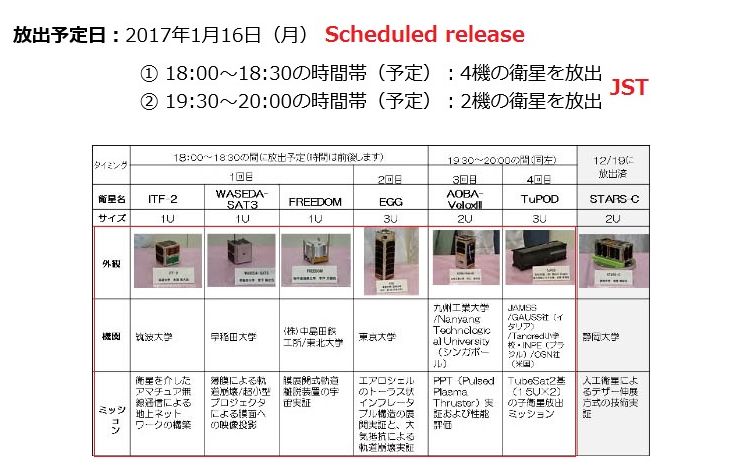
Masahiro Arai JN1GKZ reports that six CubeSats delivered to the International Space Station by the HTV-6 will deploy from the ISS using the new JEM Small Satellite Orbital Deployer (J-SSOD) on Monday, January 16.

JAXA ISS CubeSat Deployment 2017-01-16The new J-SSOD has four satellite install cases. One satellite install case has 3U space, so the new J-SSOD could deploy twelve 1U CubeSats at a time.

The six CubeSats are installed as follows:

Case    CubeSats
#1        three 1U CubeSats ITF-2、WASEDA-SAT3、FREEDOM
#2        one 3U CubeSat    EGG
#3        one 2U CubeSat    AOBA-VELOX3
#4        one 3U CubeSat    TuPOD (including Tancredo1 and OSNSAT)

ITF-2、WASEDA-SAT3、AOBA-VELOX3, TuPOD and Tancredo1 have amateur radio downlinks.

#1 and #2 will be deployed at 0900-0930z January 16, #3 and #4 will be 1030-1100z.

Live broadcast will start at 0850z on the JAXA YouTube channel.

IARU Amateur Satellite Frequency Coordination http://amsat.org.uk/iaru

Middle School Students’ Tancredo-1 TubeSat Scheduled for Launch
https://amsat-uk.org/2016/12/02/school-tancredo-1-tubesat/

ITF-2 CubeSat to deploy from ISS
http://www.southgatearc.org/news/2017/january/itf-2-cubesat-to-deploy-from-iss.htm

ITF-2 reception report form https://operationitf-2.blogspot.co.uk/p/blog-page_58.html

Small Satellite SDR Paper

Mamatha R. Maheshwarappa 2E0CZOMamatha R. Maheshwarappa 2E0CZO has released her paper “Improvements in CPU & FPGA Performance for Small Satellite SDR Applications”.

Abstract: The ongoing evolution in constellation/formation of CubeSats along with steadily increasing number of satellites deployed in Lower Earth Orbit (LEO), demands a generic reconfigurable multimode communication platforms. As the number of satellites increase, the existing protocols combined with the trend to build one control station per CubeSat become a bottle neck for existing communication methods to support data volumes from these spacecraft at any given time.

This paper explores the Software Defined Radio (SDR) architecture for the purposes of supporting multiple-signals from multiple-satellites, deploying mobile and/or distributed ground station nodes to increase the access time of the spacecraft and enabling a future SDR for Distributed Satellite Systems (DSS).

Performance results of differing software transceiver blocks and the decoding success rates are analysed for varied symbol rates over different cores to inform on bottlenecks for Field Programmable Gate Array (FPGA) acceleration. Further, an embedded system architecture is proposed based on these results favouring the ground station which supports the transition from single satellite communication to multi-satellite communications.

You can download the PDF of the paper from http://epubs.surrey.ac.uk/812783/

Mamatha worked on the STUDSAT-1, STUDSAT-2 and STRaND-1 satellites which carried amateur radio payloads and was Satellite Officer & Member of the Surrey Electronics and Amateur Radio Society
http://blog.surreyears.co.uk/
https://twitter.com/SurreyEARS
https://www.facebook.com/surreyEARS/