UKube-1 Signals Received

UKube-1 Launch Cake

UKube-1 Launch Cake

The UKube-1 satellite was successfully launched on Tuesday, July 8, 2014 at 1558 UT from Pad 31/6 at Baikonur in Kazakhstan. The 145.840 MHz beacon signal was received by the UKube team in Chilbolton at 19:16 UT.

It had been expected the first signal would be received over South Africa at about 18:52 UT but no signals were heard. The UKube team at Chilbolton and radio amateurs across the British Isles and Europe anxiously awaited the satellite coming within range, when it did a strong signal was heard from the satellite. The FUNcube-2 beacon on 145.915 MHz was also activated and received well.

Practical Wireless magazine VHF columnist Tim Kirby @G4VXE was one of the radio amateurs listening, he tweeted “Pleased to receive CW from UKube-1 on the first pass over the UK”.

Signals have also been received from DX-1 and the SSTL research satellite TechEdSat which were on the same launch as UKube-1.

UKube-1 carries a set of AMSAT-UK FUNcube boards which provide an educational beacon for use by schools and a linear transponder for amateur radio communications. Presently, commissioning of the spacecraft is continuing, and there may be future occasions when the 145.915 MHz FUNcube  telemetry transmitter will be activated during this period. The transponder is not expected to be available until later in the mission.

UKube-1 in flight configuration in the cleanroom at Clyde Space Ltd - Credit Steve Greenland

UKube-1 in flight configuration in the cleanroom at Clyde Space Ltd – Credit Steve Greenland

The first submitters of UKube-1 telemetry data to the FUNcube Data Warehouse were:
– DK3WN
– OO1A
– F-60429
– G0PGL
– G4GUO
– PD3T
– M0LTC
The current UKube-1/FUNcube-2 Rankings can be seen at http://warehouse.funcube.org.uk/ranking.html?satelliteId=1

The UKube team has asked that all stations continue to monitor the downlinks and where possible to forward their reports as follows:
– CW beacon on 145.840 MHz to operations@funcube.org.uk and steve.greenland@clyde-space.com
– FUNcube telemetry (when activated) on 145.915 MHz – your existing dashboard will not display properly (except for the Fitter Messages!) but it WILL be forwarding it to the Warehouse correctly and the data will be very useful for the team.

UKube-1 CubeSat at Clyde Space

UKube-1 CubeSat at Clyde Space

Dashboard App – Telemetry Decoder http://funcube.org.uk/working-documents/funcube-telemetry-dashboard/

Data Warehouse – Telemetry Archive http://warehouse.funcube.org.uk/

Nico Janssen PA0DLO has posted on the AMSAT Bulletin Board that Doppler measurements suggest that UKube-1 is either object 40074, 2014-037F, or object 40075, 2014-037G. The separation between these objects is now only 1 s, so no more than 7.5 km.

Keplerian Two Line Elements (TLEs) ‘Keps’ of new satellites launched in past 30 days http://celestrak.com/NORAD/elements/tle-new.txt

UKube-1 frequencies:
• 145.840 MHz Telemetry downlink
• 145.915 MHz FUNcube subsystem beacon
• 400 mW inverting linear transponder for SSB and CW
– 435.080-435.060 MHz Uplink
– 145.930-145.950 MHz Downlink
• 2401.0 MHz S Band Downlink
• 437.425-437.525 MHz UKSEDS myPocketQub Downlink

Watch UKube-1 CubeSat payload animation

Watch the launch vehicle integration of UKube-1 and the other satellites

Watch the Soyuz roll out

Watch the launch

There will be a presentation on the UKube-1 FUNcube-2 amateur radio payload at the AMSAT-UK International Space Colloquium being held at the Holiday Inn, Guildford, GU2 7XZ on July 26-27, the event is open to all, further details at https://amsat-uk.org/colloquium/colloquium-2014/

Peter Goodhall @2E0SQL made this recording of UKube-1 CW and Data
https://soundcloud.com/peter-goodhall/ukube-1-satellite-first-pass-over-the-uk

UK Space Agency announcement https://www.gov.uk/government/news/successful-launch-for-uk-space-agencys-first-cubesat-mission

UKube-1 (United Kingdom Universal Bus Experiment 1)
https://eoportal.org/web/eoportal/satellite-missions/u/ukube-1

UKube-1 Launch Information https://amsat-uk.org/2014/07/03/ukube-1-launch-information/

DX-1 Satellite https://amsat-uk.org/2014/07/04/dx-1-appeal-to-radio-hams-from-dauria-aerospace/

UKube-1 Launch Information

UKube-1 in flight configuration in the cleanroom at Clyde Space Ltd - Credit Steve Greenland

UKube-1 in flight configuration in the cleanroom at Clyde Space Ltd – Credit Steve Greenland

UKube-1, the UK Space Agency’s first CubeSat, carries a set of AMSAT-UK FUNcube boards with an amateur radio linear transponder and educational beacon for use in schools. The launch is scheduled from Pad 31/6 at Baikonur in Kazakhstan on Tuesday, July 8, 2014 at 15:58:28 UT (4:58 BST) and to be deployed from the final stage of the Soyuz-2-1B/Fregat-M launch vehicle at 18:32:42 UT.

It had been hoped the launch would be live at http://www.roscosmos.ru/317/ or at http://tv-tsenki.com/live.php but this did not occur.

UKube-1 CubeSat installed in Deployment Pod

UKube-1 CubeSat installed in Deployment Pod

The UKube-1 Operations Team have issued a Launch Briefing. This is accompanied by a spreadsheet showing the anticipated UK passes for the first orbits together with a worksheet showing the telemetry equations.

These documents can be downloaded at http://funcube.org.uk/news/

UKube-1 carries a number of experiments and payloads and also the FUNcube-2 transponder and  telemetry sub-system. This is intended to support the current, very successful, operations of FUNcube-1 and to provide an even better operational capability for schools and colleges to use for hands on educational outreach around the world. Further details of the educational outreach opportunities are available here http://funcube.org.uk/education-outreach/

When the FUNcube-2 sub-system is activated, the 1k2 BPSK telemetry will be downlinked on 145.915 MHz in the same way as already happens with FUNcube-1.

A new FUNcube-2 Dashboard UI will be released shortly. This will integrate directly with the existing FUNcube Central Data Warehouse and existing usernames and authorisation codes can be re-used.

UKube-1 ready for launch

UKube-1 ready for launch

When the transponder is activated, the downlink passband will be 145.930 to 145.950 MHz and the uplink passband  will be 435.080 to 435.060 MHz.

It is anticipated that the FUNcube sub-system may be tested for short periods during the next few weeks depending upon how the LEOP plan progresses.

AMSAT-UK personnel will be supporting the UKube-1 operations team at Chilbolton during the immediate post launch period and will be ensuring that regular status reports are made available via the #cubesat IRC channel.

A web client is available at http://webchat.freenode.net/?channels=#cubesat

AMSAT-UK and their colleagues at AMSAT-NL, are delighted that UKube-1 is carrying this FUNcube sub-system and wishes every success to the UKube Operations Team and to all the many contributors to the project.

Steve Greenland of Clyde Space receives the AMSAT-UK FUNcube-2 boards that will be incorporated into UKube-1

Steve Greenland of Clyde Space receives the AMSAT-UK FUNcube-2 boards to be incorporated into UKube-1

There will be a presentation on the satellite’s amateur radio payload at the AMSAT-UK International Space Colloquium being held at the Holiday Inn, Guildford, GU2 7XZ on July 26-27, the event is open to all, further details at https://amsat-uk.org/colloquium/colloquium-2014/

UKube-1 frequencies:
• 145.840 MHz Telemetry downlink
• 145.915 MHz FUNcube subsystem beacon
• 400 mW inverting linear transponder for SSB and CW
– 435.080 -435.060 MHz Uplink
– 145.930 -145.950 MHz Downlink
• 2401.0 MHz S Band Downlink
• 437.425-437.525 MHz UKSEDS myPocketQub Downlink

Video of the Soyuz-2 rocket being prepared for the launch

Soyuz 2-1B – Meteor-M #2 Launch Updates
http://www.spaceflight101.com/soyuz-2-1b—meteor-m-2-launch-updates.html

Check Twitter accounts of Helen Walker@SheAstronomer and Steve Greenland @strickengremlin for tweets on UKube-1 launch.

FUNcube website http://www.funcube.org.uk/

FUNcube Yahoo Group https://amsat-uk.org/funcube/yahoo-group/

FUNcube Forum http://forum.funcube.org.uk/

Like AMSAT-UK on Facebook https://www.facebook.com/AMSATUK

Data Warehouse – Telemetry Archive http://warehouse.funcube.org.uk/

Dashboard App – Telemetry Decoder http://funcube.org.uk/working-documents/funcube-telemetry-dashboard/

There will be a presentation on the FUNcube boards on UKube-1 at the AMSAT-UK International Space Colloquium which will be held on July 26-27, 2014 at the Holiday Inn, Guildford, GU2 7XZ, United Kingdom. The event is open to all, further details at https://amsat-uk.org/colloquium/colloquium-2014/

OSCAR Numbers for QB50p1 and QB50p2 CubeSats

QB50p1 and QB50p2 - Image Credit ISIS

QB50p1 and QB50p2 – Image Credit ISIS

Wouter Weggelaar PA3WEG reports on the two QB50 precursor satellites QB50p1 and QB50p2, launched on June 19, 2014 carrying amateur radio transponders.

The QB50 precursor satellites are in good health and still being commissioned. These satellites are part of a risk-reduction program for the QB50 main mission.

These satellites are also carrying amateur radio transponders:
– QB50p1 carries the FUNcube-3 transponder system by AMSAT-UK and AMSAT-NL
– QB50p2 carries an FM transponder by AMSAT-Francophone

I am grateful to be able to announce that these two CubeSat Satellites have been awarded OSCAR numbers by AMSAT-NA: QB50p1 shall be known as European OSCAR 79 or EO-79, and QB50p2 shall be known as European OSCAR 80 or EO-80. Thank you AMSAT-NA!

The transponders are expected to be switched on after the main mission, which lasts about 6 months depending on progress made.

Details about sending in reports and decoding the beacons can be found on the ISIS Ham Radio page at
http://isispace.nl/HAM/qb50p.html

Mike Rupprecht DK3WN has kindly made and published a software decoder based on the published formats at his website: http://tinyurl.com/SatSoftwareDK3WN/

Thanks all for your support and reports, they are much appreciated!

Kind Regards,

Wouter Weggelaar PA3WEG
AMSAT-NL
QB50p team

Read all about QB50 on the project website at https://qb50.eu/

FUNcube-1 – One millionth packet milestone!

1 Million Packets Uploaded to Data Warehouse

1 Million Packets Uploaded to Data Warehouse

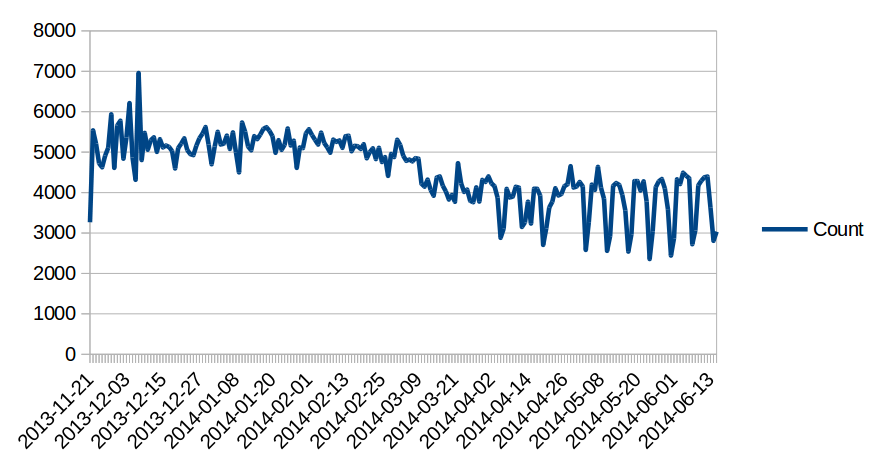
Many stations have been receiving the telemetry transmitted by FUNcube-1, which has now been in orbit for 221 days. The spacecraft, which has been operating nominally since launch, is providing on-board health and science data for the many schools and colleges who are already participating in the project around the world.

Since launch, data has been received by more than 650 stations around the world and today our online Data Warehouse received its one millionth packet of information. The Warehouse is now storing more than 256 MB of telemetry which is available for educational and research use.

The FUNcube team have been successful in capturing almost 25% of all the telemetry transmitted including almost all of the Whole Orbit Data. This success is a great tribute to our designers of the Flight software, the Dashboard programme and the matching Data Warehouse.

Count of FUNcube-1 data uploads since launch

Count of FUNcube-1 data uploads since launch

The FUNcube team are also immensely grateful to all the schools, colleges, radio amateurs and other listeners who are providing this data and want to encourage everyone to continue to listen to FUNcube-1 and to upload the data to the Warehouse. This will help enable the project to continue to provide a complete and current data set for analysis.

The team would, of course, also love to have additional receiving stations in the FUNcube Ground Station Network. This applies especially to anyone near the poles or who is located on an island in the middle of ocean. Their involvement would help  improve the rate of data capture still further.

The FUNcube records show that there were three stations who actually managed to upload the same one millionth packet to the Warehouse today. They are G0EID, OM3BC and DL3SER. If they could contact “operations at funcube.org.uk” we will arrange them to send them a small prize to honour their contribution to the project.

There will be a presentation on FUNcube-1 at 11:15 am BST on Saturday, July 26 at the AMSAT-UK International Space Colloquium which takes place at the Holiday Inn, Guildford, GU2 7XZ. The event is open to all, admittance £10 per day, further details at https://amsat-uk.org/colloquium/colloquium-2014/

Data Warehouse – Telemetry Archive http://warehouse.funcube.org.uk/

Dashboard App – Telemetry Decoder http://funcube.org.uk/working-documents/funcube-telemetry-dashboard/

FUNcube website http://www.funcube.org.uk/

FUNcube Yahoo Group https://amsat-uk.org/funcube/yahoo-group/

FUNcube Forum http://forum.funcube.org.uk/

LituanicaSAT-1 FM Transponder Active

LituanicaSAT-1 Camera and FM Voice Transponder

LituanicaSAT-1 Camera and FM Voice Transponder

The LituanicaSAT-1 (LO-78) team have announced activation of the FM transponder.

Dear radio amateurs,

I want to notify that finally after a long break (mainly due to ground station maintenance works) we have switched the transponder on again. Duty cycle will depend on battery voltage level. All other telemetry is inactive to save power. We hope the signal should be even better now as the satellite is descending steadily to 300 km and wish you all good QSOs! Next update in 24 hours.

73,
Laurynas Maciulis
LY1LM, LY5N

LituanicaSAT-1 will in the coming weeks re-enter into the Earth atmosphere and burn up, this may occur by August 5. Note: It is understood that JSpOC mixed up the IDs of the satellites that were launched from the ISS on February 28 giving rise to a misleading date for re-entry of LituanicaSAT-1. It is ARDUSAT 2, which was deployed with LituanicaSAT-1 that is expected to decay on July 2.

LituanicaSAT-1 FrequenciesFrequency are approximately 435.1755 MHz (+/- 10 kHz Doppler shift) for the downlink and 145.950 MHz for the uplink with 67 Hz CTCSS.

The tiny satellite is just 10x10x10 cm with a mass of 1.090 kg yet it has a VGA camera and a 145/435 MHz FM voice transponder, designed and built by Lithuanian radio amateurs.

The prototype of the FM repeater has been operating in the home of its designer Žilvinas Batisa LY3H in Elektrėnai, Lithuania. Further information at http://ly3h.epalete.com/?p=303

FM transponder operating techniques http://www.dk3wn.info/p/?p=44412

LituanicaSAT-1 CubeSat https://amsat-uk.org/2014/02/27/lituanicasat-1-cubesat/

Reports should be sent to: ly5n at qrz.lt

LituanicaSAT-1 was built by students from Vilnius University and deployed from the International Space Station (ISS) on February 28, 2014.

There will be a presentation on LituanicaSAT-1 by Gintautas Sulskus at 12pm BST on Saturday, July 26 at the AMSAT-UK International Space Colloquium which takes place at the Holiday Inn, Guildford, GU2 7XZ. The event is open to all, admittance £10 per day, further details at https://amsat-uk.org/colloquium/colloquium-2014/

ARTSAT1:INVADER CubeSat – Cosmic Poem

ARTSAT Project InvaderOn Saturday, June 28, the ARTSAT1:INVADER CubeSat will transmit a Cosmic Poem on 437.200 MHz FM.

The announcement says:

Sound art, experimental poetry practice on an artificial satellite by Tomomi Adachi and Akihiro Kubota.

Berlin-based Japanese sound poet/performer/composer, Tomomi Adachi and Japanese Media Artist, Akihiro Kubota will send a program code to ART satellite ARTSAT1:INVADER, the artificial satellite will interpret the code, perform a sound poem in the orbit with a voice synthesizer chip, and broadcast the voice directly to the earth by radio a few times in two weeks from June 21, 2014 (the solstice). The broadcasting will reach many major cities in the world. Probably this is the first experiment of sound art and experimental poetry in outer space by human beings.

ARTSAT1:INVADER

ARTSAT1:INVADER

How to listen

Times and places of the broadcasting will be announced just before the performance on http://cosmicpoem.wordpress.com/, http://artsat.jp/ and https://twitter.com/CosmicPoem, https://twitter.com/INVADER_ARTSAT.
The poem will be repeated several times in one place. It is a very short poem, of less than 30 seconds with the repetition. Also, please understand that this is an experiment in outer space, the satellite might fail the performances. We try again in that case. For this reason, we recommend you to follow our twitter accounts.
There are three ways to listen to the sound poem:

1. The satellite broadcasts using 437.200 MHz frequency with FM. Prepare a receiver that covers this frequency, then direct an antenna to the satellite. For details, check this site http://makezine.com/projects/make-24/homemade-yagi-antenna/
If you succeeded in recording the sound, it is recommended sending the recording to http://api.artsat.jp/report/ or cosmicpoem@gmail.com
These recordings will be published on http://artsat.jp/ and http://cosmicpoem.wordpress.com/
This would be the mechanical method to listen for people who has rich technical knowledges

2. After the performances, the sounds recorded on the earth will be uploaded into internet sites http://artsat.jp/ and http://cosmicpoem.wordpress.com/ The sounds will be from then on available at the site.
This is the easiest method to listen.

3. Look up at the sky. Imagine the 10 cm cubed small satellite that is moving at an altitude of about 340km with a speed of 7.7km per a Second, and the voice which is synthesized in outer space. Try to listen to the sounds with your imagination. To face toward the satellite is effective. It is really appreciated if you write down what you listened in your mind or make an audio recording of the sound in your imagination then send it to cosmicpoem@gmail.com (please don’t attach files more than 10MB). These materials will be published on http://artsat.jp/ and http://cosmicpoem.wordpress.com/
This is a creative method to listen.

Schedule for the first and second performances in this weekend!

The First Performance, Europe and North Africa
2014-06-28 07:26 (UTC)
June 28 2014, 09:26 (CEST)
over San Sebastian (Spain)
Covered major cities: London, Berlin, Paris, Madrid, Dublin, Copenhagen, Warsaw, Marrakesh, Tunis

The Second Performance, East/Central USA and East Canada
2014-06-28 21:26 (UTC)
June 28 2014, 17:26 (EDT)
over Ohio (USA)
Covered major cities: New York, Chicago, Toronto, Montreal, Miami, Houston, Kansas City

About Poetry

Due to a limitation in the satellite’s memory capacity (128 bytes), the poem needs to be short. Still, it contains many cultural references. Firstly, this is sound poetry which doesn’t have any linguistic meanings. The idea of sound poetry is coming from Dadaism in 1910-20s. Dadaist abandoned meanings of language and tried to attain universal language over restrictions of particular language. Sound poetry opened the door not only to experimental poetry, but also to sound art, and noise music. So we see this early experiments as a great precedent of universal language for outer space. The poem has indeed direct quotations from Poster Poem by Raoul Hausmann, one of representative figures of Berlin Dada. Also the Poster Poem is known as a source of monumental sound poem for Kurt Schwitters’ Ursonate.

Part of the cosmic poem is also inspired by Japanese writer, INAGAKI Taruho, whose 1910-20s novels focus on imagined narratives of flight and astronomy.
The poem is a homage to cosmopolitanism in the 1910-20s, which we find very suitable for cosmic imagination. Still, its format is similar to that of traditional Japanese Tanka, a short poem that has a 5-7-5-7-7 syllabic structure. We adopted this form because it works as a form of short code. Moreover, the voice synthesizer chip in the satellite is specialized in Japanese phonetic system. There are inserted phrases in the basic structure that have a direct phonetical connection to Hausmann’s poem. The phrases are also understood as a lament for Laika, the first telluric animal that made sounds on orbit with Soviet spacecraft Sputnik 2 on November 3, 1957. Possibly Laika died in several hours in the spacecraft from overheating.

This poem is written as a program code for a computer on the satellite. The computer interprets the code each time, each performance is slightly different. In this respect, this performance is not so distant from a regular performance by humans.

Probably, this cosmic poem is the first experimental poetry/sound art practice in outer space. Or maybe the second one, if really Lucia Pamela made her recording of Into Outer Space With Lucia Pamela on the moon in 1969.

http://en.wikipedia.org/wiki/Sound_poetry
http://en.wikipedia.org/wiki/Raoul_Hausmann
http://en.wikipedia.org/wiki/Kurt_Schwitters
http://en.wikipedia.org/wiki/Laika
http://en.wikipedia.org/wiki/Lucia_Pamela

About ARTSAT1:INVADER

The now-developing art satellite “ARTSAT1: INVADER” is 10cm cubed, and weighs 1.8kg, it was launched on Feb. 28 2014. The “ARTSAT Project” carries the plan of creating the world-first art satellite forward; the satellite that will be used mainly for art.
To trace the position of INVADER, see
http://artsat.jp/en/invader

ARTSAT project website http://artsat.jp/

About Artists

Tomomi Adachi (Artist)
Tomomi Adachi is a performer/composer, sound poet, instrument builder and visual artist. Known for his versatile style, he has performed his own voice and electronics pieces, site-specific compositions, improvised music and contemporary music works by John Cage, Cornelius Cardew, Christian Wolff and others in all over the world including Tate Modern, Maerzmusik, Centre Pompidou, Poesiefestival Berlin, Merkin Hall, Tempelhof Airfield, STEIM and Experimental Intermedia. As the only Japanese performer of sound poetry, he performed Kurt Schwitters’ “Ursonate” as a Japan premiere in 1996. Also he directed Japanese premiere of John Cage’s “Europera5” in 2007. CDs include the solo album from Tzadik, Omegapoint and naya records. He was a guest of the Artists-in-Berlin Program of the DAAD for 2012.
http://www.adachitomomi.com/

Akihiro Kubota (Artist / Professor, Tama Art University)
Born in 1960 in Osaka, KUBOTA is a professor of the Art & Media Course in the Information Design Department of Tama Art University. He earned his doctorate at the University of Tokyo School of Engineering. He has pioneered the development and synthesis of a broad spectrum of hybrid creative endeavors, including satellite art (artsat.jp), bioart (bioart.jp), digital fabrication (fablajapan.org), and sound performance with instruments he has invented (hemokosa.com). He is the author of Kieyuku Computer (Disappearing Computer–Human Interface; Iwanami Shoten, 1999), editorial supervisor of Post-Techno(logy) Music (Ohmura Shoten, 2001), and translation supervisor of the Japanese editions of FORM+CODE in Design, Architecture, and Art (Casey Reas, Chandler McWilliams, LUST; BNN, 2011) and Visual Complexity: Mapping Patterns of Information (Manuel Lima; BNN, 2012) etc.
http://hemokosa.com/

Cosmic Poem https://cosmicpoem.files.wordpress.com/2014/06/cosmicpoem_pressja2.pdf

Cosmic Poem Project Website http://cosmicpoem.wordpress.com/

Contact
cosmicpoem@gmail.com