Second Birthday of FUNcube-1

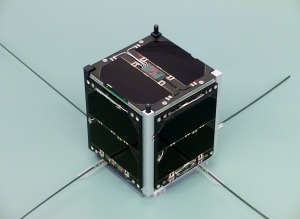
FUNcube-1 flight model - Image credit Wouter Weggelaar PA3WEG

AO-73 (FUNcube-1) – Image credit Wouter Weggelaar PA3WEG

FUNcube-1 (AO-73) was launched into space two years ago on November 21, 2013.

We are delighted to be able to report that more than 900 stations, including many schools around the world, have received the telemetry from the spacecraft since launch. Our Data Warehouse is storing more than 750 MB of data from almost 1 million data packets. We are very grateful to everyone who has been contributing to the success of this mission. Please continue to keep the data flowing as it will provide a valuable resource for students in the future.

The stats continue – speeding along at around 17,500 mph, FUNcube-1, which had a launch mass of just 982 grams, has completed more than 10,500 orbits of the earth. This means a total distance travelled of more than 260 million miles.

All telemetry sensors continue to provide valid data, real time, whole orbit and high resolution channels alike. The flight code is really robust and we have only had three unexpected “events” since launch. Two of these we believe to have been caused by noise of the command receiver being incorrectly interpreted as a command and only one appears to have been caused by a RAM error. The battery and solar panels also continue to work perfectly and provide a very positive power budget.

We have sent out many Fitter messages for school and other similar events. On November 17, 2015 there was a demonstration at Thorne Green Top School in Yorkshire. Here is a report from Dave Ryan EI4HT/M0GIW:
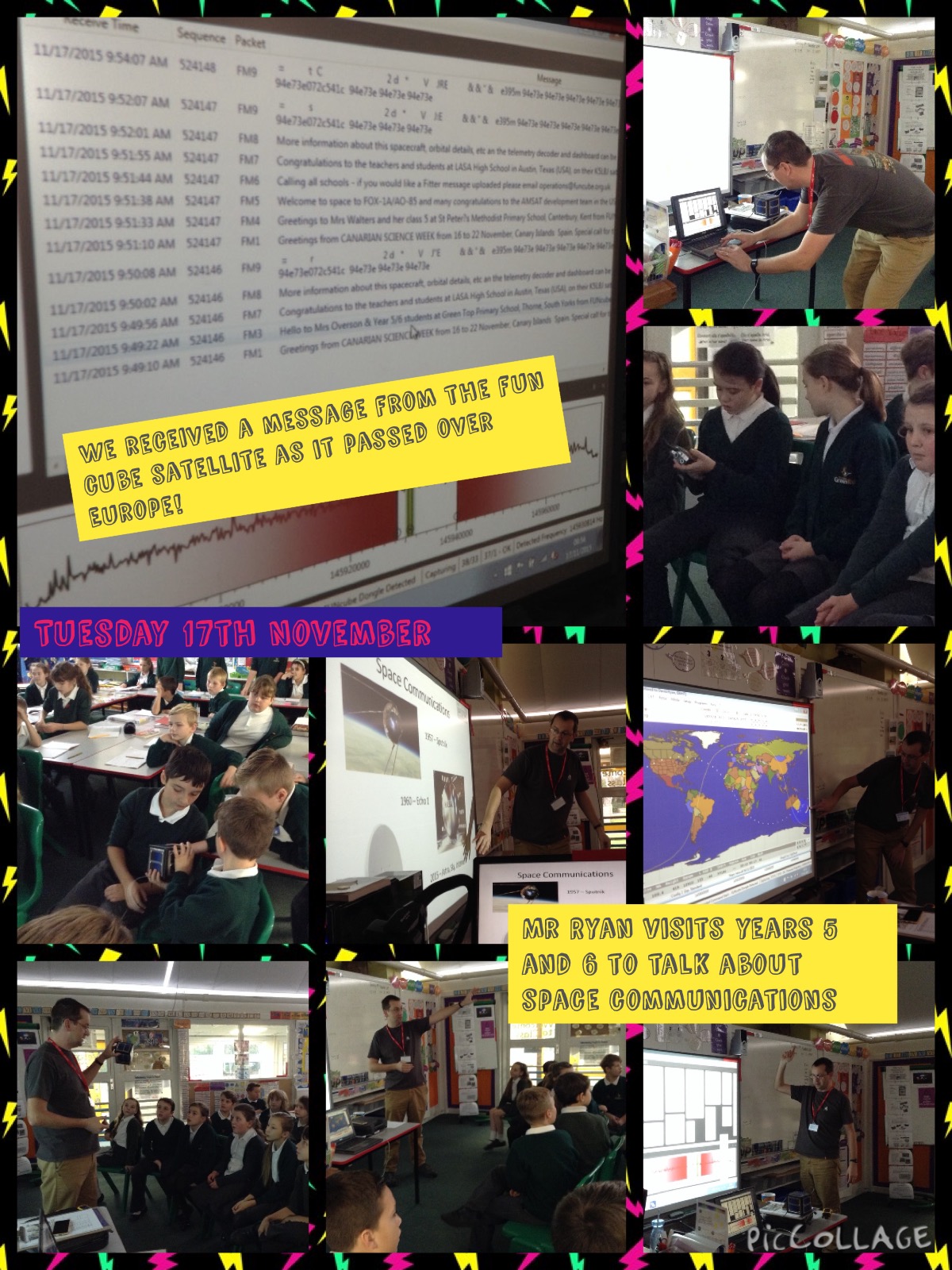
FUNcube-1 Educational Outreach - Thorne Green Top School in Yorkshire

FUNcube-1 Educational Outreach – Thorne Green Top School in Yorkshire

Good Morning All  

Firstly -thanks to all for your help, we had a great morning at Green Top and the highlight was FUNcube.

I started with a slide show talking about communications from cave paintings all the way up to smartphones, we looked at space communications and travel from Sputnik to Astra and Apollo to the Millennium Falcon! We spoke about satellites and how they are used every day and how we all got to watch “I’m A Celebrity” via Satellite last night from Australia.

I brought in lots of props too, some old Motorola MX330 radios, some PMR 446, and a marine band radio .I also had a small model of a CubeSat that I knocked up over the weekend, I also passed around some NOAA images from last week’s Abigail storm and I had a few QSL cards from ISS and MIR from years ago when I lived in Ireland.  

The FUNcube pass was great, really strong signals, I had my turnstile and FCD set up and had audio through speakers and used the class projector to show Satpc32 and the Dashboard.  

There was a great buzz of excitement when we got the first packet and even more when the Fitter messages came through. The kids were fascinated to see the signal arrive just as the software predicted and then hear the telemetry and the decode.  

After the pass we were able to look at the Warehouse online and print off the QSL card and certificate.

 I didn’t get a chance to take many pics but Mrs Overson will update the School Blog and she took lots of pics.

http://greentopschool.co.uk/blog

Once again thanks to all at FUNcube, looking forward to Tim Peake on the ISS in the New Year and planning another visit to the School then.

Regards

Dave EI4HT / M0GIW

PS: I was back dropping my own kids off this morning and Mrs Overson told me they have printed a QSL card and Certificate for each of the students and they have used them for their class journals.

As well providing a great educational resource, FUNcube-1 operates at night and generally at weekends with the linear transponder active for radio amateurs to use for communications. The transponder continues to provide an excellent service. As users will be aware, the transponder uplink frequencies vary with receiver temperature. The RX temp telemetry channel is the best one to use for tracking this effect. This does make it quite difficult to use full computer control for transponder operations and we have already developed new oscillator circuits to improve this performance for future missions.

For the telemetry uplinked to the Data Warehouse, it is possible to download special Certificate or QSL Card here http://amsatuk.me.uk/on/funcube_qsl.php and, for transponder users, the “73 on 73 award” continues at https://amsat-uk.org/funcube/73-on-73-award/

The Nayif-1 CubeSat mission, which includes a full FUNcube payload, is expected to be launched into a similar orbit in the first half of next year and will provide an additional level of service to the community.

Meanwhile we hope everyone will continue to have fun with FUNcube-1!

FUNcube-1 https://amsat-uk.org/satellites/communications/funcube-1/
Nayif-1 https://amsat-uk.org/satellites/communications/nayif-1/
FUNcube on Twitter https://twitter.com/FUNcubeUK
AMSAT-UK on Twitter https://twitter.com/AmsatUK
Facebook https://facebook.com/AmsatUK
YouTube https://youtube.com/AmsatUK
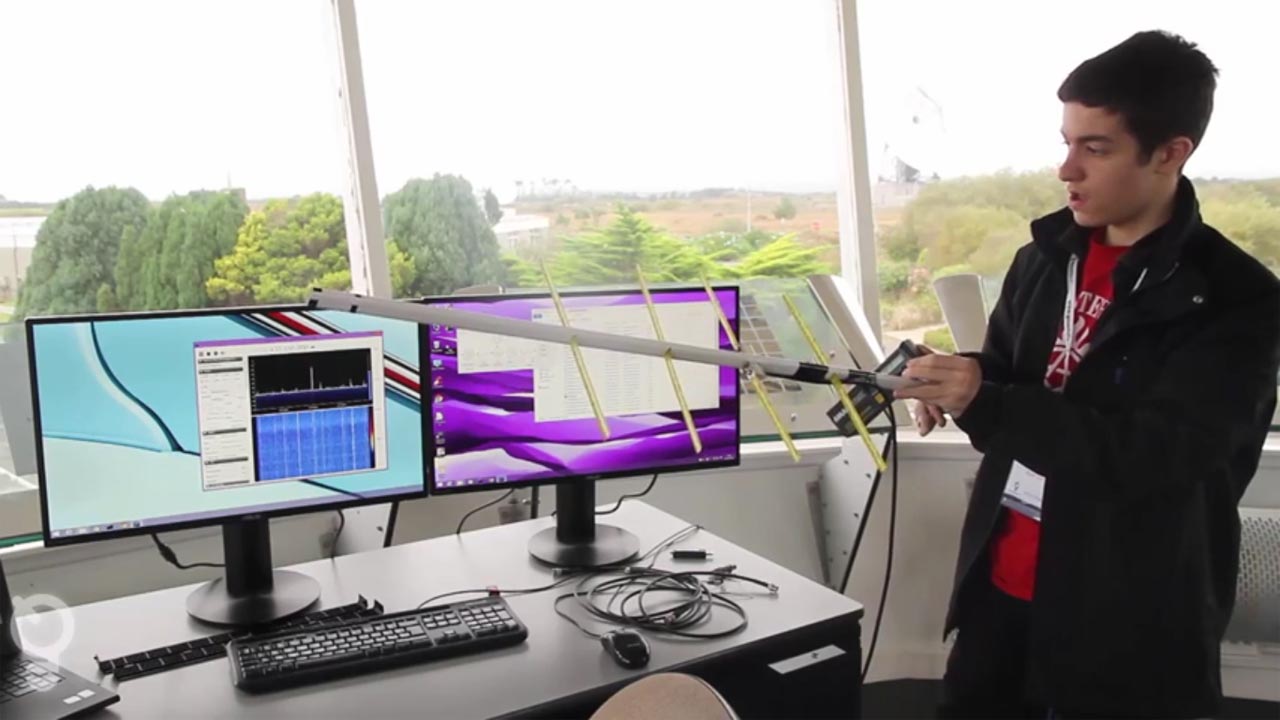
Young people build antennas at Goonhilly

Young people build antennas at GoonhillyYear 11 students have been spending a week’s work experience at Goonhilly Earth Station learning about radio and satellite receivers. They researched and built a low-cost receiver using the FUNcube Dongle Pro+ Software Defined Radio.

Watch the video How to listen to the International Space Station

Goonhilly Earth Station http://www.goonhilly.org/

FUNcube Dongle Pro+ SDR http://FUNcubeDongle.com/

AMSAT-UK at the RSGB Convention

Howard Long G6LVB talking about the FUNcube Dongle SDR at the RSGB Convention Gala Dinner

Howard Long G6LVB talking about the FUNcube Dongle SDR at the RSGB Convention Gala Dinner

The after-dinner speaker at the RSGB Convention Saturday night Gala dinner was Howard Long, G6LVB, who spoke about the trials and tribulations involved in developing the ground station segment of the FUNcube satellite project which became the successful FUNcube Dongle SDR.

The Astro Pi will be used by UK Astronaut Tim Peake KG5BVI on the ISS

The Astro Pi will be used by UK Astronaut Tim Peake KG5BVI on the ISS

On Sunday, October 11 at 11:45 BST Ciaran Morgan M0XTD gave a presentation to the Convention about Amateur Radio on the International Space Station (ARISS) and the upcoming mission to the ISS by UK astronaut Tim Peake KG5BVI.

Ciaran described the Astro Pi which Tim will be using on the ISS. It is hoped this will be used as a video source for the Space Station’s HamTV system.

School Shortlist for Tim Peake Space Station Contact
https://amsat-uk.org/2015/07/14/school-shortlist-tim-peake-iss/

FUNcube Dongle SDR http://FUNcubeDongle.com/

Read the Essex Ham review of the RSGB Convention at
http://www.essexham.co.uk/news/rsgb-convention-2015-review.html

RSGB Letter in PC Pro Magazine

PC Pro Magazine LogoRSGB President John Gould G3WKL highlights Amateur Satellites, FUNcube and the RSGB Youth Committee in a letter, an edited version of which appears on page 30 of the October issue of PC Pro Magazine, in the shops now.

See the full text of John’s letter at http://www.pcpro.link/252rsgb

The letter was a follow-up to an article in the August issue of PC Pro Magazine by Jon Honeyball G1LMS
http://www.southgatearc.org/news/2015/july/ham_radio_in_pc_pro_magazine.htm

Twitter links:
G1LMS – https://twitter.com/jonhoneyball
G3WKL – https://twitter.com/G3WKL
RSGB  – https://twitter.com/theRSGB
Youth Committee – https://twitter.com/theRSGByouth
PC Pro https://twitter.com/pcpro
AMSAT-UK https://twitter.com/AmsatUK

Work continues on ESEO FUNcube-4

Graham Shirville G3VZV working on the ESEO FUNcube-4 amateur radio payload - Credit 2E0OBC

Graham Shirville G3VZV working on the ESEO FUNcube-4 amateur radio payload – Credit 2E0OBC

AMSAT-UK members have been busy this week working on the FUNcube-4 amateur radio payload for the new European Student Earth Orbiter (ESEO) satellite. On Friday, August 7, 2015 they tested the transponder and it seems to work fine. More testing and characterisation will follow over the next few days.

ESEO FUNcube-4 Engineering Model

ESEO FUNcube-4 Engineering Model

This is the third mission within the European Space Agency’s Education Satellite Programme. The satellite, which has a mass of 40 kg and measures 33x33x63 cm, is planned to launch into a Low Earth Orbit (LEO).

The spacecraft will carry a 1260/145 MHz FM transponder and 145 MHz 1200 bps BPSK telemetry beacon to provide a telemetry downlink that can be easily received by schools and colleges for educational outreach purposes. The data will be displayed in an attractive format and provide stimulation and encouragement for students to become interested in all STEM subjects in a unique way.

The target audience is primarily students at both primary and secondary levels and the project includes the development of a simple and cheap “ground station” operating on VHF frequencies in the Amateur Satellite Service. This station is an omni-directional antenna feeding a FUNcube DonglePRO+ SDR receiver which will receive the signals direct from the satellite and transfer the data to specially developed graphical software running on any Windows laptop.

Watch “ESEO Payload Update” by Chris 2E0OBC and Graham G3VZV at 2015 AMSAT-UK International Space Colloquium

Download the ESEO Presentation Slides

2015 International Space Colloquium Presentations Playlist
https://www.youtube.com/user/AMSATUK/playlists

Frequencies Announced for Nayif-1 CubeSat

Deputy project manager of Nayif-1 Fatma Lootah

Deputy project manager of Nayif-1 Fatma Lootah

Nayif-1 is an educational single CubeSat project with the goal of providing an actual space project for Emirati University students. Additionally it is intended to enthuse and educate young people about radio, space physics and electronics.

The 1U CubeSat is a collaboration between the Mohammed Bin Rashid Space Center and the American University of Sharjah both in the United Arab Emirates.

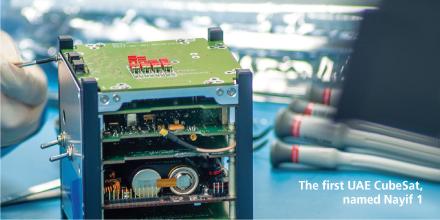
Nayif-1 - Credit Mohammed bin Rashid Space Centre

Nayif-1 – Credit Mohammed bin Rashid Space Centre

The spacecraft will only require simple ground station antennas and an SDR dongle receiver. This will make it uncomplicated for schools and colleges to use with their students.

It is anticipated Nayif-1 will be launched into an elliptical, sun synchronous, Low Earth Orbit (LEO) about 400 by 750 km. In such an orbit the satellite passes over the Emirates at least twice a day. This would allow the morning passes to be used for educational purposes and the evening passes for Amateur Radio communications.

The student team will develop and operate a special ground station for this spacecraft. They will also be developing a unique “Dashboard” to display the received telemetry data and greetings messages in Arabic.

Nayif-1 will incorporate a novel autonomous attitude determination and control system. This will be the first flight of this system. Additionally it will carry a UHF to VHF linear transponder that will have up to 0.5 watt output and which can be used by Radio Amateurs worldwide for SSB and CW communications.

A launch is planned for late 2015 on a SpaceX Falcoln 9.

IARU coordinated frequencies for NAYIF-1:
• 145.940 MHz 1200 bps BPSK FUNcube beacon
• 500 mW inverting SSB/CW linear transponder
– 435.045-435.015 MHz Uplink
– 145.960-145.990 MHz Downlink

Follow Nayif-1 on Twitter https://twitter.com/Nayifone

Nayif-1 https://amsat-uk.org/satellites/communications/nayif-1/