Tevel satellites on SpaceX launch

Tevel satellite under development - credit Herzliya Science Center

Tevel satellite under development – credit Herzliya Science Center

The Tevel mission consisting of 8 satellites developed by the Herzliya Science Center in Israel, each carrying an FM transponder, is expected to launch on January 13 at 15:25 GMT on the SpaceX Falcon-9 Transporter-3 mission. This mission also carries AMSAT-EA’s EASAT-2 and HADES satellites.

The AMSAT News Service reports:

Tevel-1, Tevel-2 ….Tevel-8

Beacon transmissions on 436.400 MHz, (9600bps BPSK G3RUH)
FM transponders uplink frequency: 145.970 MHz|
FM transponders downlink frequency: 436.400 MHz

All 8 satellites will have the same frequencies, so as long as the footprints are overlapping, only one FM transponder will be activated. The satellites were built by 8 schools in different parts of Israel.

Prelaunch TLEs:

Deployment number 28

TEVEL-4/TEVEL-5
1 12345U 22-T3TE 22013.69008102 0.00000000 00000-0 00000-0 0 9997
2 12345 97.3652 83.6317 0010843 246.0911 147.6817 15.12493461 06

Deployment number 30

TEVEL-1/TEVEL-2/TEVEL-3
1 12345U 22-T3TE 22013.69038194 0.00000000 00000-0 00000-0 0 9991
2 12345 97.3658 83.6317 0009074 254.1211 141.2940 15.11975594 07

Deployment number 55

TEVEL-6/TEVEL-7/TEVEL-8
1 12345U 22-T3TE 22013.69375000 0.00000000 00000-0 00000-0 0 9991
2 12345 97.3676 83.6318 0009046 252.0606 161.7026 15.11914367 05

Control station will be 4X4HSC at the Herzliya Science Center.

[ANS thanks David Greenberg, 4X1DG, for the above information]

IARU Satellite Frequency Coordination information
http://www.amsatuk.me.uk/iaru/finished_detail.php?serialnum=744

Launch of EASAT-2 and HADES satellites

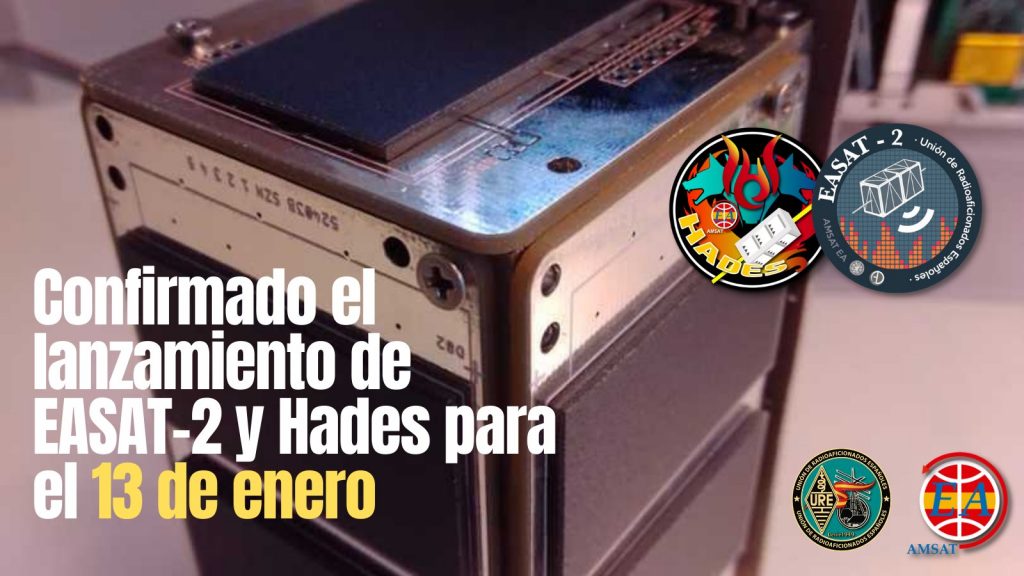
EASAT-2 and HADESThe EASAT-2 and HADES satellites, each carrying an FM transponder and digipeater, are expected to launch on January 13 at 15:25 GMT on the SpaceX Falcon-9 Transporter-3 mission.

A translation of a post by Spain’s URE reads:

The Scottish space broker Alba Orbital has confirmed the correct integration of the EASAT-2 and Hades satellites in the Falcon-9vehicle, using the company’s AlbaPOD ejector. It is confirmed, except for exceptional circumstances, the launch for this Thursday, January 13, initially at 15.25 UTC (16.25 Spanish peninsular time). Both satellites should have been launched a year ago, but the problems of the Momentusintegrator, on whose Vigoride vehicle albaPod ejectors of Alba Orbital were to be integrated with the American administration, caused this delay. Momentus was replaced by Exolaunch for the flight.

Both satellites offer FM voice communications and data relay in FSK or AFSK up to 2400 bps,such as AX.25 or APRS frames. They also broadcast voice beacons on FM with the callsigns AM5SAT and AM6SAT,as well as CW.

The EASAT-2satellite, designed and built jointly by AMSAT-EA and students of the European University of the Degrees in Aerospace Engineering in Aircraft and in Telecommunication Systems Engineering,with contributions from ICAI in the communications part, incorporates as experimental cargo basaltic material from Lanzarote,similar to lunar basalts, provided by the research group on meteorites and planetary geosciences of the CSIC at the Institute of Geosciences, IGEO (CSIC-UCM) and that could be used as a building material on the Moon. This project was promoted and has the collaboration of the ETSICCP (UPM).

The UNESCO world geopark of Lanzarote and Chinijo archipelago has been used for various investigations as an analogue of the Moon and Mars, including also the instruction of ESA astronauts. The selected basaltic material meets the requirements to be used as a simulant of the basalt existing on the Moon. The purpose of the experiment is to determine its evolution in space based on periodic measurements of some of its properties. Although the experiment is limited and constitutes a first phase of this type of study, it is an important milestone as it is the first of its kind introduced on such a small satellite.

As for Hades,its payload consists of a miniature camera module that sends the captured images as an audio signal in SSTVmode. The SSTV formats it uses are compatible with Robot36, Robot72, MP73 and MP115.

The design is based on the one used in the successful mission of the PSAT2satellite, an amateur radio satellite of the United States Naval Academy and brno University of Technology. This chamber has been operational since June 25, 2019: (http://www.aprs.org/psat2.html).

The camera chip is the Omnivision OV2640, which provides a resolution of up to 2M pixels and compressed output in JPEG. Resolution is limited by the CPU’s internal memory (MCU) that controls the camera to 320×240 (typical) or 640×480 maximum. The MCU selected for the control is the STM32F446RET6, which has the smallest possible footprint with connection to DCMI peripheral, necessary for connection with the camera.

Images can be stored on a 2 MB serial flash memory. The complete SSTV encoder has managed to be implemented in a 4-layer PCB with dimensions of only 38x38mm.

The MCU can be fully controlled from ground stations. The firmware allows the sending of images of the camera live,of imágenes previously saved in the flash memory or of images encoded in ROM. It also provides advance programming of image acquisition and PSK telemetry with the current status (event counters, temperature, voltage, light conditions, etc.) and a brief summary.

The described module has been developed and manufactured at the Department of Radioelectronics of the Brno University of Technology in the Czech Republic. Both hardware and firmware designs with the source codes will be available on Github under the MIT license (https://github.com/alpov/SatCam).

Initially only the EASAT-2 repeater is active. Hades’ will be activated by telecommand a few days after launch.

The frequencies coordinated with IARU for both satellites are as follows:

EASAT-2
  • 145.875 MHz uplink, Modes: VOICE FM (without undertone) and FSK 50 bps, AFSK, AX.25, APRS 1200 / 2400 bps
  • 436.666 MHz downlink, Modes: FM voice, CW, FSK 50 bps, FM voice beacon with AM5SAT callsign

HADES

  • 145.925 MHz uplink, Modes: VOICE FM (without undertone) and FSK 50 bps, AFSK, AX.25, APRS 1200 / 2400 bps
  • 436.888 MHz downlink, Modes: FM voice, CW FSK 50 bps, SSTV Robot 36, FM voice beacon with AM6SAT callsign

The description of the transmissions can be found in the following document:

EspañolEnglish:

AMSAT-EA appreciates the reception of telemetry, voice beacons and SSTV images. A paper QSL is sent to those who send their transmissions. It can be done through the following link: http://data.amsat-ea.org

First ever Svalbard QO-100 DXpedition JW100QO

Map of Svalbard showing the QO-100 station location

Map of Svalbard showing the QO-100 station location

A DXpedition to Svalbard (78° North) is planned for April 19-26 with the callsign JW0X. In addition to the five HF stations (FT8/FT4/RTTY/SSB/CW) the team will activate the first QO-100 satellite DX Station callsign JW100QO April 22-24.

Making the first ever QO-100 calls from Svalbard is the biggest challenge of this DXpedition. ON4CKM Cedric, ON4DCU Patrick and ON5UR Max will make a rugged snowmobile ride of almost 100 km in temperatures of -20° – 25° Celsius to reach their goal. Kapp Linné is the only place in the area that allows a view of the QO-100 satellite at only 3° above the horizon. Svalbard also lies on the edge of the satellite area (footprint), which makes the challenge even greater. We want to give as many radio amateurs as possible the opportunity to work this first QO-100 DXpedition. For this unique challenge we also have a special callsign JW100QO.

Further info at:

Svalbard QO-100 JW100QO April 22-24
https://www.dx-adventure.com/en/qo-100-our-goal/

Svalbard JW0X April 19-26
https://www.dx-adventure.com/en/svalbard-dx-pedition/

QO-100 geostationary amateur satellite transponder provides coverage from Brazil to Thailand, see
https://amsat-uk.org/satellites/geo/eshail-2/

XW-3 (CAS-9) Satellite Launch December 26

XW-3 (CAS-9) satellite

The CAMSAT XW-3 (CAS-9) satellite carrying a 145/435 linear transponder was launched from the Taiyuan Satellite Launch Center at 03:11:31 GMT on December 26, 2021.

XW-3(CAS-9) satellite was piggybacked on the rocket with primary payload ZY-1(02E) satellite. The satellite orbit is a circular sun-synchronous orbit with an altitude of 770.1 kilometers and an inclination of 98.58 degrees, the running cycle is 100.14 minutes.

The functions of XW-3(CAS-9) satellite include UHF CW telemetry beacon, GMSK telemetry data transmission, V/U mode linear transponder, a visible light band space camera and an experimental thermoelectric generator for high school students.

Deployment from the launcher took place at 98.858° east longitude and 28.413° north latitude at 03:35:58 GMT, location close to Western Australia. The amateur radio CW beacon and GMSK telemetry signals were activated approximately 38 seconds after the satellite separated from the launch vehicle, and the linear transponder was switched on approximately 49 seconds later.

Download the XW-3 (CAS-9) Amateur Radio Satellite User’s Manual V1.11

Download the XW-3 (CAS-9) Amateur Radio Satellite Launch Time Sequence

TLEs

Doppler measurements show that XW 3 (CAS 9) is object 50466 (2021-131B).

Frequency CW beacon: 435.57515 MHz.

XW-3(CAS-9)
1 50466U 21131B   21361.15310929 -.00000045  00000-0  00000+0 0  9991
2 50466  98.5981  73.3722 0003165 299.3678  60.7297 14.38435478   149

Updated at 11:45 UTC on the 27th Dec 2021

SatPC32 Doppler.SQF Line

XW-3(CAS-9),435180,145870,USB,LSB,REV,0,0

ISS SSTV in late December

Amateur Radio on the International Space Station (ARISS) logoThe ARISS team will be supporting Slow Scan TV (SSTV) operations from the International Space Station during the period of December 26-31.

The images will be related to lunar exploration. The transmissions should be available worldwide on 145.800 MHz FM. The planned SSTV mode is PD 120.

Planned start and stop times are currently listed as:
Start – Dec 26 about 18:25 GMT
Stop – Dec 31 about 17:05 GMT

The signal should be receivable even on a handheld with a 1/4 wave whip. If your rig has selectable FM filters try the wider filter for 25 kHz channel spacing.

In this video Randy Hall K7AGE shows you how to receive Slow Scan TV (SSTV) images from the International Space Station (ISS).

Several times a year SSTV images are sent from the ISS. In December 2021 from the 26th through the 31st SSTV images will be transmitted.

A simple two-meter amateur radio, or scanner, is able to receive the signal on 145.800 MHz. You can receive the signal using the antenna on an HT, mobile antenna, or a vertical antenna mounted outside.

I show you how to learn when the ISS will be in the range of your station.
Heavens-Above is a good website to use and it will generate a list of passes for your station.

To decode the SSTV signal you will need software on a computer or portable device. I show MMSSTV on my Windows computer decoding the SSTV signal. I also show decoding SSTV on my iPad.

Watch How to receive SSTV images from the ISS

After you receive your ISS images, you may apply for a certificate at –
https://www.spaceflightsoftware.com/ARISS_SSTV/submit.php

K7AGE video of SSTV sample transmissions
https://www.youtube.com/watch?v=sG4UhlByFyw&t=870s

K7AGE video shows how to build a simple 2 meter antenna
https://www.youtube.com/watch?v=HkmD3Sgz7Q0&t=697s

Heavens Above https://www.heavens-above.com/main.aspx

MMSSTV https://hamsoft.ca/

iPad SSTV https://www.blackcatsystems.com/software/sstv.html

Android https://play.google.com/store/apps/details?id=xdsopl.robot36&hl=en_US&gl=US

Linux http://users.telenet.be/on4qz/qsstv/index.html

Check the ARISS SSTV blog for the latest information http://ariss-sstv.blogspot.com/

ARISS SSTV Award https://ariss.pzk.org.pl/sstv/

You can get predictions for the ISS pass times at https://www.amsat.org/track/

Useful SSTV info and links https://amsat-uk.org/beginners/iss-sstv/

FUNcube-1 (AO73) Celebrating eight years in orbit!

FUNcube-1 Telemetry as at Nov 21, 2021

FUNcube-1 Telemetry as at Nov 21, 2021

November 21, 2021, marks the eighth birthday of the FUNcube-1 CubeSat. Remarkably the tiny spacecraft, launched from Russia on November 21, 2013, continues to work well having travelled more than a billion kilometres in space.

During the past couple of months, the spacecraft’s orbits have been running just along the edge of the terminator. Initially we had effectively full sun with no eclipses but at the beginning of this month it appears that the solar panels were not receiving enough solar radiation to keep the battery fully charged.

FUNcube-1 was transmitting continuous high-power telemetry and was therefore consuming maximum power. The screenshot above is from the AMSAT-UK/BATC groundstation at Goonhilly Earth Station. The FUNcube Dashboard shows the rapid decline in the bus voltage from an already below normal 8.0V down to 7.8V. The spacecraft was switched to “safe” mode on the afternoon of November 18th. This reduced to total power consumption by almost 50% and, as can been seen, the spacecraft is again in a happy “power positive” situation.

Although safe mode provides less than 20mW of downlink RF, it is remarkable how many stations are still receiving and decoding the 1k2 BPSK telemetry. This is a good point at which to say a massive thank you to the many many stations around the world who, even after eight years, are continuing to submit their data to the FUNcube Data Warehouse. It really is valuable to the team and has really helped us to understand what is going on up there!

We will continue to monitor the telemetry over the next few weeks and plan to return FUNcube-1 to nominal autonomous operation, with the transponder on when the spacecraft is in eclipse, as soon as possible.

Interestingly, it appears that we will not be having any more “full sunlight” periods for the foreseeable future., however those that we have experienced have provided some good data on how hot a 1U CubeSat can become in such circumstances!