A Ham Radio AX.25 Open Source Soundcard Modem

Audio from AX.25 packet radio - Image credit Sivan Toledo 4X6IZ

Audio from AX.25 packet radio – Image credit Sivan Toledo 4X6IZ

AX.25 packet radio is currently the most popular data protocol for use in CubeSats.

Radio amateur Alejandro Santos LU4EXT is developing extmodem an open source APRS compatible AX.25 packet radio modem.

It is currently capable of both sending and receive packets at 1200 bps AFSK. The main feature of the software is that it is currently running three different demodulators in parallel, increasing the quality of reception. The first modem is Thomas Sailer HB9JNX / AE4WA‘s multimon, the other two are described by Sivan Toledo 4X6IZ in an article in the July/August 2012 issue of QEX.

Download extmodem for Windows from
http://extradio.sourceforge.net/extmodem.html

QEX article – A High-Performance Sound-Card AX.25 Modem
http://www.tau.ac.il/~stoledo/Bib/Pubs/QEX-JulAug-2012.pdf

APRS destination address for ham radio satellites
https://amsat-uk.org/2013/08/23/aprs-destination-address-for-ham-radio-satellites/

LU4EXT on Twitter https://twitter.com/alejolp

SpaceUp India 2012 Videos

FSpace F-1 Amateur Radio CubeSatDhruva Space have released several videos recorded at the SpaceUp India event held in December 2012.

Among the presentations are those from
• Thu Trong Vu XV9AA
• Hackerspace Global Grid
• Suri VU2MY

Watch SpaceUp India 2012 – F1 CubeSat from Vietnam, Thu Trong Vu XV9AA

Watch SpaceUp India 2012 – Hackerspace Global Grid, Uni Stuttgart

Watch SpaceUp India 2012 – Amateur Radio, Suri, VU2MY

Other presentations from the event can be seen at http://www.youtube.com/user/DhruvaSpace

SpaceUp India 2013 takes place December 6-7 in Manit, Bhopal http://spaceupindia.org/

Facebook https://www.facebook.com/pages/SpaceUp-India/479467792071870

SpaceUp http://spaceup.org/

Giant leap for radio ham’s Pi-powered teddy bear

2013-08-26--14-45-58-PIE-51FBBC News reports on radio amateur Dave Akerman M6RPI‘s successful 434 MHz balloon flight on Monday, August 26, 2013.

The balloon carried transmitters on 434.200 MHz and 434.250 MHz and transmitted images using the amateur radio Slow Scan Digital Video (SSDV) standard, they are available here.

The BBC say:

A soft toy controlled by a Raspberry Pi computer has re-created Felix Baumgartner’s record-breaking skydive.Mr Baumgartner made the highest ever freefall in October 2012 when he jumped from a balloon about 39km up.

A bear called Babbage has now leapt from a similar height after ascending beneath a hydrogen-filled balloon.

The Raspberry Pi low-cost micro-computer inside Babbage transmitted his position and shot stills and video throughout the flight and descent.

Read the BBC news story at http://www.bbc.co.uk/news/technology-23840596

See the SSDV images at http://ssdv.habhub.org/

Slow Scan Digital Video (SSDV) Guide http://ukhas.org.uk/guides:ssdv

Dave M6RPI website http://www.daveakerman.com/

Dave M6RPI had made an initial attempt on Saturday but the bear’s release mechanism didn’t work
http://www.southgatearc.org/news/august2013/434_mhz_balloons_launch_this_weekend.htm

To get details of upcoming UK balloon launches subscribe to the UKHAS Mailing List by sending a blank email to this address: ukhas+subscribe@googlegroups.com

UK radio ham’s Lunar CubeSat to go ahead

Pocket Spacecraft

Pocket Spacecraft

Michael Johnson M0MJJ gave a presentation on his Pocket Spacecraft: Mission to the Moon project to the AMSAT-UK International Space Colloquium held in July at Guildford.

Michael - Founder

Michael – Founder

He aimed to raise funding for the project by using the Kickstarter crowd-funding website.

The 60 fund raising period ended on August 26, 2013 and it fell short of target raising pledges for £69,079 ($107,735) out of the £290,000 ($452,284) goal. However, it appears that thanks to donations from other sources, the Pocket Spacecraft: Mission to the Moon is still going ahead.

Update #6 on the Kickstarter page says:

“More than 350 private individuals, universities and companies have backed the project via Kickstarter so far, but what we weren’t expecting are the amazing direct offers of financial support and support in kind that are too big or unable to be pledged via Kickstarter. Thanks to this support from private individuals, companies, government bodies, non-profits and others, we’re excited to be able to confirm that Pocket Spacecraft: Mission to the Moon will go ahead!”

Melania - Microgravity Experiment Lead

Melania – Microgravity Experiment Lead

The plan is that a 3U CubeSat will carry Pocket Spacecraft known as ‘Scouts’ to the Moon. A ‘Scout’ is a disk with flexible electronics, smaller than a CD, containing a transceiver, antenna and solar cells. The CubeSat should first release a batch of the wafer thin Scout satellites into Earth orbit and then deploy another batch of the Scout satellites into Lunar orbit.

It is understood the mission plans to use the 435 MHz and 2400 MHz bands.

The Kickstarter page says “If you are, or would like to be, a radio amateur, we’ll show you how to communicate directly with your spacecraft in space when it is nearby using inexpensive UHF and S-band equipment. Communication at (cis-)lunar distances is more expensive (typically requiring 5-24m+ steerable dishes), but available to some clubs and enthusiasts.”
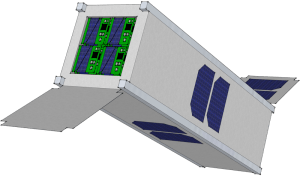
KickSat

KickSat

Pocket Spacecraft is believed to be the first UK satellite project to have used Kickstarter. Several USA satellite projects have already successfully raised money on Kickstarter:

Radio ham Zac Manchester KD2BHC used Kickstarter to raise $74,586 in donations to fund the development and deployment of 200 amateur radio KickSat sprite satellites expected to take place later this year.

Radio amateurs Jeroen Cappaert KK6BLQ, Joel Spark KK6ANB and Jonathan Oxer VK3FADO are on the team of the ham radio satellite project ArduSat. They managed to raise donations of $106,330 in just 30 days.
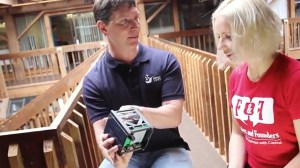
Tim DeBenedictis and Anna Vital with the SkyCube satellite

Tim DeBenedictis and Anna Vital with the SkyCube satellite

SkyCube which will transmit on 915 MHz in the 902-928 MHz amateur radio band raised $116,890.

Kickstarter is not just about raising large sums of money, for example Sandy Antunes used Kickstarter to raise $2,780 to buy a ham radio transceiver and antennas to create an amateur radio satellite ground station Calliope.

Read Pocket Spacecraft Update #6 at
http://www.kickstarter.com/projects/1677943140/send-your-own-pocket-spacecraft-on-a-mission-to-th/posts/576993

Kickstarter page http://www.kickstarter.com/projects/1677943140/send-your-own-pocket-spacecraft-on-a-mission-to-th/

Daily Mail article http://www.dailymail.co.uk/sciencetech/article-2352652/Now-send-personalised-spacecraft-moon-just-99–monitor-it-travels-space.html

Ham Radio Satellites at Tokyo Ham Fair

JAMSAT stand at the Tokyo Ham Fair 2013

JAMSAT stand at the Tokyo Ham Fair 2013

The JARL Ham Fair 2013 was held at Tokyo Big Sight, Ariake, Tokyo on August 24-25. JAMSAT and several amateur radio satellite projects were represented.

The University of Tsukuba CubeSat ITF-1 YUI “Binding” support project was there. The formal name ITF-1 comes from the initial letter of the university slogan “Imagine The Future”.  The satellite also has a popular name YUI which means bond or binding in Japanese, it came from the project’s concept‚ “Creating the Worldwide Human Community”.

The ITF-1 satellite beacon on 437.525 MHz will send telemetry by a Morse Code audio tone on an FM transmitter running 300 milliwats output. It should be possible to receive it using simple equipment such as a handheld transceiver or scanner.

According to the ITF-1 website the “Binding” support project is organized by the student volunteers to support the construction of a consolidated network and expand public relation activities with the aim of encouraging many reception reports when the satellite is launched.  ITF-1 will fly with the primary payload the Global Precipitation Measurement Dual-Frequency Precipitation Radar GPM-DPR satellite in 2014.

ARTSAT stand at the Tokyo Ham Fair

ARTSAT stand at the Tokyo Ham Fair

The ARTSAT stand featured the Invader CubeSat which is being developed by students at Tama Art University. The IARU has coordinated 437.325 MHz and 437.200 MHz for Invader which aims to have a camera for Earth imaging and a Digi-Talker, to transmit voice data using FM. Invader will be on the same launch as ITF-1.

Also at the fair was the SPROUT project. This nano-satellite, built by students from Nihon University, is 20 x 20 x 22 cm with a mass of 6.7 kg. It plans to launch with the L-band (1236.5 MHz/1257.5 MHz/1278.5 MHz) Synthetic Aperture Radar (SAR) satellite ALOS-2 in December, 2013.

SPROUT will have a digi-talker and will transmit, using Slow Scan TV (SSTV) and FM packet, pictures of the Earth taken by an on-board camera. It is believed that radio amateurs will be able to make use of the digipeater and possibly even command when pictures are taken.

ITF-1 project in Google English http://tinyurl.com/ITF-1-Yui-Binding-Project
Imagine The Future https://amsat-uk.org/2012/01/19/itf1-cubesat-imagine-the-future/

ARTSAT project in Google English http://tinyurl.com/ARTSAT
A student art satellite https://amsat-uk.org/2012/04/12/invader-cubesat-a-student-art-satellite/

SPROUT project in Google English http://tinyurl.com/Sprout-Satellite
SSTV satellite https://amsat-uk.org/2012/08/24/sprout-amateur-radio-sstv-satellite-to-launch-in-2013/

JARL Ham Fair 2013 in Google English http://tinyurl.com/JARL-Ham-Fair-2013

Reports on previous JARL Ham Fairs http://www.jarl.or.jp/English/4_Library/A-4-6_ham-fair/ham-fair.htm

Tokyo Ham Fair 2013

Tokyo Ham Fair 2013

UK stations wanted for FO-29 contacts with Cuba

Hector CO6CBF working Joe EI5EV on FO-29  2013-04-03 1440z

Hector CO6CBF working Joe EI5EV on FO-29 2013-04-03 1440z

Hector CO6CBF is looking for stations in UK to try contacts on the amateur radio satellite FO-29.

Currently when the satellite in apogee it has a big footprint which covers UK and Cuba for a few minutes.

Anyone wanting to try a contact with Cuba should email Hector on: co6cbf<at>frcuba.co.cu

FO-29 frequency information https://amsat-uk.org/satellites/fuji-oscar-29-jas-2/