Surrey Satellite to put Xbox parts in space

Surrey-based researchers are to build Xbox Kinect hardware into twin satellites in an auto-docking experiment.

The microsatellites, to be called STRaND-2, are being developed by University of Surrey and Surrey Satellite Technology (SSTL), with the Kinect providing its 3D laser scanner.

CubeSat is a mechanical standard for miniature satellites. In this case, the spacecraft will be ‘3U’ CubeSats each measuring 10x10x30cm and weighing under 4kg.

“Docking systems have never been employed on such small and low cost missions and are usually reserved for big-budget space missions to the International Space Station or historically, the Mir space station and the Apollo programme,” said SSTL.

They will dock many times, initially with ground intervention, then increasingly automatically.

SSTL’s speciality, through extensive testing, is selecting commercial electronic hardware which can be used in space – STRaND-2’s scanners will come out of actual Kinects.

Inspiration for the flight came from an experiment at the Massachusetts Institute of Technology (MIT), where a tiny helicopter equipped with Kinect hardware was used to scan rooms as it flew through them, allowing a 3D model of the environment to be built, said SSTL project leader Shuan Kenyon.

The University of Surrey and SSTL team has already developed STRaND-1 (Surrey Training, Research and Nanosatellite Demonstrator), and was looking for a further challenge.

STRaND-1, another 3U CubeSat, will famously carry a mobile phone into orbit and send data direct to schools.

STRaND-1 is also one of the most manoeuvrable small satellites ever built, with eight micro-thrusters providing rotation in three axes as well as lateral movement in two dimensions. A separate gas jet provides thrust in the third linear dimension.

If two similar satellites can be made to dock, the team is proposing larger self-assembling structures made of many, perhaps dozens, of CubeSats.

“It may seem far-fetched, but our low cost nanosatellites could dock to build large and sophisticated modular structures such as space telescopes,” said Surrey university project head Dr Chris Bridges. “Unlike today’s big space missions, these could be reconfigured as mission objectives change, and upgraded in orbit with the latest available technologies.”

“I think by STRaND-4, we should be able to build the USS Enterprise,” quipped Kenyon.

Other ideas include using small mobile scanning satellites to inspect larger spacecraft.

‘Kinect’ STRaND-2 at UK Space Agency Conference http://www.uk.amsat.org/6795

STRaND on Facebook https://www.facebook.com/nanosats

50 Years of the UK in Space

Anu Ojha Director, National Space Academy

The UK Space Agency has released a YouTube video celebrating the UK’s 50 years in space

Watch 50 Years of the UK in Space

First UK Astronaut Helen Sharman GB1MIR on the MIR Space Station

Italian Microsat to Deploy Amateur Radio Satellites

UniSat-5 with labelsThe Italian microsat UniSat-5 will itself deploy a number of additional amateur radio satellites. Among them should be the CubeSats PUCP-SAT-1, HumSat-D, Icube-1, Dove-4 (Planet Labs Inc. non-amateur) and PocketQubes Wren, Eagle-1 (BeakerSat), Eagle-2 ($50Sat), QB-Scout1. PUCP-SAT-1 intends to subsequently release a further satellite Pocket-PUCP.

Continue reading

PhoneSat at Maker Faire

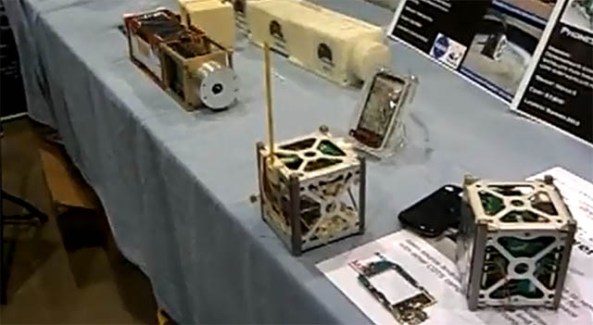
The 2012 Bay Area Maker Faire in San Mateo took place May 19-20 and among the stands was one displaying the PhoneSat amateur radio satellites.

There are two types of of these satellites both of which run the Android operating system and will be enclosed in a standard 1U CubeSat structure.

PhoneSat 1.0 cost about $3500 and is built around the Nexus One smartphone, it operates on battery power only with a mission lifetime of approx 1 week.

PhoneSat 2.0 is more expensive at $8000. It is built around the Nexus S smartphone and has solar panels on each face and a mission lifetime until de-orbit of approximately 2 weeks.

The IARU has coordinated a frequency of 437.425 MHz for the AX.25 AFSK downlink.

The first launch is scheduled for the third quarter of 2012 on Antares-110. It will carry two PhoneSat 1.0 satellites and one PhoneSat 2.0. A second PhoneSat launch is expected to occur in 2013.

Watch NANOSATHTC smart Phone-Satellite OS Android in a 10cm cube

Phonesat was also at the 2011 Maker Faire. In this video Ben explains the concept of a Phonesat.

Watch Android Phone as Autonomous Micro-Satellite: PhoneSat

IARU Amateur Satellite Frequency Coordination Status http://www.amsat.org.uk/iaru

TEDxKhartoum Presentation on KN-SAT1 CubeSat

KN-SAT1 Students at ST2UOK Khartoum

KN-SAT1 Students at ST2UOK Khartoum

Abubakr S. Eltayeb ST2AB is an Electrical Engineer specializing in communications systems. He is currently a member of the Cube Satellite Project which belongs to the Faculty of Engineering at University of Khartoum.

The team includes his colleagues Hala M. Othman, Mustafa Atta Mohamed and Yasir M. Osman ST2YM, and together they constructed the first satellite in Sudan with the help of Dr. Tahani Abdalla, their project manager and Dr. Nader Abdelhameed, the team manager. They designed, tested and experimentally launched a fully functional Cube Satellite prototype named KN-SAT1.

The team is now developing the Flight Model of the KN-SAT1, in preparation for its launch into outer space.

This TEDxKhartoum presentation is not in English, however, the segment from 09:12 until 13:25 contains video showing the development of the KN-SAT1 CubeSat including a test of the deployment of the antennas.

Watch TEDxKhartoum 2012: Abubakr S. Eltayeb, A Sudanese Satellite

Khartoum Amateur Radio Satellite Ground Station http://www.uk.amsat.org/4316

KN-Sat1 http://cubesat.uofk.edu/

Sudanese Amateur Radio and SWL History http://www.st2nh.com/sudanamateurradioandswlhistory

Vintage Spacelab 2 video featuring Amateur Radio

W0ORE STS-51-F QSL Card - Image Credit John Magliacane KD2BD

The second ham radio transmissions by an amateur radio operator in space were made by Tony England W0ORE during the Challenger shuttle mission STS 51-F in 1985.

He achieved the first ever two-way Slow Scan TV (SSTV) space contact during the flight when he contacted GB3RS the headquaters station of the Radio Society of Great Britain (RSGB).

Tony W0ORE was running a Motorola model MX-340 handheld 2-meter transceiver and a Robot Research model 1200C slow-scan television scan converter with an antenna fitted on the inside of one of Challengers windows.

Narrated by the Commander and crew, these videos contains footage selected by the astronauts, as well as their comments on the mission. Footage includes launch, onboard crew activities, and landing. The Shuttle Amateur Radio Experiment (SAREX) is mentioned 11:40 into the video.

Space Shuttle STS-51-F Challenger Spacelab 2 Post Flight Press Conference Film 1985 Part 1 of 2

Part 2 of 2

The ITN TV news report ‘Space Radio Hams’ on the two-way SSTV contact between GB3RS at RSGB HQ and Tony England W0ORE (believed to have been on 145.550 MHz) can be seen at
http://www.itnsource.com/shotlist//ITN/1985/08/04/AS040885006/

Videos taken by a local TV station, of a contact between a school in Staten Island, NY and Tony England W0ORE on STS-51F can be seen at http://www.southgatearc.org/news/january2009/historic_shuttle_videos.htm

John Magliacane KD2BD was one of the amateurs who had a contact with Tony England, see his website at http://www.qsl.net/kd2bd/kd2bd.html

STS-51-F (also known as Spacelab 2) was the nineteenth flight of NASA’s Space Shuttle program, and the eighth flight of Space Shuttle Challenger. It launched from Kennedy Space Center, Florida, on 29 July 1985, and landed at Edwards Air Force Base, California, just under eight days later on 6 August 1985, at 12:45:26 pm PDT.

Shuttle Mission STS-51-F http://en.wikipedia.org/wiki/STS-51-F

Vintage Videos of STS-9 Columbia Mission and Spacelab http://www.uk.amsat.org/7265