New Satellite Launch Vehicle To Carry CubeSat Swarm in 2013

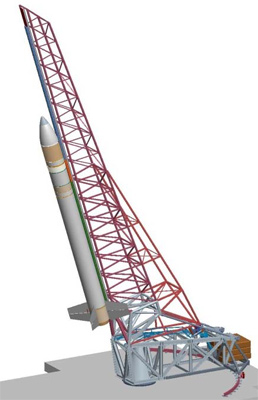
Super Strypi – SPARK

2013 should see the first flight of a new satellite launch vehicle.

Super Strypi, also known as SPARK (Space-borne Payload Assist Rocket – Kauai), has been developed by Sandia National Laboratories, the University of Hawaii and Aerojet. The rocket is based on an enlarged version of Sandia’s Strypi sounding rocket.

The all solid fueled vehicle uses a GEM-46 (LEO-46) motor of Delta-2H heritage as first stage. A Orbus-7S (LEO-7) motor acts as second stage and a Star-30BP (Spark-30) or an Orbus-1 (LEO-1) as third stage. It is spin and fin stabilized during fist stage burn and has attitude control for the two upper stages. The low cost rocket will be launched from a rail launcher and can put a payload of 250 kg into a 400 km sun-synchronous orbit.

The Super Strypi vehicle will be launched from a rail-launcher at Barking Sands, Kauai (Pacific Missile Range Facility) towards the end of 2013.

Conceptual representation of a cluster of EDSN satellites illustrating their ability to communicate and share data as a network.  Credit NASA

Super Strypi will be carrying a swarm of CubeSats, the Edison Demonstration of Smallsat Networks (EDSN). The CubeSats are an unusual size of 10 by 10 by 15 cm (1.5U) and weigh 2 kg. The EDSN swarm will demonstrate distributed, multipoint space weather measurement and are expected to operate for at least 60 days and have an orbit life-time of up to 4 years.

ORS Project – Super Strypi http://www.govsupport.us/ORSSSEA/Documents/DEA.pdf

Operationally Responsive Space (ORS) Project – Super Strypi http://www.govsupport.us/orsssea/

NASA – Small Spacecraft Technology Program
http://www.nasa.gov/offices/oct/stp/small_satellite_subsystem_tech/index.html

Gunter’s Space Page 2013 http://space.skyrocket.de/doc_chr/lau2013.htm

UKube-1 Signs up for Launch and Completes Thermal Vacuum Testing

Clyde Space have successfully completed Thermal Vacuum Testing, where the UKube-1 Flight Model was operated in a simulated space environment (i.e. no air and at temperature extremes)

UKube-1 the UK Space Agency’s (UKSA) first satellite has ‘booked’ its journey into space on a Russian Soyuz-2 rocket. The launch from Baikonur in Kazakhstan is expected to take place in the 3rd quarter of 2013. UKube-1 has also completed Thermal Vacuum Testing to verify the spacecraft operation in a simulated space environment.

UKube-1 will carry a set of AMSAT-UK FUNcube boards to provide a 435/145 MHz linear transponder and a 145.915 MHz BPSK telemetry beacon for educational outreach.

Continue reading

Cubesat Community Workshop

The UK Space Agency will be running a Cubesat Community Workshop in January. Registration for the workshop is now open. This is a free event and is open to all, hosted by the Open University, Milton Keynes, on 22 January 2013. Please note that space is limited and places will be allocated on a first come, first serve basis.

The event will be an opportunity for the UK Space Agency to provide the cubesat community with an update on its pilot cubesat mission UKube-1, due for launch in early 2013, and to discuss the overall philosophy and timing for the proposed UKube-2 programme. Attendees will have the opportunity to provide input on the future direction of a proposed rolling national programme of cubesat missions.

Parallel breakout sessions will be held as detailed in the downloadable programme. These themes have been selected in response to the common issues raised by members of the community. The findings from each session will feed into a concluding discussion in which follow up actions will be identified.

To confirm attendance, please email ryan.king@ukspaceagency.bis.gsi.gov.uk indicating which breakout session you would prefer to attend, by the 21st December. One of the stated aims of the workshop is to encourage more potential cubesat users to engage with the programme, therefore please share the news.

Download the proposed programme. (PDF, 17 Kb)

Canadian – Norwegian Student Exchange, Rocket & CubeSat Program

This video provides a short description of the Canada-Norway Student Sounding Rocket (CaNoRock) exchange program and plans for the student CaNoSat sub-orbital CubeSats.

CaNoRock is a partnership between the Universities of Alberta, Calgary and Saskatchewan, the University of Oslo, University of Tromsø, Andøya Rocket Range and NAROM (Norwegian Center for Space Related Education) in Norway. The University of Bergen and University Centre in Svalbard (UNIS) in Norway are currently working to be included in the program.

Continue reading

OSSI CubeSat in New Scientist Magazine


Hojun Song DS1SBO and the NovaNano FlyMate™ deployer

Hojun Song DS1SBO and the NovaNano FlyMate™ deployer

New Scientist magazine has an article about Hojun Song DS1SBO and his Open Source Satellite Initiative OSSI-1 CubeSat.

OSSI-1 is planned to launch in the 2nd quarter of 2013 into a 575 km 63° inclination orbit on a Soyuz-2-1b rocket from the Baikonur launch facility in Kazakhstan along with the Bion-M1, SOMP, BEESAT 2, BEESAT 3 and Dove-2 satellites. The Soyuz-2-1b launch had originally been planned for August 2012 but was delayed.

Continue reading

Video of Interorbital Systems’ Neptune Rocket Test Firing

MOJAVE-10.28.2012—On a calm clear high-desert October evening, Interorbital Systems’ NEPTUNE rocket series’ main engine roared to life in its first hot-firing test. The engine, the IOS GPRE 7.5KNTA (General Purpose Rocket Engine; 7,500lb-thrust; Nitric Acid; Turpentine; Ablative cooling), blasted a 22-foot (6.71-meter) plume of fire across Interorbital’s Mojave Spaceport test area, scorching the sand an additional 50 feet (15.24 meters) beyond the plume end.

Continue reading