VK1ALR Interview – Mission to make Curiosity count

Canberra Deep Space Communication Complex 70m Dish – Image Credit NASA

Prior to the Curiosity Mars landing this morning Aug 6, The Canberra Times interviewed radio amateur Len Ricardo VK1ALR, operations manager at the Canberra Deep Space Communication Complex, who will be providing a communications link for the Mars Curiosity Rover.

Continue reading

NASA lands car-size Rover beside Martian mountain

Curiosity – Image Credit NASA

NASA’s most advanced Mars rover Curiosity has landed on the Red Planet. The one-ton rover, hanging by ropes from a  rocket backpack, touched down onto Mars Monday, August 6 UT to end a 36-week flight and begin a two-year investigation.

Continue reading

Upcoming ARISS contact-Sunday, August 5, 2012

Space Jam 6 at the Octave Chanute Aerospace Museum, Rantoul, Illinois, USA – Akihiko Hoshide, KE5DNI Sunday, August 5, 2012. Station WB9SA in Illinois, USA will call NA1SS at approximately 10:06 UT.

Continue reading

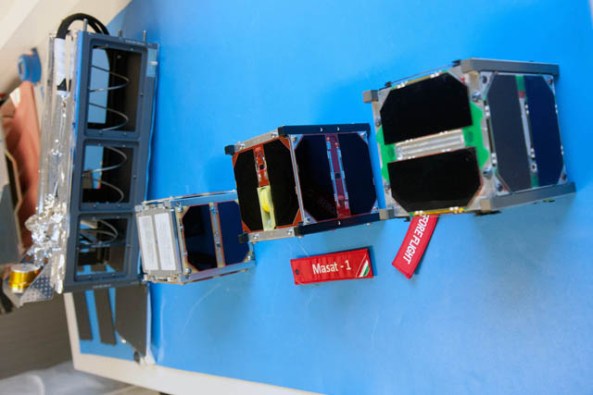
Amateur Radio CubeSat Launch Postponed

Aeneas – University of Southern California

The launch of the amateur radio CubeSats on an Atlas 5 rocket from Vandenberg Air Force Base has been postponed until at least Tuesday, August 14.

Continue reading

2o12W Active on the Amateur Radio Satellites

Ken Eaton GW1FKY operating the Amateur Radio Satellites at 2o12W – Picture Credit Phil Jones MW0PJJ

Olympic Flagship Special Event Station 2 Oscar 12 Whiskey (2o12W) has been active on the amateur radio satellites working stations in the USA and across Europe.

Continue reading

TubeSat aims to test Ion Engine

FRETS1 TubeSat – Image Credit Wes Faler

Wes Faler is building a small satellite called Fluid & Reason Engine Test Satellite 1 or FRETS1.

FRETS1 is a TubeSat-style picosatellite that aims to fly in 2013 on an Interorbital Systems Neptune rocket into a 310 km sun synchronous orbit. Its mission is to test a new kind of ion engine, one designed for higher thrust and lower power than traditional designs.

It’s planned to use a closed cell foam filled with pressurized nitrogen, vaporizing the supporting plastic and releasing the enclosed nitrogen using a spark system similar to that used by Pulsed Plasma Thrusters (PPTs).  PPTs create an arc across the face of a solid Teflon bar, turning a few micrograms of Teflon into plasma.  The plasma moves along the PPT’s cathode and anode by Lorentz forces, much the same way that a rail gun accelerates its conducting projectile.

This video gives a brief overview of what a TubeSat is.

Watch SatTV Technology Update – TubeSat

Note it is understood the first launches will take place in California rather than the site mentioned in the video.

Building An Ion Engine http://www.science20.com/satellite_diaries/building_ion_engine-81149

FRETS1 TubeSat http://frets1.wordpress.com/

Interorbital Systems http://www.interorbital.com/

Tubesat – Image Credit Interorbital Systems