ALMOST READY: The Cubesat is almost ready for its launch into space
CPUT’s satellite endeavours have been given the thumbs up by a delegation from the US National Security Department.
The F’SATI satellite programme which is based at the Bellville Campus and headed by Prof Robert van Zyl was visited by the high profile visitors recently during a tour of the country.
Wes Faler is building a small satellite called Fluid & Reason Engine Test Satellite 1 or FRETS1.
FRETS1 is a TubeSat-style picosatellite that aims to fly in 2013 on an Interorbital Systems Neptune rocket into a 310 km sun synchronous orbit. Its mission is to test a new kind of ion engine, one designed for higher thrust and lower power than traditional designs.
It’s planned to use a closed cell foam filled with pressurized nitrogen, vaporizing the supporting plastic and releasing the enclosed nitrogen using a spark system similar to that used by Pulsed Plasma Thrusters (PPTs). PPTs create an arc across the face of a solid Teflon bar, turning a few micrograms of Teflon into plasma. The plasma moves along the PPT’s cathode and anode by Lorentz forces, much the same way that a rail gun accelerates its conducting projectile.
This video gives a brief overview of what a TubeSat is.
Watch SatTV Technology Update – TubeSat
Note it is understood the first launches will take place in California rather than the site mentioned in the video.
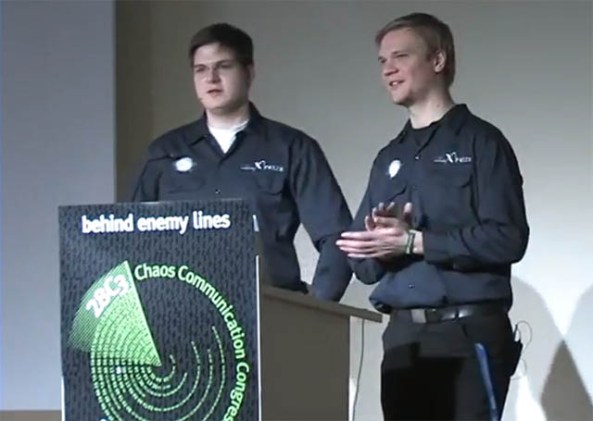
Part-Time Scientists team members Robert Böhme and Karsten Becker
The Google Lunar X-Prize team Part-Time Scientists delivered a presentation Not your Grandfathers moon landing at the Chaos Communication Congress.
The YouTube description reads:
Karsten Becker, Robert Böhme: Not your Grandfathers moon landing
Hell yeah, it’s Rocket Science 3.1415926535897932384626!
The basics, we are team of part-time scientists and engineers who want to send a rover to the moon before the end of the year 2013. There is a lot to be done towards this first private moon landing and we want to take the chance to explore what we want to do and show what we already accomplished in the past 12 months. The talk will feature important technical milestone like our very first R3 rover prototype and great events like the CCCamp11. There is also be a live demonstration of the very first R3A rover right in the presentation.
We want to take this chance to present where we are and what is next to go on the worlds first private mission to the moon. 2011 was great and we want to show you some of our personal highlights like us actually doing real rocket science at the CCCamp11. We will have a close look at the first R3 Rover prototype how it got made and all the cool things we already did with it and going to test along the next year.
We’re aiming for a pretty quick and dense 30 minute review of 2011 with an outlook for 2012 and then do a live presentation of the R3 rover with an open Q&A round.
This time we split our efforts and got our most interesting presenters to enroll for separate talks on one self picked exciting topic they worked on this year in their own free time.
Watch 28c3: Not your Grandfathers moon landing
Electromagnetic Interference (EMI) issues the team encountered are discussed at 19:15 into the video.
A high quality version of this video can be downloaded from http://bit.ly/vROKTo
In the second presentation Wes Faler talks about Evolving custom communication protocols – Hell Yeah, it’s rocket science
Even after years of committee review, communication protocols can certainly be hacked, sometimes highly entertainingly. What about creating a protocol the opposite way? Start with all the hacks that can be done and search for a protocol that gets around them all. Is it even possible? Part-Time Scientists has used a GPU to help design our moon mission protocols and we’ll show you the what and how. Danger: Real code will be shown!
Watch 28c3: Evolving custom communication protocols
A high quality version of this video can be downloaded from http://bit.ly/vOzAsF
An English language NHK TV news story covers the amateur radio CubeSat FITSAT-1 also known as NIWAKA which launched to the International Space Station (ISS) on July 21.
Takushi Tanaka JA6AVG and FITSAT
FITSAT-1 has multiple downlinks, CW on 437.250 MHz, AX.25 on 437.445 MHz and a 4 watt high speed data transmitter on 5840 MHz capable of sending a 640 by 480 pixel VGA JPEG image in 6 seconds.
In addition it carries high power LEDs that will be driven with 100W pulses to produce extremely bright flashes. These, it is hoped, will be observable by the unaided eye or with small binoculars. Both the 5840 MHz and optical downlinks have a high power consumption so they may only be activated when in range of the ground station in Japan. It use a neodymium magnet for attitude control.
The CubeSat will remain on the ISS until September when it will be deployed by Japanese astronaut and radio amateur Akihiko Hoshide KE5DNI using the ISS Kibo robot arm.
FITSAT-1 (NIWAKA) is mounted in a JEM-Small Satellite Orbital Deployer (J-SSOD) with the amateur radio TechEdSat and F-1 CubeSats. In a second deployment pod are WeWish and a scientific 2U CubeSat Raiko. The CubeSats will be deployed into a 400 km orbit and should have a lifetime of 3 or 4 months before re-entering the Earth’s atmosphere and burning up.
In this video NHK interviews Takushi Tanaka JA6AVG and students from the Fukuoka Institute of Technology (FIT) about the project.
In the July 17 ARISS meeting Kenneth Ransom N5VHO reported that his group is in the final stages of preparing the certification for flight of the replacement hardware for the degraded Ericsson VHF [145 MHz] radio.
The Ericsson rig is part of the second ISS amateur radio station that is located in the Columbus module.
The team had hoped for a launch of the equipment on flight 33-S [Dec. 5], but it may be launched on flight 49-P [Nov. 1], which is a month sooner than 33-S. The team is endeavoring to finish the certification in time for this earlier flight option. The degraded Ericsson VHF radio may be returned on flight 32-S in October. The team is very interested in trying to determine what the problem has been with this radio.
Funds for the OSSI CubeSat have been raised by selling T-shirts
The amateur radio CubeSat OSSI is planned to launch in December according to an Antara News article. [UPDATE rocket launch has been delayed and may now be April 2013]
The article describes how Korean artist Hojun Song DS1SBO developed his own home made satellite and says radio operators will be able to communicate with the satellite. If all goes well, it will repeat a message in Morse code using its LED lights at a set time and location.
The DIY satellite OSSI is planned to launch on a Soyuz-2-1b from the Baikonur launch facility in Kazakhstan in December with the Bion-M 1 and Dove 2 satellites. (The Dove 2 CubeSat will transmit images on a 2.4 GHz downlink). The satellites will be placed into an orbit with an apogee of 575 km, perigee of 290 km and inclination of 64.9 degrees. They are expected to remain in orbit for about a year before burning up on re-entry into the Earth’s atmosphere.
The OSSI uplink is in the 145 MHz band and the downlink in the 435 MHz band.






 AMSAT-UK
You must be logged in to post a comment.