Dear All, The Dnepr Cluster Launch 2013 has just been successfully accomplished: if anyone of the CubeSat community has the chance, please support GAUSS team in receiving some of the US5 payloads. Try to get: – PUCPSAT (from Perù): beacon @ 145.840 MHz (transmitting call sign OA0PUCP) – WREN: 437.405 MHz Thank you for your support! GAUSSteam — Gruppo di Astrodinamica per l’Uso dei Sistemi Spaziali – Group of Astrodynamics for the Use of Space Systems Via Lariana, 5 00199 Roma
Erich, DK1TB, has provided a short guide on how to manually add new satellites to the SatPC32 satellite tracking app which is available from the AMSAT-UK shop.
The FUNcube-1 AO-73 satellite is used as an example.
b. Copy the following line to the file AmsatNames.txt
39417 13066B AO-73
That will convert the CelesTrak sat name 213-066B to AO-73. In menu “Satellites” choose “SatNames”, “Use Amsat Names if Available”.
c. Copy the following lines to Doppler.SQF:
AO-73,145934.0,,USB,,,,TLM
AO-73,145960.0,435140.0,USB,LS
B,REV,,, Transponder
In menu “Satellites” choose “Sat Groups” and select – for example- the group “Diverse” to have the sat in a separate list. With “Update Keps” download the Celestrak file. It will appear in the left list of the menu. Click on the file name. In the middle list you will see AO-73 with this name. Select it for the right list and click “OK”. The group will later automatically use the chosen CelesTrak file.
73s, Erich, DK1TB
Watch How to add the new XW-2/CAS3 satellites into SatPC32
Gpredict
Bryce KB1LQC describes how to update the free satellite tracking software Gpredict:
You can add new TLE’s by using the Edit->Update TLE and choose network or local files. I’ve found it interesting to get some of the FUNcube TLE’s in there, maybe Gpredict is being picky but it’s worked. Also, there’s a downward facing arrow in the top right window of Gpredict with a “configure” menu option. I’ve placed my cursor over it in one of the screenshots. When you are in there you can add and remove satellites as shown in the second screenshot. Hope this helps!
• Go to Nova for windows menu to —> Kep Elements—> Disk file update—->Manual update from file—–> Click on the “Update” button.
• Now you see a window appear and browse to the funcube1.txt file.
• If you can not find click in the same window all files.
• If you have uploaded the keps from the file than go to the Nova menu to —> Views configure current view —> Click on Artificial satellites —> browse through the satellite – list till you see FUNcube-1 and drag it to the right window.
•Click on the OK button and now you should see FUNcube-1 on the world map.
Triton-1 is a 3U cubesat from ISIS-BV (Innovative Solutions In Space BV) with a AIS (ship location service) radio science experiment which was launched on November 21. After the experiment is complete (est. 3 months), the spacecraft radios will be reconfigured to U/V FM to DSB (“AO-16 mode”) repeaters open for amateur use.
This update was issued at 08:48 on November 23, 2013.
Hi all,
New TLE’s for the DNEPR launch have been issued, we believe that Triton-1 is object M.
Meanwhile, Triton-1 is still in nominal mode, transmitting AX.25 BPSK on 145.822 MHz. Reception reports, especially in case the satellite is in safe mode (transmitting the safe mode CW beacon) are welcome!
Delfi Nanosatellite Program Manager, Jasper Bouwmeester PC4JB, provides this update on the Delfi-n3Xt satellite which was launched November 21 and carries a 435/145 MHz linear transponder.
Dear radio amateurs,
We had a fantastic launch and early reception of Delfi-n3Xt! The good news is that Delfi-n3Xt is transmitting when in the Sun and is off in eclipse to save battery power; just as we want it to be. The signal strength is also good.
VHF Reception
We have noticed however that the DUDe telemetry client does not properly indicate the frequency offset and it is very difficult to get a lock on the signal.
Also our ICOM910 receivers have too limited bandwidth to receive a 2400 bit/s BPSK signal properly (although we had a few packets decoded with this, so it is just on the edge of what is possible). We now use only AR5000 in combination with an SDR to record a wide spectrum in IQ files. This way we can replay the files and retune the signal again and have been able to decode more packets than before. This morning at our second pass we were lucky to have a real time lock on the signal and retrieve many packets, so it is possible to have it right at once. But of course we would like to get the ‘luck-factor’ out of it.
A few people will look into the Costas PLL inside DUDe to see if we can improve its performance. Meanwhile, you can regard Delfi-n3Xt as a real challenging game to decode packets…
S-band reception
With respect to the S-band, we have not been able to test this as all our efforts go into VHF reception. The beacon is however on (also in eclipse), transmitting packets in a duty cycle of 5%, 1 Hz at 50 kbit/s MSK. The satellite is however still tumbling, so the antenna might be pointing in arbitrary direction. Next to this, a lot of gain is needed to be able to even see something above the noise floor (we have an 38dB dish). I believe that dish antenna below 25 dB will not be able to receive the beacon (let alone decode it). If someone however has the right equipment and good see the 1 Hz beacon, e.g. in a waterfall plot, please let us know and sent us a picture!
TLEs
These are the latest TLEs we have received:
1 00371U 00371A 13325.30974640 .00000000 00000-0 10000-4 0 7
2 00371 97.7888 38.2587 0131876 190.4863 345.6615 14.61864099 08
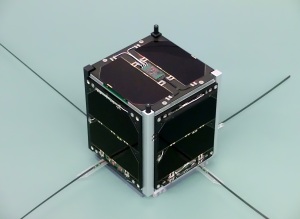
FUNcube-1 flight model – Image credit Wouter Weggelaar PA3WEG
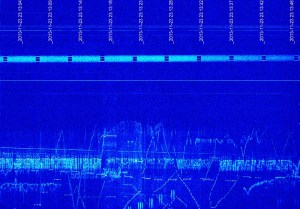
The FUNcube Team have had reports of an apparent distortion in the transmitted telemetry and difficulty in decoding around 12:00 UT today.
It is believed that this may have actually been occurring due to the natural phenomena of an active aurora rather than a problem on board the spacecraft. We understand that another spacecraft had the same issues around the same time.
The Team intend to command AO-73 back into autonomous mode during the 2035 UT pass this evening. This will mean that we should have the transponder active when in eclipse and telemetry only when in sunlight.
Everyday we learn something new!
best 73
FUNcube-1 team
Analysis of the telemetry data from FUNcube-1 (AO-73) is continuing. Thank you to all stations who have provided telemetry so far. More telemetry data is needed to enable the FUNcube team to characterise the satellite.
We would encourage stations to download the Dashboard software to receive the telemetry and upload it to the Data Warehouse.
FUNcube-1 flight model – Image credit Wouter Weggelaar PA3WEG
A test of the Autonomous Mode on the FUNcube-1 (AO-73) SSB/CW linear transponder has been carried out.
It was switched into Autonomous Mode during orbit 32 at 1113 UT on Saturday, November 23. In this mode the transponder will automatically switch on when the spacecraft enters darkness, and switch off again when it enters sunlight.
During the test all radio amateurs in the footprint were encouraged to make their own tests of the transponder up/down links, and make contacts.
Among the contacts reported have been:
Alan ZL2BX:Transponder switched to eclipse mode OK about mid pass over ZL. Good signals from the transponder and had a brief contact with VK2MAL.
Malcolm VK2MAL: Good signals from AO-73 over VK tonight. Stations heard through the transponder were ZL2BX Alan and VK4CBW Wal.
If you did make a contact or test please report the details as a comment on the FUNcube website at http://funcube.org.uk/
Please note that the transponder frequencies have not yet been fully characterised.
FUNcube-1 Radio Communications Subsystem:
• 145.935 MHz BPSK Telemetry 300 mW or 30 mW when the transponder has been activated
• Inverting SSB/CW transponder 300 mW PEP
– 435.150 – 435.130 MHz Uplink LSB
– 145.950 – 145.970 MHz Downlink USB
Analysis of the telemetry data from FUNcube-1 (AO-73) is continuing. Thank you to all stations who have provided telemetry so far. More telemetry data is needed to enable the FUNcube team to characterise the satellite.
We would encourage stations to download the Dashboard software to receive the telemetry and upload it to the Data Warehouse.
You must be logged in to post a comment.