Autumn Issue of OSCAR News

The cover of OSCAR News issue 199 shows the FUNcube-1 CubeSat during a “fit check” of the Flight Model hardware at ISIS BV in The Netherlands. (See FUNcube Project update, page 11). Picture by Wouter Weggelaar PA3WEG

The Autumn (Fall) edition of the AMSAT-UK newsletter OSCAR News is now at the printers and should be posted to members soon.

In this issue
• A filtered 2m preamp for wideband receivers by David Bowman G0MRF
• A Multi-purpose Portable Setup: Working low-earth orbit satellites from any place (part 2 of 2)  by Ivo Klinkert, PA1IVO
• A full update on the FUNcube Project
• Experiments with Orbital Decay by John Heath G7HIA
• Minutes of the 2012 Annual General Meeting
• A report on the 27th AMSAT-UK Colloquium
• The Parkes Dish tracking the Mars Science Laboratory landing by John M. Sarkissian

AMSAT-UK Membership year lasts for 12 months starting on January 1 each year.

If you join after July 31 of any particular year, then you will receive complimentary membership for the whole of the following year, i.e. join on October 8, 2012, and you have nothing to pay until Dec 31, 2013.

Now is a very good time to join.

AMSAT-UK FUNcube Mission Patch

AMSAT-UK FUNcube Mission Patch

Membership of AMSAT-UK is open to anyone who has an interest in amateur radio satellites or space activities, including the International Space Station (ISS).

There are two rates:
UK
Rest of the World (Overseas)

These separate rates go to offset the extra postage costs involved in mailing our quarterly publication, “Oscar News”, to different parts of the World.

See a PDF sample copy of “Oscar News” at http://www.amsat-uk.org/on_193_final.pdf

Join AMSAT-UK using PayPal, Debit or Credit card at
http://shop.amsat.org.uk/shop/category_9/Join-Amsat-UK.html

Martin Sweeting G3YJO to speak at Nano-Satellite Symposium

Martin Sweeting G3YJO 2012 Image Credit SSTL

Prof. Sir Martin Sweeting G3YJO – Image Credit SSTL

The United Nations / Japan Nano-Satellite Symposium in Nagoya starts Wednesday, October 10 at 0930 JST (0030 UT) and runs until Oct. 13. The Mission Ideas Contest presentations on Oct. 10 will be broadcast live on USTREAM.

The event has attracted speakers from the USA, Canada, UK, Europe, Africa and Asia.

Prof. Sir Martin Sweeting G3YJO will be giving a presentation titled ‘Pushing the capabilities of small satellites’ on Thursday, October 11 at 0900 JST (0000 UT).

Continue reading

Radio amateurs asked to help track and decode the F-1 CubeSat

FSpace Team Phạm Quang Hưng, Đinh Quốc Trí, Khánh Has, Thu Trong Vu XV9AA, Hong Thai Pham, Dao Thang picture taken by Nguyễn Trần Hoàng

The F-1 CubeSat, callsign XV1VN, developed by the FSpace team of young engineers and students at the FPT University, deployed from the International Space Station (ISS) on Thursday, October 4 at 15:44 UT. A Google English newspaper report with pictures of the F-1 team’s attempts to receive the satellite after deployment can be seen at http://tinyurl.com/Chungta-F-1-Article. F-1 Keps (1998-067CP) are at http://celestrak.com/NORAD/elements/tle-new.txt.

On Sunday, October 7 Thu Trong Vu XV9AA provided this update:

So far the team has received several mixed reports about F-1 status, there is no definite conclusion yet. We will continue to collect information and analyze the situation, this afternoon we will hold a team meeting to discuss different situations that may happen with the little satellite up there. Please continue to help us listening for F-1 on 437.485 in daylight and 145.980 in the dark, thank you!

Continue reading

FITSAT-1 Update

FITSAT-1 plans to use LED’s to signal in Morse code

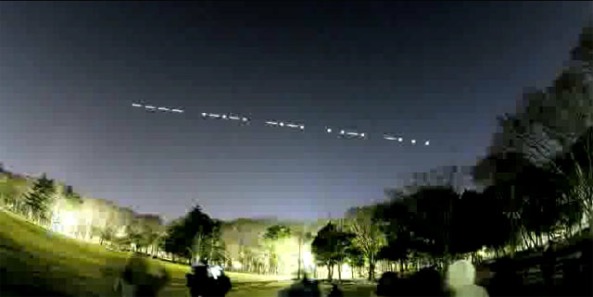
The amateur radio CubeSat FITSAT-1 (aka NIWAKA) carries an Optical Communications experiment that aims to write Morse Code across the night sky. The satellite is fitted with a bank of high power LEDs that will be driven with 200W pulses to produce extremely bright flashes that may be visible to the unaided eye.

FITSAT-1 was deployed from the International Space Station (ISS) at 15:44 UT on Thursday, October 4 along with F-1 and TechEdSat.

On Sunday, October 7 Takushi Tanaka JA6AVG provided this update:

We have received a lot of signal and telemetry reports from amsat members. All reports show FITSAT-1 starts working and sound. Thank you very much for your help.

We will examine movements, temperatures, and battery states of FITSAT-1 during these 10 days, and start experiments of 5.8GHz transmission and flashing LEDs.

I will announce the experiments on my web-page http://www.fit.ac.jp/~tanaka/fitsat.shtml

As well as 437.250 MHz and 437.445 MHz (both +/- 10 kHz Doppler) this innovative satellite can also transmit on 5840.0 MHz (+/- 134 kHz Doppler).

Continue reading

Assembled Amateur Radio 2m Filtered Pre-Amps Now Available

This is the completely assembled version of the 2m filtered preamplifier from G0MRF. The connectors supplied are a high quality PTFE insulated reduced flange Ntype for the connection to the antenna and a chassis mounted female BNC for the RF output to the receiver, this also carries the 5 V DC input from a FUNcube Dongle or the DC supply from an external bias tee or radio. *** LIMITED AVAILABILITY *** When they are gone, they are gone!

Read the Measurement Report here.

Buy the assembled 144 MHz pre-amp from the AMSAT-UK shop at
http://shop.amsat.org.uk/shop/category_11/G0MRF-Filtered-PreAmps.html

The pre-amp is also available in kit form, read the Construction Notes here.

FITSAT-1 received with 1/4 wave antenna and FUNcube Dongle SDR

FUNcube Dongle Pro+ LF/MF/HF/VHF/UHF Software Defined Radio

Howard Long G6LVB has released a video showing reception of the FITSAT-1 CubeSat 437.250 MHz CW beacon using just a 1/4 wave antenna on a baking tray sat on his balcony in London. The receiver was a FUNcube Dongle Pro+ LF/MF/HF/VHF/UHF Software Defined Radio (SDR). No preamp or external filtering were used.

Continue reading