The Vietnamese TV station VTV1 broadcast a news story about the amateur radio CubeSat F-1, callsign XV1VN, due to be launched to the International Space Station (ISS) on July 21.
The broadcast shows students from the FPT University in Hanoi who are involved in the project and has an interview with Thu Trong Vu XV9AA.
F-1 carries a low-resolution camera (640×480), a 3-axis magnetometer and two Yaesu VX-3R transceivers using 145.980 and 437.485 MHz.
It is planned to launch to the ISS on July 21 in the HTV-3 cargo vessel and be deployed in September by Japanese astronaut Akihiko Hoshide KE5DNI using the ISS Kibo robot arm.
Wednesday, July 11, saw the official opening of the RSGB’s National Radio Centre (NRC) at Bletchley Park in Milton Keynes.
Ed Vaizey MP Unveiling the Plaque with RSGB President Dave Wilson M0OBW
The opening and unveiling of the plaque was undertaken by Mr Ed Vaizey MP. Mr Vaizey is the Minister for Culture, Communications and the Creative Industries and, as such, has overall responsibility for OFCOM. He stated that he fully supported the aim of the Centre in being able to enthuse and inspire children to become the engineers of the future.
Attendees included many of the sponsors together with Iain Standen, the Chief Executive of the Bletchley Park Trust plus, from overseas, Dave Sumner K1ZZ, CEO of the ARRL and Ole Garpestad, LA2RR IARU Vice-President.
Ed Vaizey MP and RSGB President Dave Wilson M0OBW
AMSAT-UK have supported the creation of this valuable educational outreach resource at Bletchley Park and have arranged for the provision and installation of a set of fully steerable VHF and UHF satellite antenna arrays. It is hoped that it may be possible to use the NRC as the FUNcube-1 Mission Control Centre during the Launch and Early Operations Phase (LEOP) of the mission later this year.
On July 11, Surrey Satellite Technology US LLC (SST-US) signed a memorandum of understanding (MOU) with Virgin Galactic optimizing Surrey’s innovative satellites for Virgin’s new launch vehicle, radically lowering the cost of building and launching small satellites.
This MOU comes on the heels of Virgin Galactic’s announcement of its new ”LauncherOne” program, an unmanned rocket that will be air-launched by SpaceShipTwo’s carrier aircraft, WhiteKnightTwo, and that will be capable of delivering as much as 225 kg to low Earth Orbit. SST-US and Virgin Galactic have agreed to work together to provide SST-US, the world leader in small satellite manufacturing, the information needed to build the most powerful spacecraft that LauncherOne can support, giving satellite customers a powerful and affordable option to put their payloads into space.
SST-US is the US operation of Surrey Satellite Technology Ltd (SSTL), the pioneer in small and cost effective space missions. The collaboration with Virgin Galactic is expected to involve the development by SST-US of new launcher-optimised satellite platforms, the supply of subsystems to the launch vehicle, and advising on market requirements for launch services.
Dr. John Paffet, CEO of SST-US, commented: “Since we launched our first small satellite in the Eighties, we have been changing the economics of space by leveraging innovation. As our platforms have become an integral part of many space programmes, launching satellites at a cost that is synergistic with the mission programme remains a challenge. We look forward to collaborating with Virgin Galactic on this exciting new venture to develop a solution to this need.”
LauncherOne will be a two stage vehicle capable of carrying up to 500 pounds (225 kilograms) to orbit for prices below $10 million. The rocket will be launched from Virgin Galactic’s WhiteKnightTwo, the uniquely capable aircraft also designed to carry SpaceShipTwo aloft to begin her suborbital missions. With more than 85 flights completed to date, WhiteKnightTwo has substantially completed her test flight program.
“Virgin Galactic’s goal is to revolutionize the way we get to space,” Virgin Galactic’s Founder Sir Richard Branson said. “I’m immensely proud of what we have already achieved as we draw near to regular suborbital flights on SpaceShipTwo. Now, LauncherOne is bringing the price of satellite launch into the realm of affordability for schools, non-profits, and start-ups, in addition to companies and space agencies. This provides a completely new resource to the global research community, letting us learn about our home planet more quickly and more affordably.”
Watch LauncherOne – Furthering the Space Frontier
Watch Virgin Galactic’s WhiteKnightTwo and LauncherOne take flight
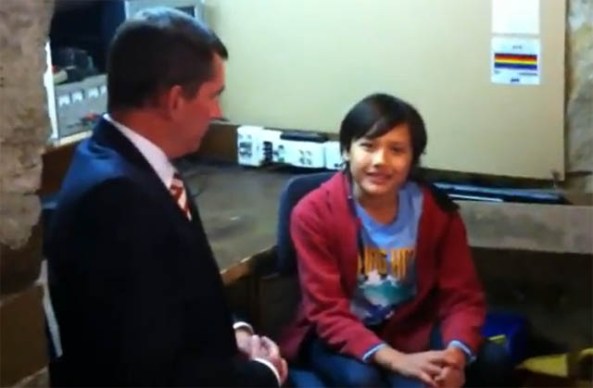
Jason Brand VK2FJAB (10) was interviewed for the morning “Today” show on Channel 9 in Australia. He talks about amateur radio and his Do-It-Yourself space projects.
Watch Channel 9 (Australia) interview with Jason
Watch Robert Brand VK2URB and Jason Brand VK2FJAB WotzUp Radio, Space and Balloon Workshop
The crowd-sourced funding website Kickstarter, which has been used for amateur radio projects in the USA, is to launch in the UK this autumn.
Radio ham Zac Manchester KD2BHC used Kickstarter to raise $74,586 in donations to fund the development and deployment of over a hundred amateur radio KickSat sprite satellites.
The amateur radio satellite project ArduSat managed to raise donations of $80,379 in just 26 days.
Kickstarter is not just about raising large sums of money, for example Sandy Antunes used Kickstarter to raise $2,780 to buy a ham radio transceiver and antennas to create an amateur radio satellite ground station Calliope
Helen Sharman GB1MIR was the first UK astronaut. On May 18, 1991, she flew to the Mir Space Station on board Soyuz-TM12, aged 27.
Before flying, Helen spent 18 months in intensive flight training in Star City on the outskirts of Moscow. The Soyuz TM-12 mission, which included Soviet cosmonauts Anatoly Artsebarsky and Sergei Krikalev, lasted eight days, most of that time spent at the Mir space station. Helen’s tasks included medical and agricultural scientific experiments, photographing the British Isles, and participating in an amateur radio hookup with UK schoolchildren.
Watch Rocket Science – Helen Sharman Interview
Since her return, Helen has become one of the UK’s leading ambassadors for science. She was awarded the OBE in 1992 and is a fellow of the Royal Society of Chemistry, the Royal Geographical Society, the Royal Aeronautical Society and the British Interplanetary Society. Helen has won numerous awards including the Medal “For Merit in Space Exploration” in 2012 from the Russian Federation government. Helen is currently Group Leader of Surface and Nanoanalysis at the National Physical Laboratory.
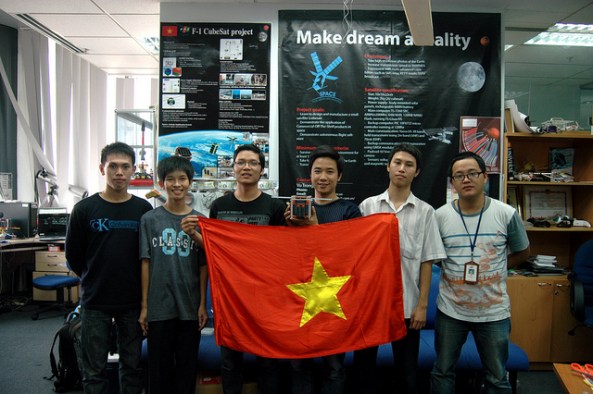
 The broadcast shows students from the FPT University in Hanoi who are involved in the project and has an interview with Thu Trong Vu XV9AA.




 AMSAT-UK
You must be logged in to post a comment.