
KN-SAT1 Students at ST2UOK Khartoum
The KN-SAT1 CubeSat, which will have a VHF downlink, is being developed at the University Of Khartoum.
Mahmoud Esawi has made available a video which shows KN-SAT1 Prototype2 subsystems design and testing.
KN-SAT1 Students at ST2UOK Khartoum
The KN-SAT1 CubeSat, which will have a VHF downlink, is being developed at the University Of Khartoum.
Mahmoud Esawi has made available a video which shows KN-SAT1 Prototype2 subsystems design and testing.
 Phonesat, which hopes to launch in December carrying an amateur radio payload on 437.425 MHz, has been chosen as one of the winners in the Aerospace category for the Popular Science magazine “Best of What’s New 2012” awards.

Kentucky Space have released an App for the iPhone, iPad and iTouch that tracks the CXBN CubeSat – 437.525 MHz 9k6 FSK AX.25, FM.
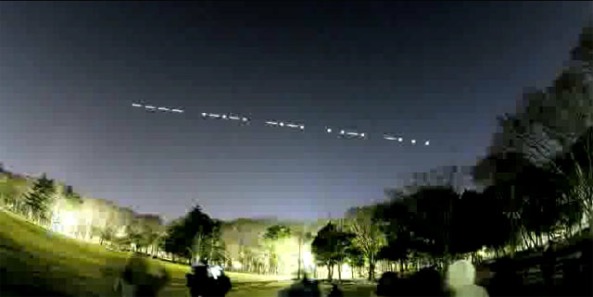
FITSAT-1 plans to use LED’s to signal in Morse code
On Christmas Eve (Dec. 24) the Japanese students who built FITSAT-1 are planning to active the satellite’s LED optical array and flash a message in Morse code to Earth. The Morse message may be visible to the unaided eye.
According to Takushi Tanaka JA6AVG the students plan to start testing the optical system at the end of November.
The FITSAT-1 CubeSat was developed by students at the Fukuoka Institute of Technology (FIT) in Japan. In addition to the LED array it also has a CW beacon on 437.250 MHz, a data link on 437.445 MHz and a 5840.0 MHz data downlink.
Further FITSAT-1 information at http://www.fit.ac.jp/~tanaka/fitsat.shtml
CubeSats deployed from International Space Station http://www.uk.amsat.org/?page_id=10967

FITSAT-1 Flight Model
The 5840.0 MHz downlink of FITSAT-1 was received in Vermont on both Saturday and Sunday by Mike Seguin N1JEZ.

Hojun Song DS1SBO and the NovaNano FlyMate™ deployer
New Scientist magazine has an article about Hojun Song DS1SBO and his Open Source Satellite Initiative OSSI-1 CubeSat.
OSSI-1 is planned to launch in the 2nd quarter of 2013 into a 575 km 63° inclination orbit on a Soyuz-2-1b rocket from the Baikonur launch facility in Kazakhstan along with the Bion-M1, SOMP, BEESAT 2, BEESAT 3 and Dove-2 satellites. The Soyuz-2-1b launch had originally been planned for August 2012 but was delayed.
 AMSAT-UK
You must be logged in to post a comment.