FITSAT-1 Update

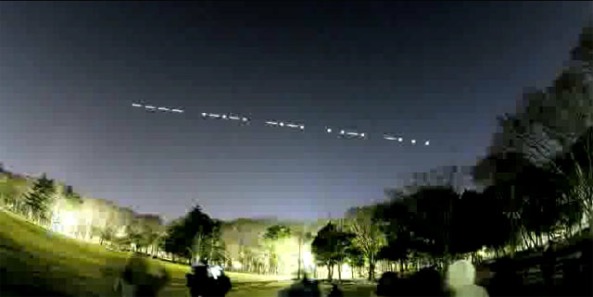
FITSAT-1 plans to use LED’s to signal in Morse code

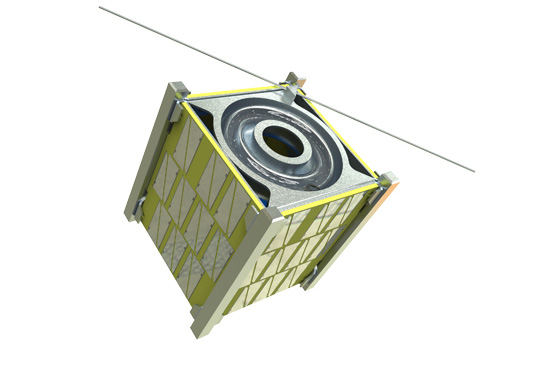
The amateur radio CubeSat FITSAT-1 (aka NIWAKA) carries an Optical Communications experiment that aims to write Morse Code across the night sky. The satellite is fitted with a bank of high power LEDs that will be driven with 200W pulses to produce extremely bright flashes that may be visible to the unaided eye.

FITSAT-1 was deployed from the International Space Station (ISS) at 15:44 UT on Thursday, October 4 along with F-1 and TechEdSat.

On Sunday, October 7 Takushi Tanaka JA6AVG provided this update:

We have received a lot of signal and telemetry reports from amsat members. All reports show FITSAT-1 starts working and sound. Thank you very much for your help.

We will examine movements, temperatures, and battery states of FITSAT-1 during these 10 days, and start experiments of 5.8GHz transmission and flashing LEDs.

I will announce the experiments on my web-page http://www.fit.ac.jp/~tanaka/fitsat.shtml

As well as 437.250 MHz and 437.445 MHz (both +/- 10 kHz Doppler) this innovative satellite can also transmit on 5840.0 MHz (+/- 134 kHz Doppler).

Continue reading

FITSAT-1 received with 1/4 wave antenna and FUNcube Dongle SDR

FUNcube Dongle Pro+ LF/MF/HF/VHF/UHF Software Defined Radio

Howard Long G6LVB has released a video showing reception of the FITSAT-1 CubeSat 437.250 MHz CW beacon using just a 1/4 wave antenna on a baking tray sat on his balcony in London. The receiver was a FUNcube Dongle Pro+ LF/MF/HF/VHF/UHF Software Defined Radio (SDR). No preamp or external filtering were used.

Continue reading

Euroluna Google Lunar X-Prize Quarterly Update

Euroluna

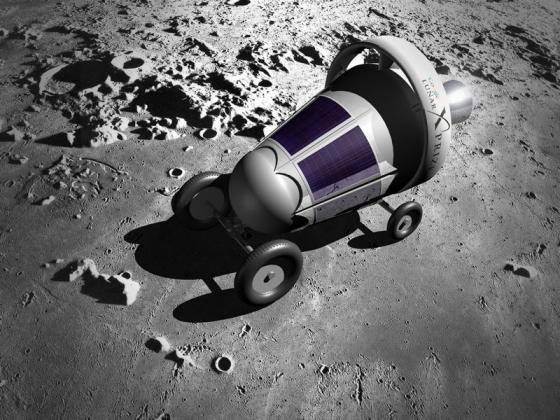
Original design of the Euroluna Romit3 Lunar Rover – Image courtesy of Andrew Collis/X-Prize Foundation

The President of Euroluna, Palle Haastrup OZ1HIA, provides an update on the progress of the Euroluna Google Lunar X-Prize team who are aiming to land a rover on the Moon.

Their first amateur radio spacecraft Romit-1 is a 2U CubeSat that will transmit on 437.505 MHz using 1200 bps AX.25 packet radio. It will be fitted with an Ion Motor and if everything goes well it should, after a year, be able to raise its orbit from 310 km to 700 km.

Continue reading

Join AMSAT-UK

AMSAT-UK is a non-profit volunteer organisation for those interested in amateur radio space communications.

AMSAT-UK produces a quarterly newsletter OSCAR News and its members are involved in designing, building and operating amateur radio satellites.

Membership is open to anyone who has an interest in amateur radio satellites or space activities, including the International Space Station (ISS).

The Membership year lasts for 12 months starting on January 1 each year.

If you join after July 31 of any particular year, then you will receive complimentary membership for the whole of the following year, i.e. join on Oct 3, 2012, and you have nothing to pay until Dec 31, 2013.

Now is a very good time to join.

AMSAT-UK_FUNcube_Mission_PatchThere are two rates:
UK
Rest of the World (Overseas)

These separate rates go to offset the extra postage costs involved in mailing our quarterly publication, “Oscar News”, to different parts of the World. Sample copy at http://www.amsat-uk.org/on_193_final.pdf

Join AMSAT-UK using PayPal, Debit or Credit card at
http://shop.amsat.org.uk/shop/category_9/Join-Amsat-UK.html

EQUiSat Optical Beacon CubeSat

EQUiSat – Image Credit Brown University

Students at the Ivy League Brown University are developing an amateur radio satellite EQUiSat.

It will carry a Xenon Flash Tube (XFT) subsystem to act as an Optical Beacon that should be visible to the unaided eye of observers on Earth. The Radio Beacon is planned to operate in the 435-438 MHz band.

Continue reading

Sid May ET3SID / AB3OZ / G4CTQ Silent Key

Sid May ET3SID AB3OZ G4CTQ

Ethiopian Amateur Radio Society Chairman Sid May ET3SID / AB3OZ / G4CTQ passed away September 25.

Sid had recently contacted AMSAT-UK regarding an amateur radio CubeSat project he planned to start in Ethiopia.

He had been looking forward to attending the National Hamfest at Newark during a planned visit to the UK for medical treatment.

Sid helped form the Ethiopian Amateur Radio Society. An article in the Ethiopian Herald newspaper about amateur radio in that country says:

“In the words of Mr. May a group of radio Amateurs visited Ethiopia in January 1993, with their equipment to operate  from the country. He said that it was during this time the existing licensed amateurs namely ET3AZ, 9E2A, ET3SID, 9F2CW and ET3DX formed, with other interested persons, the Ethiopian Amateur Radio Society in name.”

In July 2011 Sid organized an RSGB International RAE exam in Addis Ababa and later in December 2011 he took part in administering the FCC exams which saw 57 people achieve passes enabling them to get USA amateur radio licenses, a significant turning point for amateur radio in Ethiopia.

Continue reading