Open Mission Control Software for Satellite & Balloon Projects

Open Mission Control

Open Mission Control

Open Mission Control is open source, open access software for monitoring and controlling small spacecraft or balloon projects.

The software is designed to provide an application and framework that can be adapted quickly and easily to support a variety of spacecraft including CubeSats, myPocketQubs and NanoLab experiments, and sounding rocket and high altitude balloon experiments.

The team include students, space professionals, educators and enthusiasts from around the world, all working together to build a great mission control application for small spacecraft projects.

The Open Mission Control framework consists of the application and graphical user interface which contain the basic structure of the program, and the Open Mission Control toolbox, which provides a number of ready to use functions typically required for mission control applications.

The Open Mission Control application and graphical user interface can be adapted to a project quickly and easily, by populating them with elements from the Open Mission Control toolbox and other standard library elements. This approach allows also users with limited programming experience to create sophisticated mission control software by building on a solid basic implementation.

Designed to work with any spacecraft project, the first flight mission that is expected to use Open Mission Control is myPocketQub442. Developed by UK Students for the Exploration and Development of Space (UKSEDS) myPocketQub442 was selected to fly as a pocket spacecraft attached to UKube-1, the first United Kingdom Space Agency CubeSat. It is expected to be the first mission controlled by Open Mission Control and to demonstrate and verify various use cases:

+ The first use case is for professional monitoring, command and control of a real spacecraft.

+ The second use case involves schools and universities using Open Mission Control to upload their virtual payloads for their OpenSpace365 projects, monitor their experiments as they run and download the data for analysis.

+ The third use case involves the use of Open Mission Control as monitoring software for the various scientific and engineering sub-payloads that will fly on myPocketQub442. The students conducting these experiments will use Open Mission Control to access and store the data from these payload experiments for analysis and research.

+ The fourth use case is communication with engineering models of the real spacecraft which will be made available on the Internet. These engineering models are duplicates of the flight hardware and allow Open Mission Control to command and monitor them and their sub-payloads in real time and to simulate different critical mission phases under real conditions.

Additional information and links are available on the Open Mission Control webpage at: http://openmissioncontrol.wordpress.com/

Bright sparks redefine propulsion

CubeSats, like STRaND-1, are essential for the breakthrough of new technologies in the space industry. The relatively inexpensive CubeSat enables institutes and companies to test technologies and gain valuable flight heritage without risking millions (or even billions) of pounds of investment.

STRaND-1, the joint project between SSTL and the Surrey Space Centre (SSC), is one of these exciting experimental satellites and it’s not only its smartphone that makes it exceptional. Engineers at the Surrey Space Centre have also developed a unique mass and power saving plasma propulsion system to fly on the satellite. This system will be the first propulsive technology to provide very precise attitude control and pointing.

Pulsed Plasma Thruster flight hardware

STRaND-1 will carry both a Resistojet and a Pulsed Plasma Thruster (PPT) module on board. The PPT will consist of eight micro thrusters; four located at the top of the satellite stack and four located at the bottom. The micro thrusters operate by discharging a discrete train of pulses. Each pulse is a plasma discharge that forms between two metal electrodes, much like a small lightning bolt or electrical spark. The spark erodes the metal from the electrodes and electromagnetics accelerate the eroded mass out of the nozzle, which produces thrust. This is known as the Lorentz force.

Surrey Space Centre has developed two ways of minimising mass and volume. Firstly, the electrodes which form the plasma discharge also function as the propellant. As metal is highly dense, more propellant can be stored in a smaller volume than that of conventional chemical propulsion systems. The total weight of the propellant for the whole STRaND-1 PPT system is just 10g.

Secondly, Surrey Space Centre’s novel discharge initiation system uses a mechanical contact trigger built out of a tiny piezoelectric motor only 5mm in length. This takes up less space than the conventional spark plug system which requires volume intensive circuitry.

The Pulsed Plasma Thruster module firing

Not only does SSC’s PPT module reduce mass and volume, it also uses less power than other propulsion systems. Between each pulse, energy is stored in a capacitor. This substantially reduces the power requirements for the thruster, making it perfect for small satellites such as STRaND-1. In fact, the power requirement for the system flying on STRaND-1 is only 1.5W, about the power needed to operate a bicycle light.

If successful, the STRaND-1 PPT will be the first propulsion system to provide full axis control on this class of satellite. Having an active propulsion system in orbit would open up new possibilities for future CubeSat missions like rendezvous and docking, and flyby inspection. The flight heritage and experience gained in using the PPT on STRaND-1 could then be transferred and scaled for other SSTL missions providing a low cost, mass and volume solution for future endeavours.

For updates on STRaND-1, visit the Facebook page or follow @SurreyNanosats on Twitter!

Read about STRaND-1 in a free sample issue of OSCAR News at http://www.uk.amsat.org/on_193_final.pdf

How Disposable, Networked Satellites Will Democratize Space

A New Standard	 Satoshi

A New Standard Satoshi

In 1999, professors Robert Twiggs of Stanford University and Jordi Puig-Suari of California Polytechnic State University began to standardize the satellite business. They designed a small orbital unit-–a four-inch cube with little metal feet–-that was wide enough for solar cells, basing their design on a plastic display box for Beanie Babies. Their “CubeSat” had enough room for a computer motherboard and a few other parts necessary to do limited experiments in space, such as monitoring weather or photographing Earth. The design would significantly lower the cost for students to conduct experiments in space. CubeSats could be launched at the same time and piggyback on larger, more expensive missions, mitigating the expense of getting satellites into orbit.

With the design complete, Puig-Suari began to work with the three U.S. agencies that regularly launch satellites—the National Reconnaissance Office, the Department of Defense’s Space Test Program and NASA—to convince them to build CubeSat-ready berths into as many launches as possible. Meanwhile, the aerospace engineering department at CalPoly has become a sort of standards clearinghouse for NASA, testing each academic satellite to make sure the box won’t shake itself apart and cast shrapnel through the rocket during launch. CalPoly and Stanford maintain a forum and post all standards on CubeSat.org.

With so many scheduled launches, an undergraduate engineering student […] can design one during her freshman year and see it reach space before graduation.Twiggs and Puig-Suari’s efforts are paying off. Since 2001, about 50 CubeSats have entered space. The pair sent up their first in 2003, spending $100,000 in grant money to stow it on a Russian Dnepr launch. When the SpaceX Falcon 9 rocket launched in December 2009, six CubSats were aboard, packed three units at a time inside a spring-loaded jack-in-the-box container called a Poly-Picosatellite Orbital Deployer (P-POD), that was developed at CalPoly. After the payload deployed, the door of the P-POD popped open and the spring pushed all three satellites into orbit, where they unfurled solar panels and began transmitting information to their creators below. This year at least three rockets will launch with room for CubeSats, including the NROL-36, which can fit 11.

With so many scheduled launches, an undergraduate engineering student at one of the nearly 100 schools making CubeSats can design one during her freshman year and see it reach space before graduation. When Roland Coelho, a CalPoly graduate student, was filling out a preflight survey for his CubeSat last year, the range safety officer at Vandenberg Air Force Base in California approached him in confusion. “It asks whether you’ll need a military convoy to escort you,” the officer said. “You don’t?”

“Oh, that’s right,” Coelho replied. “It fits in the trunk of my car.”

Many academic CubeSats currently in orbit report their position, battery life and findings to ham-radio operators on Earth, who forward the information to the originating school. But projects are becoming more ambitious. The Air Force plans to use two networked CubeSats to monitor the Earth’s atmosphere and provide the world’s first real-time look at space weather. Carl Brandon of Vermont Technical College is developing an ion-drive CubeSat system that he says will be able to propel itself to the moon.

Puig-Suari and Charles Scott MacGillivray, who ran a small team of satellite developers at Boeing until last year, have now spun off their own company, called Tyvak, which produces CubeSats on a contract basis for private clients and the U.S. government. A marketplace of standardized components has also emerged, led by Stanford engineering professor Andrew Kalman’s Pumpkin, Inc., which has sold CubeSat kits to more than 100 universities, governments and nonprofit organizations. Kalman says that once people begin to think of CubeSats as disposable, building them out of off-the-shelf components and sending them up 100 at a time, the devices will truly have come of age. “If we launch a group of satellites built out of Android phones, you’ll have app developers able to dream up what to put in space,” he says.

A CubeSat today can cost as little as $100,000 to build, and buying a berth on something like a Falcon 9 runs around $250,000. In the aerospace industry, that’s spare change. The low cost also makes losing a CubeSat tolerable. Last March, a rocket carrying NASA’s Glory satellite and three CubeSats crashed into the ocean. “We were bummed,” says Coelho, who watched the failed launch. “But the NASA guys had lost a $400 million satellite.” One of the lost CubeSats was, in fact, a duplicate. In October, its twin made it into space.

CubeSat:  Austin Williams/Polysat, California Polytechnic University

HOW TO READY A CUBESAT FOR SPACE

The pre-launch guidelines for CubeSats stipulate that the object must be 10 by 10 by 11 centimeters (the extra centimeter is for the little metal feet) and no heavier than 1.3 kilograms. A satellite must remain fully deactivated—no power of any kind—until it exits its spring-loaded launch container; errant signals could scramble the electronics of the primary payload or the rocket’s guidance system. And teams must submit a detailed plan for de-orbiting—tipping the satellite such that it disintegrates in the atmosphere—within five years of leaving Earth, or risk having their satellite killed before it ever takes off.

AO, Cubesat Mission Concept Studies

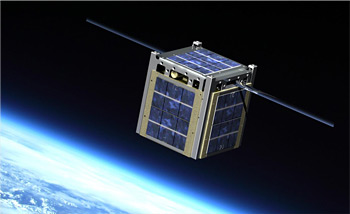
A CubeSat in Space

A CubeSat in Space

(Source: Technology Strategy Board)

CubeSats offer huge potential to accelerate technology development of sensors and instruments in a miniaturised package for deployment in space. New technology concepts for space missions can be demonstrated on CubeSat payloads, delivering a test bed at low cost and significantly reduced timescales.

The UK Space Agency is currently funding a pilot programme, called Ukube1, to demonstrate the capabilities of a CubeSats with a launch towards the end of 2012. If successful, this pilot project could pave the way for a national programme starting in the third quarter of 2012, offering launch opportunities every 12-18 months. The aims of a national programme will also encompass the delivery of educational opportunities and science applications as well as testing new technologies.

Proposals are invited to develop CubeSat preparatory studies for future mission concepts e.g. UKube-2. The concept can address a scientific theme or be of an in-orbit technology demonstration nature (e.g. formation flying), providing a real impact to the UK. All UK based communities (academic, industrial and other) are invited to submit proposals. Applications can be made individually or in partnership with other organisations, however industry and academia will be funded under the rules stipulated in the scope of funding presented below.

Funding is available up to £35K per proposal; the size of award will depend on the requirements of the proposed project and the applicants’ case for support. Proposals should not exceed a grant value of £35K. Funding will be awarded in 2012 and the project cannot exceed 3 months duration. Due to the short nature of these studies and the amount of funding available, we intend funding successful applicants at the onset of the project. It is anticipated the scheme will fund a minimum of 7 proposals; the facility to fund more will depend on the size of awards and will be assessed on a competitive basis as detailed below. The deadline for submission of proposals is 01 February 2012, 12pm.

See TSB website for more information

Vega rocket ready for first flight


Vega VV01 liftoff
Flight VV01

Vega rocket ready for first flight

19 January 2012
Final checkout of Europe’s new Vega launcher was completed last Friday, marking another milestone towards its maiden flight from Europe’s Spaceport in Kourou, French Guiana.

The first Vega launch campaign began in November with the installation of the P80 first stage on the launch pad. The two solid-propellant second and third stages were added to the vehicle, followed by the AVUM – Attitude & Vernier Upper Module – liquid-propellant fourth stage.  

AVUM pressurisation
AVUM pressurisation

All four stages have undergone final acceptance, including the testing of the avionics, guidance, telemetry, propulsion, separation pyrotechnics and safety systems.These steps culminated on 13 January with Vega’s ‘synthesis control checks’, where all systems were put into launch mode for the vehicle’s final acceptance. This included pressurising the AVUM propulsion systems that actuate the thruster valves.

The rocket’s elements were switched on from the control bench to simulate the launch countdown. The onboard software then took over and simulated the different stages of a flight. The interfaces between the vehicle and the control bench were also tested.

The test review confirmed that everything ran as expected and that the launcher is ready for flight.

AVUM in mobile gantry
AVUM

What’s next?

The ‘upper composite’ – the fairing and payload – will be integrated, followed by final checkout of the fully assembled launcher and the countdown rehearsal.

The first launch, VV01, is targeted for 9 February. It will carry nine satellites into orbit: the Italian space agency’s LARES and ALMASat-1, together with seven CubeSats from European universities.

This mission aims to qualify the Vega launch system, including the vehicle, its launch infrastructure and operations, from the launch campaign to payload separation and disposal of the upper module.

Artist's impression of Vega
Vehicle VV01

A flexible system

Vega is designed to cope with a wide range of missions and payload configurations in order to respond to different market opportunities and provide great flexibility.

In particular, it offers configurations able to handle payloads ranging from a single satellite up to one main satellite plus six microsatellites.

Vega is compatible with payload masses ranging from 300 kg to 2500 kg, depending on the type and altitude of the orbit required by the customers. The benchmark is for 1500 kg into a 700 km-altitude polar orbit.

More information on Vega and updates are now available on the new launch website here.

Announcement of Opportunity: CubeSat Mission Concept Studies

The core of the UK Space Agency strategy is to lead and sustain the growth of the UK Space Sector. In support of this the National Space Technology Programme (NSTP) promotes the development of new commercial and scientific applications by offering grant funding for truly novel concepts to be fully explored.

CubeSats offer huge potential to accelerate technology development of sensors and instruments in a miniaturised package for deployment in space. New technology concepts for space missions can be demonstrated on CubeSat payloads, delivering a test bed at low cost and significantly reduced timescales. The CubeSat is a relatively new concept, which is maturing rapidly, in which the UK has existing leading capability.

This NSTP programme is to facilitate the acceleration of space technologies up the Technology Readiness Level (TRL) curve but can also attract new players into the space sector by offering a low cost route to getting flight heritage. To follow, the NSTP Pathfinder studies programme is to be released in early 2012 and will be specifically to develop technology concepts.