Probable UKHASnet launch May 21/22

UKHASnet LogoJames Coxon M6JCX reports he is hoping to launch a UKHASnet node from East Anglia this weekend.

On the UKHAS Google Group he writes:

I’ve put together a GPS enabled, temperature controlled node AJ2 which will be launched on a latex balloon (rather than pico).

Due to the pattern of the winds the aim will be to float the balloon at around 30-35 km and current predictions suggest that it’ll drift east first then turn around and come back across the UK travelling west. This should give pretty good coverage of the UK and at a push across the sea towards the Netherlands so it would be great if any UKHASnet nodes could be brought online.

The node itself will be in repeater mode as well as transmitting its own packets every 30 seconds with GPS and other data. Previous tests and flights have had a mixture of results, the EMF launch allowed for 65 km downlink range and recent tests on the IoW made a solid 2 way link over 18 km however other flights haven’t been successful. Hopefully the temperature control will stabilise the radio to stop it drifting too much (both on tx and rx) and the node will recalibrate its noise floor etc as well as reset the rx loop of the radio to stop it locking up (a previous issue). The more nodes that we can have online the better (it is even possible to setup an RTLSDR dongle as a UKHASnet gateway)

There will be a backup tracker providing a RTTY downlink on 434.300 MHz (Atlas) which will be uploaded to spacenear.us This will be RTTY, ASCII 7, 425 Hz shift and is an old pAVA R7 board with a RFM22 so be prepared for some drift.

Current plan is to launch around 1100 on Sat 21/05/16 though the window will be the whole weekend and launch will be from Preston St Mary, Suffolk.

Flight data will be on the UKHASnet map https://ukhas.net/map

I’ve made a grafana page for the node
https://grafana.ukhas.net/dashboard/db/21-05-16-balloon-launch-aj2
and as always there will be discussions on #ukhasnet on freenode.

Thanks

James

Useful High Altitude Balloon links https://amsat-uk.org/beginners/balloons/

ÑUSAT-1 SSB/CW Transponder Satellite

LU Satellite Experiment Payload ÑUSAT-1, carrying an amateur radio 435/145 MHz linear transponder and a 436 MHz telemetry beacon, was launched May 30, 2016 at 0317 UT on a CZ-4B rocket from Taiyuan into 500 km 97 degree inclination  polar orbit. With ÑUSAT-1 on the launch was its sister satellite ÑUSAT-2 which has a 437 MHz beacon.

ÑuSAT-1 and ÑuSAT-2 beacons

ÑuSAT-1 and ÑuSAT-2 beacons

UPDATE May 30, 2016 at 1300 UT: ÑUSAT-1 and ÑUSAT-1 launched and deployed successfully, signals reported from both telemetry beacons. Satellogic reports “All Systems: Nominal”.

AMSAT-LU reports both satellites are sending strong TLM on 436.445/437.445 at 9K6/19K2 GFSK. During first few days they are being stabilized, after that the U/V linear transponder will be activated on ÑUSAT-1. A notice will be given on the AMSAT Bulletin Board (AMSAT-BB).

AMSAT Argentina say:

As we quoted when the announcement of the launching of this experiment, Amsat Argentina has been working for several years to keep alive the dream of many Argentine amateurs to get back into Space with their own satellite as a follow-on of the legendary 1990’s LUSAT-1, reaping the benefits of Technological advancement of our days.

We believe technical activities and developments of experiments in near space share the same goals: preserving the human group, enhancing their capabilities as well as disseminate and guiding the education and development of the activity, meanwhile contributing to Space available resources.

Our agreement with Satellogic Enterprises, which already launched three low orbit satellites: Captain Beto, Manolito y Tita, two of which transmit telemetry and data currently in UHF identifying themselves with callsign LU7AA, allowed us to ride a linear analog amateur radio transponder and corresponding antenna aboard one of their next satellite, ÑUSAT-1

AMSAT-LU provides simultaneously, support for this mission and the ÑUSAT-2 mission, by operating one of the control stations at Tortuguitas, Prov. Of Bs.As.

The experiment Amsat-LU developed, evolved from original design of our colleague and partner William, PE1RAH, while electronic adaptation, mechanical and software was made by the LU Satellite Experiment group, mounted on a 10 x 10 centimeters radiating plate, in which components of the power supply as well as a duplexer and dual band antenna where also incorporated.

This set was installed on the Ñusat-1 bus, which supplies power and becomes part of several other experiments this satellite will make.

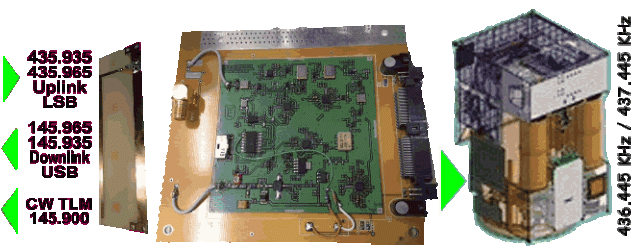
The transponder receives UHF which is broadcasted in VHF, has a bandwidth of 30 kHz. with an output power of 250 mW.

435.935 ~ 435.965 are LSB/CW uplink passband
145.965 ~ 145.935 are USB/CW downlink passband
145.900 Basic CW Telemetry

Telemetry beacons:
ÑUSAT-1 436.445 MHz 9k6 GFSK
ÑUSAT-2 437.445 MHz 9k6 GFSK

73 AMSAT ARGENTINA

http://www.amsat.org.ar
https://www.facebook.com/Amsat.LU
http://lusex.org.ar
http://amsat.org.ar/pass.htm
info [at] amsat.org.ar

CubeSats with Amateur Radio payloads deploy from ISS

MinXSS-1 and CADRE CubeSats deployed by Tim Peake KG5BVI / GB1SS on May 5, 2016

MinXSS-1 and CADRE CubeSats deployed by Tim Peake KG5BVI / GB1SS on May 5, 2016

Monday, May 16, 2016 saw the deployment of five CubeSats carrying amateur radio payloads.

STM students building antenna to receive data from STMSat-1 - Credit Saint Thomas More Cathedral School

STM students building antenna to receive signal from STMSat-1 – Credit Saint Thomas More Cathedral School

UK astronaut Tim Peake KG5BVI / GB1SS deployed the first two satellites MinXSS-1 and CADRE from the Japanese ISS Kibo module at 1005 UT. The Slow Scan Television (SSTV) satellite STMSat-1, built by Elementary students at Saint Thomas More Cathedral School (STM), was deployed along with the pair of NODES CubeSats built by students at Santa Clara University at 1440 UT.

STM is thought to be the first Elementary school to build their own satellite, even Pre-Kindergarten, Kindergarten, and First Grade students were involved in the project. It is designed to transmit a Robot36 SSTV signal.

UPDATE May 18: STMSat-1 Twitter feed suggests listening 437.000 MHz FM.

UPDATE May 20: STMSat-1 Twitter feed suggests listening 437.800 MHz FM.

CubeSat Frequency Chart - Credit Mike Rupprecht DK3WN

CubeSat Frequency Chart – Credit Mike Rupprecht DK3WN

IARU Coordinated Frequencies:
http://amsat.org.uk/iaru
• STMSat-1 437.800 MHz FM SSTV Robot36
• MinXSS-1 437.345 MHz 9600 bps FSK
• CADRE 437.485 MHz 9600 bps FSK and 3.404 GHz
• NODES 437.100 MHz 1200 bps AX.25 and 2401.2-2431.2 MHz 115.2 kbps spread spectrum FSK

Watch NASA video on the First Elementary School Built CubeSat

How Did 400 Grade School Students Built A Nano-Satellite?
http://jewelbots.tumblr.com/post/134465599599/how-did-400-grade-school-students-built-a

First CubeSat Built by an Elementary School Deployed into Space
https://www.nasa.gov/feature/first-cubesat-built-by-an-elementary-school-deployed-into-space

Deployment of two NODES satellites and STMSat-1

Deployment of two NODES satellites and STMSat-1

STMSat-1
https://twitter.com/STMSAT11
https://www.facebook.com/stmsat1/
https://www.facebook.com/groups/491135804399695/
http://www.stmsat-1.org/

MinXSS CubeSat http://lasp.colorado.edu/home/minxss/

CADRE CubeSat http://exploration.engin.umich.edu/blog/?page_id=961

NODES mission dashboard http://nodes.engr.scu.edu/

School SSTV CubeSat to deploy from ISS
https://amsat-uk.org/2016/03/03/school-sstv-cubesat-to-deploy-from-iss/

MinXSS and CADRE CubeSats ISS Deployment
https://amsat-uk.org/2016/05/14/minxss-cadre-cubesats/

CADRE video – Meet an Aerospace Engineering Student: Prince Kuevor
https://amsat-uk.org/2016/04/21/cadre-cubesat-iss/

Students at Saint Thomas More Cathedral School awaiting deployment of their CubeSat STMSat-1

Students at Saint Thomas More Cathedral School awaiting deployment of their CubeSat STMSat-1

MinXSS and CADRE CubeSats ISS Deployment

University of Michigan CADRE CubeSat

University of Michigan CADRE CubeSat

The MinXSS and CADRE CubeSats, both carrying amateur radio payloads, are set to be deployed from the International Space Station (ISS) on May 16, 2016 between 1000-1100 UT.

MinXSS will be beaconing in the UHF at 437.345 MHz every 9 seconds and will initially be in an orbit very similar to the ISS. We’ll get the TLE identifier in JSpOC labeled ASAP. The CADRE team may send out an email with their frequency information as well. [IARU has coordinated 437.485 MHz and 3.404 GHz for CADRE]

If you hear the MinXSS beacons, we would greatly appreciate it if you’d email us (me and those cc’d) to let us know. We’re still working on beacon decode/forward software that would bring you more in the loop.

For those interested, MinXSS is a science mission to study soft x-ray spectra from the sun. We’ll also be the first to fly the very popular Blue Canyon Technologies XACT attitude determination and control system.

Thanks for your help!

James Paul Mason, PhD
Postdoctoral research associate
MinXSS grad student lead turned co-investigator
University of Colorado at Boulder
Laboratory for Atmospheric and Space Physics

MinXSS CubeSat http://lasp.colorado.edu/home/minxss/

CADRE CubeSat http://exploration.engin.umich.edu/blog/?page_id=961

CADRE video – Meet an Aerospace Engineering Student: Prince Kuevor
https://amsat-uk.org/2016/04/21/cadre-cubesat-iss/

Ofcom propose using Ham Radio band for Wi-Fi

AMSAT members with the amateur radio 5 GHz and 10 GHz Phase 4B transponder MSS geosynchronous satellite

AMSAT members with the amateur radio 5 GHz and 10 GHz Phase 4B transponder MSS geosynchronous satellite

Ofcom is consulting on plans to put Wi-Fi across Amateur and Amateur Satellite spectrum in the 5 GHz band.

The Ofcom consultation document implies that amateur satellites in 5 GHz only operate in very Low Earth Orbits – This is false.

UNITEC-1 Venus spacecraft with amateur radio 5840 MHz payload

UNITEC-1 Venus spacecraft with amateur radio 5840 MHz payload

A5.28 Amateurs can access 5650-5850 MHz with amateur satellite Earth-to-space links in 5650-5670 MHz and space-to-Earth links in 5830-5850 MHz. Most current amateur satellites are typically nano or picosats (also called ‘cubesats’) that occupy slightly elliptical sun-synchronous low earth orbits at 60-800 km altitude. These smaller satellites have relatively low power and antenna gain.

Radio amateurs have sent 5 GHz payloads into far higher orbits. Examples are the Venus orbiter Unitec-1 which operated on 5.840 MHz and AO-40 which is in a 58,836 km High Earth Orbit (HEO). The 5 GHz band will also be used by the Geosynchronous Phase-4B payload and the HEO Phase-3E satellite both of which are currently under construction.

The use of 5725-5850 MHz for Wi-Fi would adversely affect reception of the network of amateur weak-signal propagation beacons.

Ofcom-logo-col-tThe Ofcom press release says:

As broadband delivered to the home gets faster, people increasingly expect their Wi-Fi to provide several services at once – such as video streaming, video calls, gaming and remote working. This demand puts pressure on the spectrum which carries Wi-Fi signals.

Most Wi-Fi routers in the UK currently use a part of the spectrum called the 2.4 GHz band, but this is becoming increasingly congested and can impair broadband delivery of high data rate applications such as streaming video or live TV.

Many people now have newer broadband routers, which use not only the 2.4 GHz band, but also the 5 GHz band – which offers much more spectrum and can accommodate wide channels suitable for high data rate uses.

To make connections faster, Ofcom is proposing to open up an additional ‘sub-band’ within the 5 GHz frequency range for Wi-Fi – while ensuring protection for other users, such as satellite services.

The extra sub-band would increase the number of 80 MHz channels available for Wi-Fi from four to six, to accommodate data-hungry applications. These extra channels – which are already being used in the United States – could be opened up in around two to three years.

The consultation closes on July 22, 2016.

Ofcom 5 GHz consultation http://stakeholders.ofcom.org.uk/consultations/5-GHz-Wi-Fi/

You can respond online at
https://stakeholders.ofcom.org.uk/consultations/5-GHz-Wi-Fi/howtorespond/form

The UK Microwave Group (UKuG) point out that Ofcom’s plans for 5725-5850 MHz would unilaterally raise the noise floor for little benefit to consumers. They say 5760 terrestrial & EME and 5840 satellite reception need maximum protection. A Word Doc response form is available on the UKuG site at http://www.microwavers.org/

The UK Microwave Group loans equipment to get amateurs started on 5.7 GHz
http://www.microwavers.org/6cm-loan-system.htm

Network of amateur weak-signal 5.7 GHz propagation beacons
http://www.microwavers.org/maps/6cms.htm

Unitec-1 amateur radio Venus spacecraft
http://www.southgatearc.org/news/may2010/unitec1_signal_received.htm

Schools in mass launch of 434 MHz balloons

Successfully launched tracked and retrieved - Credit Hobb Computer Services

Successfully launched tracked and retrieved – Credit Hobb Computer Services

TV presenter Jason Bradbury 2E0JAB was among those present at a mass launch of 25 balloons transmitting in 434 MHz on Thursday, May 12, 2016.

Tracks of some of the balloons - Credit PitsProject

Tracks of some of the balloons – Credit PitsProject

Balloons from 25 schools were launched in batches of five from RAF Cosford. Each balloon carried a payload incorporating two small cameras and the Raspberry Pi In The Sky telemetry tracker. The balloons transmitted on unique frequencies ranging from 434.040 to 434.790 MHz.

Jason Bradbury’s balloon reached an altitude of 33 km before it burst and the payload parachuted back to Earth. The next problem was finding it. He tweeted:

Call out to my radio amateur friends. Need help finding 434.04mhz telemetry binary code

The balloon was eventually found stuck up a tall tree.

Watch the BBC TV Midlands Today report on the event

The Sentinel newspaper report – Students are flying high as experiment takes them to the edge of space http://www.stokesentinel.co.uk/VIDEO-Engineering-students-launch-giant-balloons/story-29266315-detail/story.html

Pi In The Sky telemetry board
http://pi-in-the-sky.com/
https://twitter.com/pitsproject

Sent into Space
http://sentintospace.com/
https://twitter.com/Sent_into_space

Useful High Altitude Balloon links https://amsat-uk.org/beginners/balloons/

Getting ready for the launch - Credit KMF Metal

Getting ready for the launch – Credit KMF Metal