Slow Scan TV from Space Dec 5-6

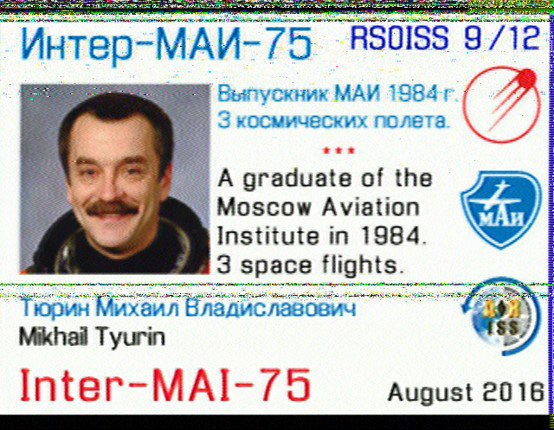
ISS SSTV MAI-75 image 9/12 received by Chertsey Radio Club on Baofeng handheld

ISS SSTV MAI-75 image 9/12 received by Chertsey Radio Club on Baofeng handheld

The 145.800 MHz FM Slow Scan Television (SSTV) transmissions from the International Space Station on December 5-6 should be receivable by radio amateurs around the world.

There should also be SSTV activity on December 7 and 8 at times when the ISS is in range of Moscow.

UPDATE: On Dec 5 ISS Ham @RF2Space Tweeted:
Looks like the #ISS #SSTV test activity was delayed a day. The MAI-75 part is still there but some time changes and session removed. See new schedule at https://ariss-sstv.blogspot.com/

The MAI-75 SSTV system in the Russian Service Module will be put through some extended testing from December 5 starting around 15:00 UTC and running until 09:00 UTC on December 6. Test images will be used during this period. This will provide near global coverage if all works well on 145.800 MHz FM.

In the past images have been sent using the SSTV mode PD120, with a 2-minute off time between each image.

All you need to receive SSTV pictures direct from the space station is to connect the audio output of a scanner or amateur radio transceiver via a simple interface to the soundcard on a Windows PC or an Apple iOS device, and tune in to 145.800 MHz FM. You can even receive pictures by holding an iPhone next to the radio loudspeaker.

The ISS puts out a strong signal on 145.800 MHz FM and a 2m handheld with a 1/4 wave antenna should be enough to receive it.

Many FM rigs can be switched been wide and narrow deviation FM filters. For best results you should select the filter for wider 5 kHz deviation FM. Handhelds all seem to have a single wide filter fitted as standard.

ARISS SSTV Blog http://ariss-sstv.blogspot.co.uk/

ISS Slow Scan TV information with links to Apps and ISS tracking
https://amsat-uk.org/beginners/iss-sstv/

FUNcube-1 celebrates its 4th birthday

Final gluing of FUNcube-1 bolt by Wouter Weggelaar PA3WEG – Image credit Gerard Aalbers

Final gluing of FUNcube-1 bolt by Wouter Weggelaar PA3WEG – Image credit Gerard Aalbers

Today, November 21st 2017, marks the fourth birthday for FUNcube-1 (AO-73) in orbit.

FUNcube-1 was launched at 07:10 UTC on November 21st 2013 and its first signals were received immediately after deployment over the Indian Ocean by amateurs in South Africa. Since then it has been operating continuously in either its education mode or, with the transponder active, in amateur mode when in eclipse and at weekends.

AMSAT-UK FUNcube Mission Patch Rev4 20100609

AMSAT-UK FUNcube Mission Patch

The spacecraft has spent the four years in space orbiting the earth at between 640 and 580 km and has now traveled around the earth more than 20,000 times. That represents a distance traveled of approaching 500 million miles.

Up to now, each of the orbits has been spilt approximately 65% in sunlight and 35% in eclipse. This has resulted in the temperatures inside the small spacecraft varying by about 25° C during each orbit.

During the recent AMSAT-UK Colloquium, Wouter Weggelaar, PA3WEG, in his presentation about the FUNcube project mentioned that the power available from the solar panels has been slowly increasing since launch. This observation led the team to do some further investigations as to the cause.

Although the launch was into a nominally Sun Synchronous orbit, over time this has drifted and the spacecraft is now entering a period when it will be in the sun for longer periods during each orbit. The exact details are still being determined, but it seems likely that, starting from January 2018, there will be periods when the spacecraft will be in the sun for all, or almost all, of its orbits.

FUNcube-1 temperature rise

FUNcube-1 temperature rise

This means that the on-board temperatures will be much higher than we have previously experienced in flight, although we have some test records from pre-flight thermal air testing that were undertaken after integration.

The key will be to discover what the equilibrium temperature will be internally. For comparison, AO85 has already “enjoyed” periods of full sun and its internal temperatures have reached up to around 55° C.

So the next few months will be quite an exciting time for the team! We remain extremely grateful to everyone is using the spacecraft for both its educational and amateur missions. Of course we are also very very grateful to those who are downloading the telemetry and uploading the data to the Data Warehouse. It continues to provide a unique record of “life on board” a 1U CubeSat in space.

Watch the FUNcube presentation by Wouter Weggelaar PA3WEG

Get your 73 on 73 Award, details at https://amsat-uk.org/funcube/73-on-73-award/

AO-73 (FUNcube-1) website https://amsat-uk.org/funcube/funcube-website/

FUNcube Yahoo Group https://amsat-uk.org/funcube/yahoo-group/

ZACUBE-1, FUNcube-1 and HiNCube in the deployment pod - Image credit Wouter Weggelaar PA3WEG

ZACUBE-1, FUNcube-1 and HiNCube in the deployment pod – Image credit Wouter Weggelaar PA3WEG

RadFxSat (Fox-1B) Launched, Designated AMSAT-OSCAR 91 (AO-91)

RadFxSat (Fox-1B) signal received by Mike Rupprecht DK3WN

RadFxSat (Fox-1B) signal received by Mike Rupprecht DK3WN

The Delta II rocket carrying RadFxSat (Fox-1B) launched at 09:47:36 UTC on November 18, 2017 from Vandenberg Air Force Base, California.

RadFxSat (Fox-1B) CubeSat

RadFxSat (Fox-1B) CubeSat

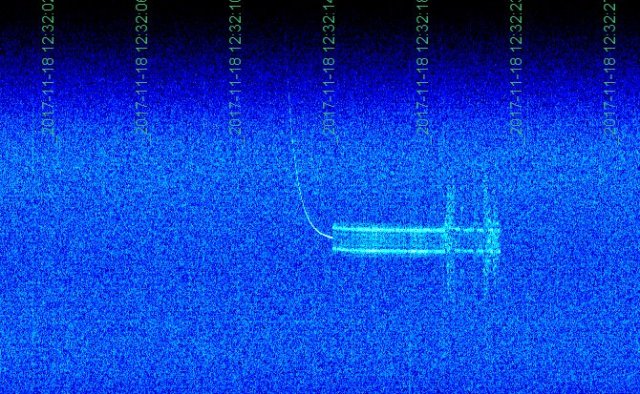
Following a picture-perfect launch, RadFxSat was deployed at 11:09 UTC. Then the wait began. At 12:12 UTC, the AMSAT Engineering team, watching ZR6AIC’s WebSDR waterfall, saw the characteristic “Fox Tail” of the Fox-1 series FM transmitter, confirming that the satellite was alive and transmitting over South Africa. Shortly after 12:34 UTC, the first telemetry was received and uploaded to AMSAT servers by Maurizio Balducci, IV3RYQ, in Cervignano del Friuli, Italy. Initial telemetry confirmed that the satellite was healthy.

After confirmation of signal reception, OSCAR Number Administrator Bill Tynan, W3XO, sent an email to the AMSAT Board of Directors designating the satellite AMSAT-OSCAR 91 (AO-91). Bill’s email stated:

“RadFxSat (Fox-1B) was launched successfully at 09:47 UTC today November 18, 2017 from Vandenberg Air Force Base in California and has been received by several amateur stations.

RadFxSat (Fox-1B), a 1U CubeSat, is a joint mission of AMSAT and the Institute for Space and Defense Electronics at Vanderbilt University. The Vanderbilt package is intended to measure the effects of radiation on electronic components, including demonstration of an on-orbit platform for space qualification of components as well as to validate and improve computer models for predicting radiation tolerance of semiconductors.

RadFxSat (Fox-1B) signal received at 12:12 GMT, Nov 18 by the ZR1AIC WebSDR in South Africa

RadFxSat (Fox-1B) signal received at 12:12 GMT, Nov 18 by the ZR1AIC WebSDR in South Africa

AMSAT constructed the remainder of the satellite including the spaceframe, on-board computer and power system. The amateur radio package is similar to that currently on orbit on AO-85 with a FM uplink on 435.250 MHz (67.0 Hz CTCSS) and a FM downlink on 145.960 MHz. Experiment telemetry will be downlinked via the DUV subaudible telemetry stream, which can be decoded using the FoxTelem software.

RadFxSat (Fox-1B) was sent aloft as a secondary payload on the United Launch Alliance (ULA) Delta II rocket that will transport the Joint Polar Satellite System (JPSS)-1 mission. RadFxSat (Fox-1B) is one of four CubeSats making up this NASA Educational Launch of Nanosatellites (ELaNa) XIV mission, riding as secondary payloads aboard the JPSS-1 mission.

Since RadFxSat (Fox-1B) has met all of the qualifications necessary to receive an OSCAR number, I, by the authority vested in me by the AMSAT President, do hereby confer on this satellite the designation AMSAT-OSCAR 91 or AO-91. I join amateur radio operators in the U.S. and around the world in wishing AO-91 a long and successful life in both its amateur and scientific missions.

RadFxSat (Fox-1B) LogoI, along with the rest of the amateur community, congratulate all of the volunteers who worked so diligently to construct, test and prepare for launch the newest amateur radio satellite.

William A. (Bill) Tynan, W3XO
AMSAT-NA OSCAR Number Administrator”

The FM voice transponder was made available for amateur use on November 23, 2017.

Source AMSAT News Service http://www.amsat.org/mailman/listinfo/ans

FoxTelem software https://www.amsat.org/foxtelem-software-for-windows-mac-linux/

Radio Programming Chart

RadFxSat (Fox-1B) Doppler Shift Correction

Memory 1 (AOS) – Transmit 435.240 MHz (67.0 Hz Tone), Receive 145.960 MHz
Memory 2 (Approaching) – Transmit 435.245 MHz (67.0 Hz Tone), Receive 145.960 MHz
Memory 3 (TCA) – Transmit 435.250 MHz (67.0 Hz Tone), Receive 145.960 MHz
Memory 4 (Departing) – Transmit 435.255 MHz (67.0 Hz Tone), Receive 145.960 MHz
Memory 5 (LOS) – Transmit 435.260 MHz (67.0 Hz Tone), Receive 145.960 MHz

Frequencies are subject to change post-launch.

Online real-time satellite tracking http://www.n2yo.com/

Keplerian Two Line Elements (TLEs) ‘Keps’:
• New satellites launched in past 30 days http://celestrak.com/NORAD/elements/tle-new.txt
• CubeSats http://celestrak.com/NORAD/elements/cubesat.txt
• Experimental satellites http://celestrak.com/NORAD/elements/x-comm.txt
• Engineering satellites http://celestrak.com/NORAD/elements/engineering.txt
• Amateur radio satellites http://www.amsat.org/amsat/ftp/keps/current/nasa.all

AMSAT Bulletin Board (AMSAT-BB) http://www.amsat.org/mailman/listinfo/amsat-bb
RadFxSat (Fox-1B) Telemetry Reception Challenge

RadFxSat (Fox-1B) CubeSat

RadFxSat (Fox-1B) CubeSat

Get FoxTelem set up and ready to go on Saturday! The first amateur radio operator that successfully receives RadFxSat (Fox-1B) telemetry and uploads it to the AMSAT server will receive a commemorative 3D printed QSL card.

RadFxSat is scheduled for launch at 1:47am PST (09:47 UT) on Saturday, November 18 from Vandenberg Air Force Base, California. The first transmission from RadFxSat is expected to occur around 12:07 UT. Due to a lack of prelaunch Keplerian elements, it is not known exactly where the satellite will be when it makes it’s first transmission.

For further details regarding the Launch and Early Orbit Phase (LEOP) of RadFxSat operations, please see:
https://amsat-uk.org/2017/11/04/getting-ready-for-radfxsat-fox-1b/

FoxTelem software https://www.amsat.org/foxtelem-software-for-windows-mac-linux/

Follow the launch day chat on the #CubeSat IRC channel
https://riot.im/app/#/room/#freenode_#cubesat:matrix.org
http://irc.lc/freenode/cubesat

Initial post-launch Keplerian Two Line Elements (TLEs) ‘Keps’
RadFxSat
1 00000U 17000A 17322.46057870 -.00000000 00000-0 00000-0 0 00004
2 00000 97.6996 257.5922 0258900 235.2917 178.7268 14.79536000 07

AMSAT Bulletin Board (AMSAT-BB) http://www.amsat.org/mailman/listinfo/amsat-bb

AMSAT News Service http://www.amsat.org/mailman/listinfo/ans

Countdown to World Radiocommunication Conference 2019

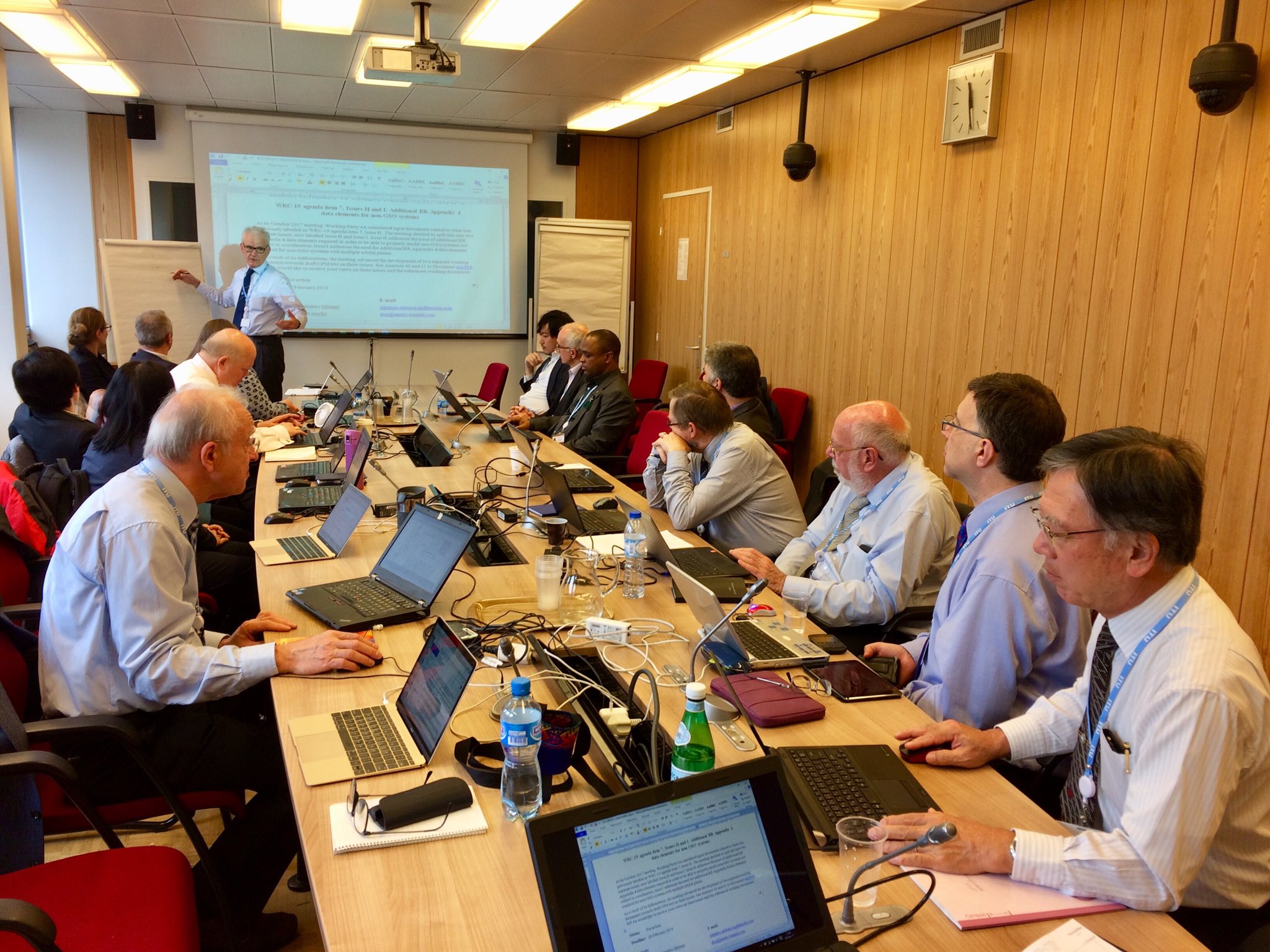
ITU WP-5A - Amateur Satellite Management Discussion Nov 8, 2017 - Credit Bryan Rawlings VE3QN

ITU WP-5A – Amateur Satellite Management Discussion Nov 8, 2017 – Credit Bryan Rawlings VE3QN

Bryan Rawlings, VE3QN, RAC Special Advisor, is in Geneva, Switzerland attending Preparatory Meetings for the 2019 World Radiocommunication Conference (WRC-19) until Friday, November 17.

The current meetings are the fourth of a series of meetings which will continue until just before WRC-19 now scheduled to be held from October 28 to November 22, 2019.

Preparatory Meetings are usually held at the International Telecommunication Union (ITU) headquarters in Geneva and are usually of two weeks duration. This time Bryan is attending as a member of the Canadian Delegation and also as an Expert Consultant for the International Amateur Radio Union (IARU).

Preparatory Meetings primarily prepare documents on the agenda items identified for the upcoming WRC. They are in turn preceded by meetings and the submission of documents from the participating administrations, for example, Canada through its authorized government agency, the Department of Innovation, Science and Economic Development (ISED; formerly Industry Canada). The RAC representative is made a member of the delegation by invitation and Bryan’s role is to advise on Amateur issues.

The principal Amateur Radio issue is an international authorization of the 50 to 54 MHz band in ITU Region 1 (Europe, Africa and the Middle East). Canada has submitted a contribution to this meeting indicating no concerns about interference to the Canadian users who are, of course, Radio Amateurs since 50 – 54 MHz is a Primary Allocation in Canada. Indeed, Canadian Amateurs would welcome harmonization of the six-metre band worldwide.

ITU-R Working Party 5A is chaired by Dr. José Costa, a Canadian, and the Canadian Delegation to WP-5A is being chaired by Ms. Cindy-Lee Cook of ISED.

In addition to Canada, there are Amateur delegates in Geneva this time representing their individual delegations and/or the IARU and they come from the United States, the Netherlands, the United Kingdom, Germany, Japan, Norway, Brazil and Australia.

These meetings are also debating an expansion of the frequencies, powers and deployment of Radio Local Area Networks (RLANs) in the 5 GHz range. Canadian Amateurs have a secondary allocation here in 5650 to 5925 MHz which we already share with the Primary Users – principally meteorological radars – and with ISM (Wi-Fi, etc.).

Also warranting close attention is an agenda item proposing frequencies for wireless power transfer, e.g., charging cellphones and – significantly – larger devices including vehicles. Frequencies under discussion lie in the range 19 to 300 kHz and – possibly – just below the 40m Amateur band. Depending upon the frequencies planned and the technical characteristics there may be significant interference issues to users of the HF and VHF spectrum.

As he has done in recent meetings, Bryan will be tweeting comments on Amateur Radio issues from the meeting using the hashtag #RACatITU. You can also follow him at @VE3QN

Bryan will also be including a report in the next issue of The Canadian Amateur magazine at the conclusion of the meetings.

For more information about the Preparatory Meetings visit:
http://www.itu.int/en/events/Pages/Calendar-Events.aspx?sector=ITU-R

Alan Griffin
RAC MarCom Director

Source http://wp.rac.ca/wrc-preparatory-meetings-november2017/

Follow Bryan Rawlings VE3QN on Twitter https://twitter.com/VE3QN

6th Staines Scouts receive FUNcube-1 message

AO-73 (FUNcube-1) – Image credit Wouter Weggelaar PA3WEG

The Chertsey Radio Club got some good publicity for both amateur radio and the FUNcube-1 (AO-73) satellite in the Heathrow Villager newspaper published on November 4, 2017.

Club members James Preece M0JFP, Ian Parbery 2E0IPP and Bob Conduit M6FLT along with the 6th Staines Scout Group ran a Jamboree On The Air (JOTA) station GB6SS.

During the event the FUNcube-1 satellite transmitted a special Fitter Message from Space that the Scouts successfully decoded, it said:
“ChertseyRC: GB6SS have fun celebrating 60 years of JOTA 6th Staines Scouts, Cubs and Beavers 20 Oct 17”

Download a PDF of the Heathrow Villager newspaper, the article is on page 5
http://www.heathrowvillager.co.uk/download/i/mark_dl/u/4005923139/4633391054/Villager%20031117a.pdf

What is a FUNcube-1 Fitter message? https://funcube.org.uk/ground-segment/fitter-messages/

Awarding 6th Staines Cubs with their Communicators badges
http://chertseyradioclub.blogspot.co.uk/2017/11/awarding-6t-staines-cubs-with-their.html

The Chertsey Radio Club were recently presented with the RSGB Region 10 small Club of the Year award
http://chertseyradioclub.blogspot.co.uk/2017/11/chertsey-presented-small-coty-2016.html