On Wednesday, October 10 it was announced in Moscow that UK private spacefarer Sarah Brightman had passed the required mental and physical examinations to fly into space. In 2013 she will undertake six months of training at Star City in Moscow in preparation for her mission to the International Space Station (ISS).
Tag Archives: ISS
Radio amateurs asked to help track and decode the F-1 CubeSat

FSpace Team Phạm Quang Hưng, Đinh Quốc Trí, Khánh Has, Thu Trong Vu XV9AA, Hong Thai Pham, Dao Thang picture taken by Nguyễn Trần Hoàng
The F-1 CubeSat, callsign XV1VN, developed by the FSpace team of young engineers and students at the FPT University, deployed from the International Space Station (ISS) on Thursday, October 4 at 15:44 UT. A Google English newspaper report with pictures of the F-1 team’s attempts to receive the satellite after deployment can be seen at http://tinyurl.com/Chungta-F-1-Article. F-1 Keps (1998-067CP) are at http://celestrak.com/NORAD/elements/tle-new.txt.
On Sunday, October 7 Thu Trong Vu XV9AA provided this update:
So far the team has received several mixed reports about F-1 status, there is no definite conclusion yet. We will continue to collect information and analyze the situation, this afternoon we will hold a team meeting to discuss different situations that may happen with the little satellite up there. Please continue to help us listening for F-1 on 437.485 in daylight and 145.980 in the dark, thank you!
FITSAT-1 Update
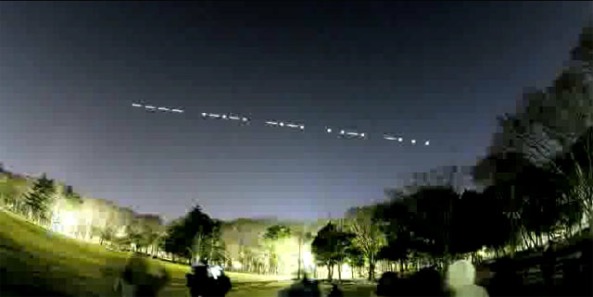
The amateur radio CubeSat FITSAT-1 (aka NIWAKA) carries an Optical Communications experiment that aims to write Morse Code across the night sky. The satellite is fitted with a bank of high power LEDs that will be driven with 200W pulses to produce extremely bright flashes that may be visible to the unaided eye.
FITSAT-1 was deployed from the International Space Station (ISS) at 15:44 UT on Thursday, October 4 along with F-1 and TechEdSat.
On Sunday, October 7 Takushi Tanaka JA6AVG provided this update:
We have received a lot of signal and telemetry reports from amsat members. All reports show FITSAT-1 starts working and sound. Thank you very much for your help.
We will examine movements, temperatures, and battery states of FITSAT-1 during these 10 days, and start experiments of 5.8GHz transmission and flashing LEDs.
I will announce the experiments on my web-page http://www.fit.ac.jp/~tanaka/fitsat.shtml
As well as 437.250 MHz and 437.445 MHz (both +/- 10 kHz Doppler) this innovative satellite can also transmit on 5840.0 MHz (+/- 134 kHz Doppler).
FITSAT-1 received with 1/4 wave antenna and FUNcube Dongle SDR
Howard Long G6LVB has released a video showing reception of the FITSAT-1 CubeSat 437.250 MHz CW beacon using just a 1/4 wave antenna on a baking tray sat on his balcony in London. The receiver was a FUNcube Dongle Pro+ LF/MF/HF/VHF/UHF Software Defined Radio (SDR). No preamp or external filtering were used.
NASA Release Amateur Radio CubeSat Deployment Pictures
ISS Amateur Radio CubeSats Deployed
On October 4, 2012 five CubeSats were successfully deployed from the International Space Station (ISS). The first pod containing RAIKO and WE-WISH was deployed at 1437 UT while the second pod containing FITSAT-1, F-1 and TechEdSat deployed at 1544 UT. Pictures can be seen at http://www.uk.amsat.org/?p=10804
October 4 was also the 55th anniversary of the launch of the first satellite Sputnik 1. Videos of Sputnik are here.
Four of the CubeSats carry Amateur Radio payloads, they are TechEdSat, F-1, FITSAT-1, and WE-WISH. As of Oct 5, 1015 UT signals had been reported from WE-WISH and FITSAT-1 as well as weak signal reports for TechEdSat.

ISS CubeSat Frequency Chart – Image Credit Mike Rupprecht DK3WN


You must be logged in to post a comment.