KiwiSAT hoping for launch mid-2013

The development of the amateur radio satellite KiwiSAT is completed and it is now ready for a LEO launch.

It carries a 435 or 1268 MHz to 145 MHz  linear transponder for SSB/CW operation.
* Transmit Power: 2 Watts PEP.
* Beacon frequency: 145.885 MHz
* Uplink: (U-Band) 435.265 to 435.235 MHz LSB or
* Uplink: (L-Band) 1268.880 to 1268.850 MHz LSB
* Down link: 145.850 to 145.880 MHz USB

The KiwiSAT website says the team have been in discussion with ISC Kosmatras for a DNEPR launch. They hope the satellite will be launched mid-2013.

The KiwiSAT team released a status update which can be read at http://www.kiwisat.org/status.html

In addition to the transponder KiwiSAT also carries an Atitude Determination And Control (ADAC) experiment developed by students at Massey University.

Read the article Massey students create space satellite software at http://www.massey.ac.nz/massey/about-massey/news/article.cfm?mnarticle_uuid=238ABC1A-FC7C-B944-8CC0-987538B6B665

KiwiSAT http://www.kiwisat.org/

AMSAT-ZL http://www.amsat-zl.org.nz/

// < ![CDATA[
// < ![CDATA[
// < ![CDATA[
// < ![CDATA[
// < ![CDATA[
// < ![CDATA[
//

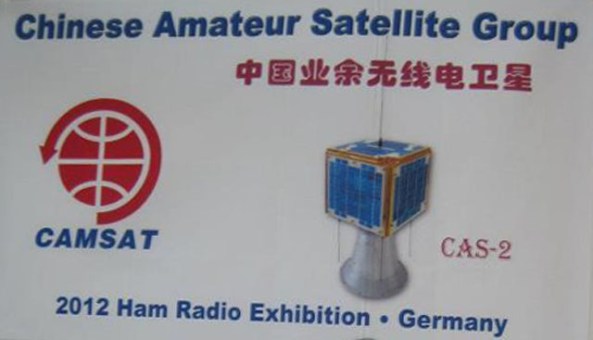
New CAMSAT Satellite CAS-2

CAMSAT CAS-2 at Friedrichshafen Ham Radio 2012 Event – Image Credit ARRL

The first CAMSAT amateur radio satellite CAS-1 (aka XW-1, HO-68) carried a linear transponder and proved very popular with radio amateurs world-wide.

Fan Shaomin BA1EO with CAS-2 A1

Fan Shaomin BA1EO with CAS-2 A1

CAMSAT and students at the Qian Youth Space Academy have been working on the next satellite CAS-2.

The launch of CAS-2 is planned for 2014 into a 1000 km orbit with an inclination of 12 degrees. This orbit means it may not be receivable in those countries at high latitudes.

It is understood that most of the room in CAS-2 will be taken up by the primary (non-amateur) payload and it has only been possible to fit a single channel FM amateur transponder in the satellite.

The announcement of May 20 indicates that two separate CAS-2 satellite structures are being built – A1 and A2.

Further information in Google English can be seen at http://tinyurl.com/CAMSAT-CAS-2-Satellite

The CAMSAT delegation to Ham Radio 2012 in Friedrichshafen was led by Gong Wancong BA1DU. A group picture taken at the CAMSAT and AMSAT-DL stands and a picture of the engraved glass plaque that CAMSAT presented to AMSAT-DL can be seen on the AMSAT Deutschland Facebook page at https://www.facebook.com/media/set/?set=a.420116544697800.90571.168177559891701&type=3

Randy Hall K7AGE visited Beijing in March 2008. Among the people he visited was Fan Shaomin BA1EO.

Watch Randy’s video which provides an insight into amateur radio in Beijing. The BA1EO visit is at 12:55

Read more about Ham Radio in that part of the world from Larry’s, KH6ITY, article at ARRL – http://www.arrl.org/news/cq-china

ARISS unable to do Beijing contacts http://tinyurl.com/ARISS-Cancel-Beijing

F-1 CubeSat Delivered to Tsukuba Space Center

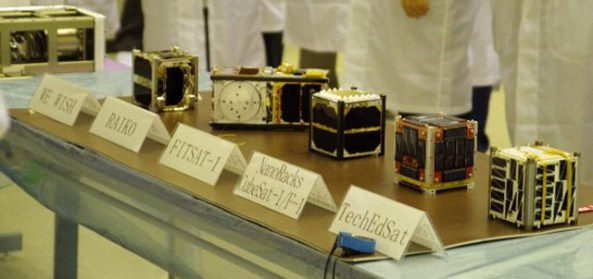
CubeSats ready for HTV-3 Launch – Image Credit Koumei Shibata

The amateur radio CubeSat F-1 built by students at the FPT University in Hanoi, Vietnam has now been delivered to the Tsukuba Space Center in Japan.

F-1 CubeSat – Image Credit Koumei Shibata

F-1 and the other four CubeSats  (RAIKO, WE WISH, FITSAT-1 and TechEdSat) will be integrated with the small satellite deployer J-SSOD before leaving for Tanegashima launch pad.

The CubeSats should be launched to the International Space Station (ISS) on July 21 in the HTV-3 cargo vessel.  It is planned that they will be deployed from the ISS in September by Japanese astronaut Akihiko Hoshide KE5DNI using the Kibo robot arm.

F-1 carries a low-resolution camera (640×480), a 3-axis magnetometer and two Yaesu VX-3R transceivers using 145.980 and 437.485 MHz.

See the story on the FPT University website http://tinyurl.com/FTP-F-1-To-Launch

Further pictures of the CubeSats by Koumei Shibata can be seen at http://fspace.edu.vn/?p=633

An NHK TV News video showing the CubeSats shows the LED’s on FITSAT-1 that will be used to flash Morse Code from space. See http://www3.nhk.or.jp/news/html/20120625/t10013095191000.html

For the latest news on F-1 see the FSpace website http://fspace.edu.vn/

Video depicting F-1 CubeSat XV1VN deployment from the ISS http://www.uk.amsat.org/?p=8446

Vietnam Student CubeSat F-1 http://www.uk.amsat.org/?p=5025

Winner of HORYU-2 Receiving Competition

Testing_HORYU-2_Solar_Panels

Testing HORYU-2 Solar Panels

Built by students at the Kyushu Institute of Technology (KIT) the amateur radio satellite HORYU-2 was launched on May 17 at 1639 UT.

HORYU-2 Receiving Competition Prize

Radio amateurs from around the world sent in telemetry and the winner with the most points has been announced as Yoshitomo Iji JA6PL who will be presented with a bottle as the prize.

The top three places were:

1st place: JA6PL (91 points)
2nd place: ZL2BX (36 points)
3rd place: JF1EUY (35 points)

The satellite’s callsign is JG6YBW and the CW telemetry beacon frequency is 437.375 MHz (+/- Doppler shift).

The free KIT HORYU-2 telemetry software can be downloaded from
http://kitsat.ele.kyutech.ac.jp/Documents/information_launch_english.html

KIT HORYU Blog in Google English http://tinyurl.com/HORYU-Blog

Japanese HORYU website in Google English http://tinyurl.com/HoryuSatellite

English language version of HORYU website http://kitsat.ele.kyutech.ac.jp/index_e_new.html

Further information on HORYU-2 is at http://www.uk.amsat.org/7404

HORYU-2 online WebSDR receiver http://sdr.opt.ro:8901/

KIT HORYU-2 Facebook Group https://www.facebook.com/groups/277436165678985/

HORYU-2 CW Telemetry Decoder by DK3WN http://tinyurl.com/SatSoftwareDK3WN/

SimpleSatLookDown satellite tracking software http://www.uk.amsat.org/?p=8217

Students Build Supercapacitor Battery for next ARISSat

Penn State Behrend students Jacob Sherk, Kathleen Nicholas and David Jesberger put final touches to the amateur radio satellite supercapacitor battery – Image Credit Pennsylvania State University

On Feb. 3, 2006, astronauts tossed an old spacesuit off the International Space Station. Inside was an amateur radio transmitter, a temperature sensor and some batteries.

The suit was a DIY satellite. It circled the Earth twice, repeating a greeting recorded in multiple languages; ham radio operators listened in as it passed overhead.

Then the batteries died.

The Radio Amateur Satellite Corporation, or AMSAT, tried again in 2011. The battery in that satellite, a more traditional box design, also failed.

Penn State Nittany Lions Paw Print

For the next model, AMSAT, a volunteer group, turned to the School of Engineering at Penn State Erie, The Behrend College. Three students designed a brand-new battery: a 1.8 kg cube powered by 15 supercapacitors, each roughly the size of a film canister.

The battery was built to handle 16 charge cycles in a 24-hour period. That will power the satellite in dark orbits, when the solar panels are not facing the sun.

To activate the battery before those solar panels charge, the students – David Jesberger, of St. Marys; Kathleen Nicholas, of Pittsburgh; and Jacob Sherk, of Elizabethtown – added four 9-volt Duracells.

AMSAT hopes to fit the satellite into a rocket payload and onto the International Space Station sometime in 2013. The astronauts won’t have to do much with it.

“It’s simple by design. They flip a switch, and they throw it out,” said Dakshina Murthy Bellur, an assistant professor of electrical and computer engineering at Penn State Behrend. He supervised the battery work, which counted as the students’ senior capstone project.

All three students have since graduated. All three have jobs: Nicholas and Jesberger signed on with defense contractors, and Sherk works at the Three Mile Island nuclear power plant.

They continue to track the AMSAT project. They want to know when their battery, upon which they laser-etched with their names and a Nittany Lion paw print, gets a launch date.

“That’s going to be cool,” Jesberger said. “We’ll have our signatures in space.”

Source Pennsylvania State University http://live.psu.edu/story/60125

ARISSat http://www.arissat.org/
Interview with author of DIY Satellite Platform

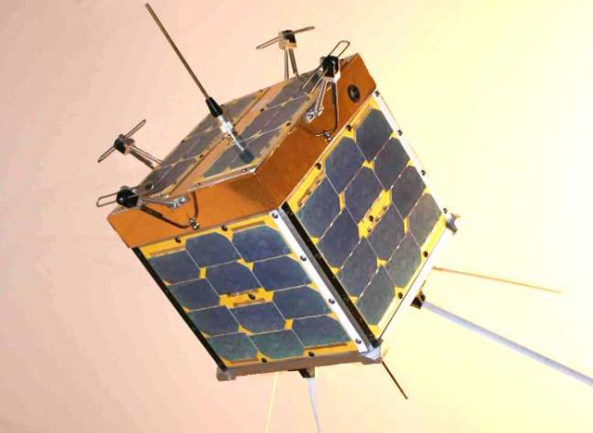
Tubesat - Image Credit Interorbital Systems

Have you ever wanted to build your own personal satellite but your last name doesn’t start with Gates or Branson? Well, now there’s good news. For the price of a car you can now build, test and launch your own personal satellite at home.

Dr. Sandy Antunes, Author of DIY Satellite Platform, talks about building his own amateur radio personal spacecraft Project Calliope. The best part (besides having your own satellite) is that you can now do some serious science.

Find out what kind of satellite Dr. Antunes is building and how he’s running the same kinds of tests the large Aerospace companies do, but for a fraction of the cost.

Project Calliope: http://www.projectcalliope.com/

Watch How to build your own personal satellite

Dr. Sandy Antunes used Kickstarter to raise funds for the project
http://www.kickstarter.com/projects/ghostlibrary/capturing-the-ionosphere-ground-station-calliope

Amazon – DIY satellite Platform
http://www.amazon.co.uk/DIY-Satellite-Platforms-Space-Ready-Picosatellite/dp/1449310605/

Interorbital Systems http://www.interorbital.com/