
FITSAT-1 Flight Model
The 5840.0 MHz downlink of FITSAT-1 was received in Vermont on both Saturday and Sunday by Mike Seguin N1JEZ.
FITSAT-1 Flight Model
The 5840.0 MHz downlink of FITSAT-1 was received in Vermont on both Saturday and Sunday by Mike Seguin N1JEZ.

Hojun Song DS1SBO and the NovaNano FlyMate™ deployer
New Scientist magazine has an article about Hojun Song DS1SBO and his Open Source Satellite Initiative OSSI-1 CubeSat.
OSSI-1 is planned to launch in the 2nd quarter of 2013 into a 575 km 63° inclination orbit on a Soyuz-2-1b rocket from the Baikonur launch facility in Kazakhstan along with the Bion-M1, SOMP, BEESAT 2, BEESAT 3 and Dove-2 satellites. The Soyuz-2-1b launch had originally been planned for August 2012 but was delayed.

Hojun Song DS1SBO at WIRED 2012 London
Hojun Song DS1SBO, developer of the OSSI CubeSat, will be speaking at the WIRED 2012 event taking place in London, EC1Y 4SD on Friday, October 26.
OSSI-1 has a beacon in the 145 MHz band and a data communications transceiver in the 435 MHz band. It carries a 44 watt LED array to flash Morse Code messages to observers on Earth. It is planned to launch in April on a Soyuz-2-1b rocket from the Baikonur launch facility in Kazakhstan along with the Bion-M1 and Dove-2 satellites.

First picture from FITSAT-1 on 5840.0 MHz showing the solar panels on the ISS
When the FITSAT-1 CubeSat was deployed from the International Space Station on October 4 it took a picture using the on-board camera. On Friday, October 19 UT, the team successfully downloaded the picture using the high-speed 115.2 kbps data transmitter on 5840.0 MHz.
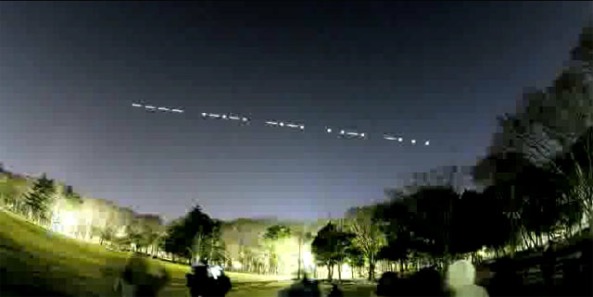
FITSAT-1 plans to use LED’s to signal in Morse code
The amateur radio CubeSat FITSAT-1 (aka NIWAKA) carries an Optical Communications experiment that aims to write Morse Code across the night sky. The satellite is fitted with a bank of high power LEDs that will be driven with 200W pulses to produce extremely bright flashes that may be visible to the unaided eye.
FITSAT-1 was deployed from the International Space Station (ISS) at 15:44 UT on Thursday, October 4 along with F-1 and TechEdSat.
On Sunday, October 7 Takushi Tanaka JA6AVG provided this update:
We have received a lot of signal and telemetry reports from amsat members. All reports show FITSAT-1 starts working and sound. Thank you very much for your help.
We will examine movements, temperatures, and battery states of FITSAT-1 during these 10 days, and start experiments of 5.8GHz transmission and flashing LEDs.
I will announce the experiments on my web-page http://www.fit.ac.jp/~tanaka/fitsat.shtml
As well as 437.250 MHz and 437.445 MHz (both +/- 10 kHz Doppler) this innovative satellite can also transmit on 5840.0 MHz (+/- 134 kHz Doppler).
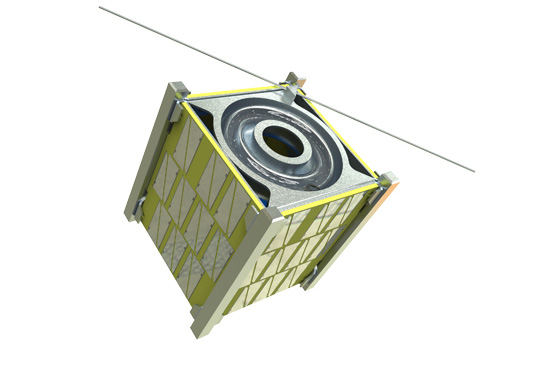
EQUiSat – Image Credit Brown University
Students at the Ivy League Brown University are developing an amateur radio satellite EQUiSat.
It will carry a Xenon Flash Tube (XFT) subsystem to act as an Optical Beacon that should be visible to the unaided eye of observers on Earth. The Radio Beacon is planned to operate in the 435-438 MHz band.
 AMSAT-UK
You must be logged in to post a comment.