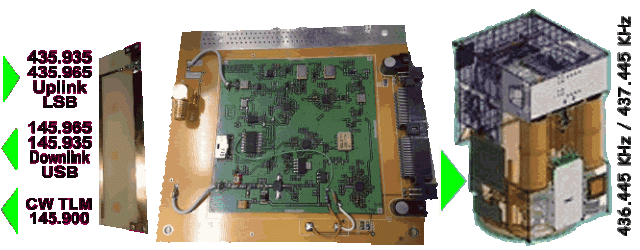
The MinXSS and CADRE CubeSats, both carrying amateur radio payloads, are set to be deployed from the International Space Station (ISS) on May 16, 2016 between 1000-1100 UT.
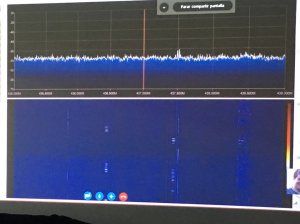
MinXSS will be beaconing in the UHF at 437.345 MHz every 9 seconds and will initially be in an orbit very similar to the ISS. We’ll get the TLE identifier in JSpOC labeled ASAP. The CADRE team may send out an email with their frequency information as well. [IARU has coordinated 437.485 MHz and 3.404 GHz for CADRE]
If you hear the MinXSS beacons, we would greatly appreciate it if you’d email us (me and those cc’d) to let us know. We’re still working on beacon decode/forward software that would bring you more in the loop.
For those interested, MinXSS is a science mission to study soft x-ray spectra from the sun. We’ll also be the first to fly the very popular Blue Canyon Technologies XACT attitude determination and control system.
Thanks for your help!
James Paul Mason, PhD
Postdoctoral research associate
MinXSS grad student lead turned co-investigator
University of Colorado at Boulder
Laboratory for Atmospheric and Space Physics
AMSAT members with the amateur radio 5 GHz and 10 GHz Phase 4B transponder MSS geosynchronous satellite
Ofcom is consulting on plans to put Wi-Fi across Amateur and Amateur Satellite spectrum in the 5 GHz band.
The Ofcom consultation document implies that amateur satellites in 5 GHz only operate in very Low Earth Orbits – This is false.
UNITEC-1 Venus spacecraft with amateur radio 5840 MHz payload
A5.28 Amateurs can access 5650-5850 MHz with amateur satellite Earth-to-space links in 5650-5670 MHz and space-to-Earth links in 5830-5850 MHz. Most current amateur satellites are typically nano or picosats (also called ‘cubesats’) that occupy slightly elliptical sun-synchronous low earth orbits at 60-800 km altitude. These smaller satellites have relatively low power and antenna gain.
Radio amateurs have sent 5 GHz payloads into far higher orbits. Examples are the Venus orbiter Unitec-1 which operated on 5.840 MHz and AO-40 which is in a 58,836 km High Earth Orbit (HEO). The 5 GHz band will also be used by the Geosynchronous Phase-4B payload and the HEO Phase-3E satellite both of which are currently under construction.
As broadband delivered to the home gets faster, people increasingly expect their Wi-Fi to provide several services at once – such as video streaming, video calls, gaming and remote working. This demand puts pressure on the spectrum which carries Wi-Fi signals.
Most Wi-Fi routers in the UK currently use a part of the spectrum called the 2.4 GHz band, but this is becoming increasingly congested and can impair broadband delivery of high data rate applications such as streaming video or live TV.
Many people now have newer broadband routers, which use not only the 2.4 GHz band, but also the 5 GHz band – which offers much more spectrum and can accommodate wide channels suitable for high data rate uses.
To make connections faster, Ofcom is proposing to open up an additional ‘sub-band’ within the 5 GHz frequency range for Wi-Fi – while ensuring protection for other users, such as satellite services.
The extra sub-band would increase the number of 80 MHz channels available for Wi-Fi from four to six, to accommodate data-hungry applications. These extra channels – which are already being used in the United States – could be opened up in around two to three years.
The UK Microwave Group (UKuG) point out that Ofcom’s plans for 5725-5850 MHz would unilaterally raise the noise floor for little benefit to consumers. They say 5760 terrestrial & EME and 5840 satellite reception need maximum protection. A Word Doc response form is available on the UKuG site at http://www.microwavers.org/
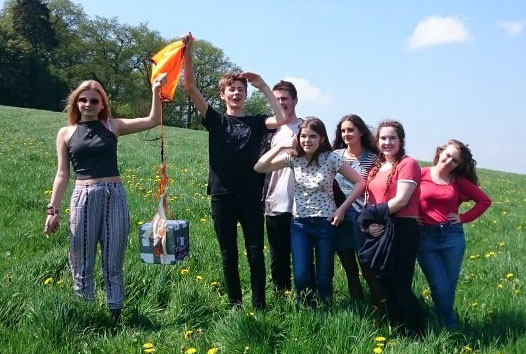
Successfully launched tracked and retrieved – Credit Hobb Computer Services
TV presenter Jason Bradbury 2E0JAB was among those present at a mass launch of 25 balloons transmitting in 434 MHz on Thursday, May 12, 2016.
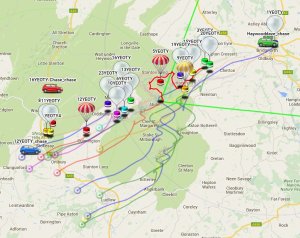
Tracks of some of the balloons – Credit PitsProject
Balloons from 25 schools were launched in batches of five from RAF Cosford. Each balloon carried a payload incorporating two small cameras and the Raspberry Pi In The Sky telemetry tracker. The balloons transmitted on unique frequencies ranging from 434.040 to 434.790 MHz.
Jason Bradbury’s balloon reached an altitude of 33 km before it burst and the payload parachuted back to Earth. The next problem was finding it. He tweeted:
Call out to my radio amateur friends. Need help finding 434.04mhz telemetry binary code
The balloon was eventually found stuck up a tall tree.
Watch the BBC TV Midlands Today report on the event
The King’s School amateur radio contact with Tim Peake featured HamTV
The final ARISS school contact of the Principia Mission took place on Monday, May 9 at 0926 GMT (10:26 am BST) between The King’s School GB1OSM in Ottery St Mary, Devon and Tim Peake GB1SS on the International Space Station.
The contact was receivable by radio amateurs across the British Isles and Western Europe and webcast on the ARISS Principia website. As well as the voice link on 145.800 MHz FM there was a Digital Amateur Television HamTV link on 2395 MHz.
The King’s School students Matt Ilsley and Hector Sethi obtained their Foundation amateur radio licences by taking a training course provided by the Sidmouth Amateur Radio Society.
Tim Peake KG5BVI / GB1SS preparing for his spacewalk in January
Ciaran Morgan [M0XTD], team lead UK ARISS coordinator, described the live link-up as ‘nothing more than a humongous experiment’ as he talked people through the equipment – especially the critical radio used to speak to Major Tim Peake.
Year 13 student Matt Ilsley [M6MTI] passed his foundation radio licence especially for the moment and held his cool as – after much anticipation – he made first contact with the British astronaut.
Summing up the event, head girl at The King’s School, Millie Perkins, said: “We have just experienced something amazing and to you younger years, this will be a highlight of your time here at King’s. I feel very privileged to have experienced it. This is something that we will remember about King’s for the rest of our lives.”
Science Technology Engineering and Maths (STEM) leader Alison Argent-Wenz … spear-headed the whole project and – along with a member of Sidmouth Amateur Radio Society, Mike Marsh [G1IAR] – put forward a proposal for a two-day Space-STEM event surrounding contact with the ISS.
The amateur radio contact generated plenty of media coverage which included:
Events at The King’s School in lead up to Tim Peake contact by year 13 student Matt Ilsley M6MTI
Video of the Tim Peake ARISS contact
Participant’s Presentation:
The King’s School is an 11-18 comprehensive school with approximately 1150 students of which 230 are in the Sixth Form. It has a long and proud history that can be traced back to a fourteenth century choir school which was replaced in 1545 by Henry VIII in 1545 with “The King’s School”.
Although The King’s School became an academy in 2011 we continue to work in close partnership with Devon County Council and our fellow secondary schools to ensure that we offer the best educational opportunities possible. Our inclusive philosophy of “Achievement for All” encapsulates our belief that every person who enters The King’s School has unique skills and potential which we believe we have the creativity and ability to unlock.
We were graded Outstanding by OfSTED in 2011, and in the latest 2014 OfSTED inspection we were again graded Outstanding but this time in every category. The report endorsed the school’s belief that its ethos has a hugely positive impact on student achievement.
We are extremely proud of our students and of the brilliant examination results they achieve year on year. However, we are also incredibly proud of the myriad of extra-curricular activities in which they are involved. This richness of opportunity is central to what we believe develops our students into well rounded young people. We are very much a community school, working very closely with our hugely supportive parents, Governors, excellent partner primary schools, local business representatives and a wide range of other agencies to provide opportunities for all.
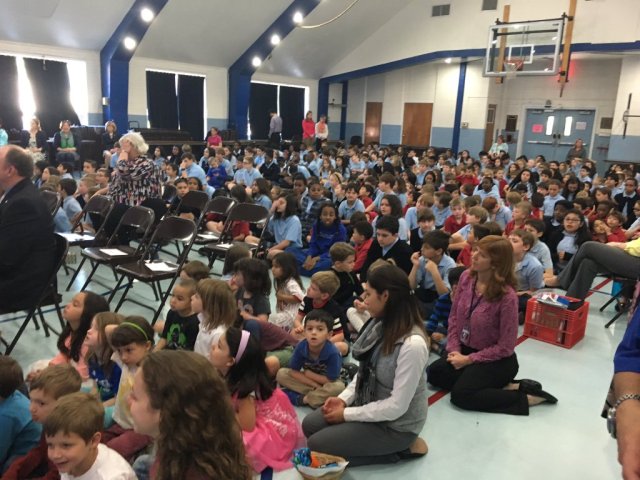
The Kings School students – Credit Goonhilly GES Ltd
Participants questions:
1. Lara, aged 13 – You have missed Christmas and Easter with your family and friends – how have you celebrated big events in space?
2. Harry, aged 12 – We have seen videos of you playing about in microgravity on the ISS – what is your favourite thing to do when ‘weightless?’
3. Elizabeth, aged 18 – From your elevated advantage point, looking down on the Earth, has your perception of the events on our planet, such as conflicts and wars been altered? Does the change in perception give any insight that we could learn from?
4. Eleanor, aged 11 – Having spent many months looking at the Earth from afar, where is the first place you would go for a family holiday when you get home?
5. Freddie, aged 12 – Over 500 astronauts have been into space, but only 12 have set foot on the moon. Do you think that we will return people to the moon again in the future? How will your research on the ISS help us if we did?
Rehearsal at The Kings School for Tim Peake contact – Credit GES Ltd
6. Naomi, aged 13 – We have learned about your experiments on how the human body adapts to conditions in space. How will the research improve our quality of life on Earth?
7. Robert, aged 13 – Taking into account Einstein’s theory of relativity, do you think you are ageing slower because you are travelling faster then the Earth?
8. Ben, aged 11 – I often stare into the inky blackness of space and wonder.. if the universe is expanding, then what is it expanding into? Has your time in space given you any insight?
9. Robbie, aged 14 – Is the sunrise more spectacular from your perspective?
10. Emily, aged 13 – After 6 years of training to be an astronaut, I bet it’s all been worth it. The experiments you are doing are amazing, but did you ever struggle with Science at school? What would you say to anyone that finds it difficult?
11. Josh, aged 12 – How do you get your air in space? Do you bring it up in tanks, or do you make it in the space station, if so, how? Also, do you have a special ‘space mixture’ of air or is it the same as we have on earth?
12. Tristan, aged 12 – Do you and the other astronauts onboard control the space station, or is it controlled from Earth?
UK astronaut Tim Peake KG5BVI / GB1SS
13. Katie, aged 12 – Research shows that your sleeping position can affect the kind of dreams that you have. Have you noticed any difference in your sleep patterns or dreams during your time in space?
14. Chloe, aged 12 – I am reading ‘The Astronaut’s Handbook’ at the moment, which is fascinating. If you could take one thing into space to make life more comfortable, or easier, what would it be?
15. James, aged 12 – We have enjoyed listening to your music choices on ‘Space Rocks’ – what is your all-time favourite song to listen to in space?
16. Jessica, aged 12 – How do you keep the temperature constant inside the space station?
17. James, aged 12 – What would happen to a goldfish if you took it up to the ISS? Would it just float around in a bubble of water?
18. Josh, aged 12 – Do you have a special ‘space mixture’ of air or is it the same as we have on earth?
19. Freddie, aged 12 – How will your research on the ISS help us return people to the moon?
ARISS is an international educational outreach program partnering the volunteer support and leadership from AMSAT and IARU societies around the world with the ISS space agencies partners: NASA, Russian Space Agency, ESA, CNES, JAXA, and CSA.
ARISS offers an opportunity for students to experience the excitement of Amateur Radio by talking directly with crew members on-board the International Space Station. Teachers, parents and communities see, first hand, how Amateur Radio and crew members on ISS can energize youngsters’ interest in science, technology, and learning.
Tomsk-TPU-120 CubeSat – Credit Tomsk Polytechnic University
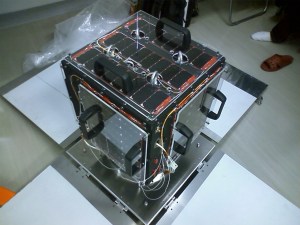
The Russian Tomsk-TPU-120 CubeSat is different from other CubeSats – it has a handle!
The 3U CubeSat was launched from Baikonur to the ISS on March 31, 2016 in a Progress-MS-2 cargo vessel. It will be deployed by hand during a future Russian spacewalk (EVA), which is why it has a handle.
The satellite was developed by students at the Tomsk Polytechnic University to test new space materials technology and will be the world’s first space vehicle with a 3D-printed structure.
In May 2016 Tomsk Polytechnic University celebrates its 120th anniversary. As part of the celebrations from 0755 UTMay 10 until 1005 UT May 11 Tomsk-TPU-120 will be activated in the ISS and will transmit a greeting to Earth inhabitants, recorded by students of the university in 10 languages: Russian, English, German, French, Chinese, Arabic, Tatar, Indian, Kazakh and Portuguese.
The greeting signal will be transmitted once a minute on 437.025 MHz FM. One of the Kenwood transceivers (TM D700) on the ISS will provide a cross-band relay, re-transmitting the signal on 145.800 MHz FM.
Andy Thomas G0SFJ reports that an image sent to him by Serg RV3DR indicates the call sign of the satellite is RS4S.
Dmitry Pashkov R4UAB reports that on May 5 the Russian ISS crew will charge the satellite battery, connect the antenna and configure the Kenwood transceiver for relay operation, they will then make a test transmission.
Watch Микроспутник ТОМСК ТПУ 120 на МКС
Dmitry operates a WebSDR which you can use to receive the transmissions when the ISS is over Russia http://websdr.r4uab.ru/
SamSat-218 lead developer Efim Ustiugov with Professor Igor Belokonov
Two Russian satellites AIST-2D and SamSat-218D operating in the Amateur bands were launched on April 28, 2016 at 02:01 UT on a Soyuz 2-1A launch vehicle from the new Vostochny Cosmodrome located in the Amur Oblast. The satellites were placed into a 471 km × 485 km orbit with a 97.3° inclination.
AIST-2D weighs 500 kg and is a technology demonstration and scientific research satellite developed at Samara Aerospace University. The 3U CubeSat SamSat-218 was developed by students at the Samara State University and weighs just 4 kg.
AIST-2D – Credit TsSKB Progress
Frequency information from Dmitry R4UABhttp://r4uab.ru/?p=11842
AIST-2D / RS-48 Downlinks
• 435.3065 – 435.3235 MHz Telemetry Data
• 435.3565 – 435.3735 MHz Telemetry Data
• 433 – 438 MHz 200 watt Synthetic Aperture Radar (SAR)
• 8025 – 8393 MHz Remote Sensing Data
AIST-2D / RS-48 Uplinks
• 145.831 – 145.849 MHz Control Link
• 145.861 – 145.879 MHz Control Link
September 2003 issue of QST magazine has an article on page 44 by VE3PU on satellite-based Synthetic Aperture Radar (SAR) in 432-438 MHz (ARRL members only) http://p1k.arrl.org/pubs_archive/104721
You must be logged in to post a comment.